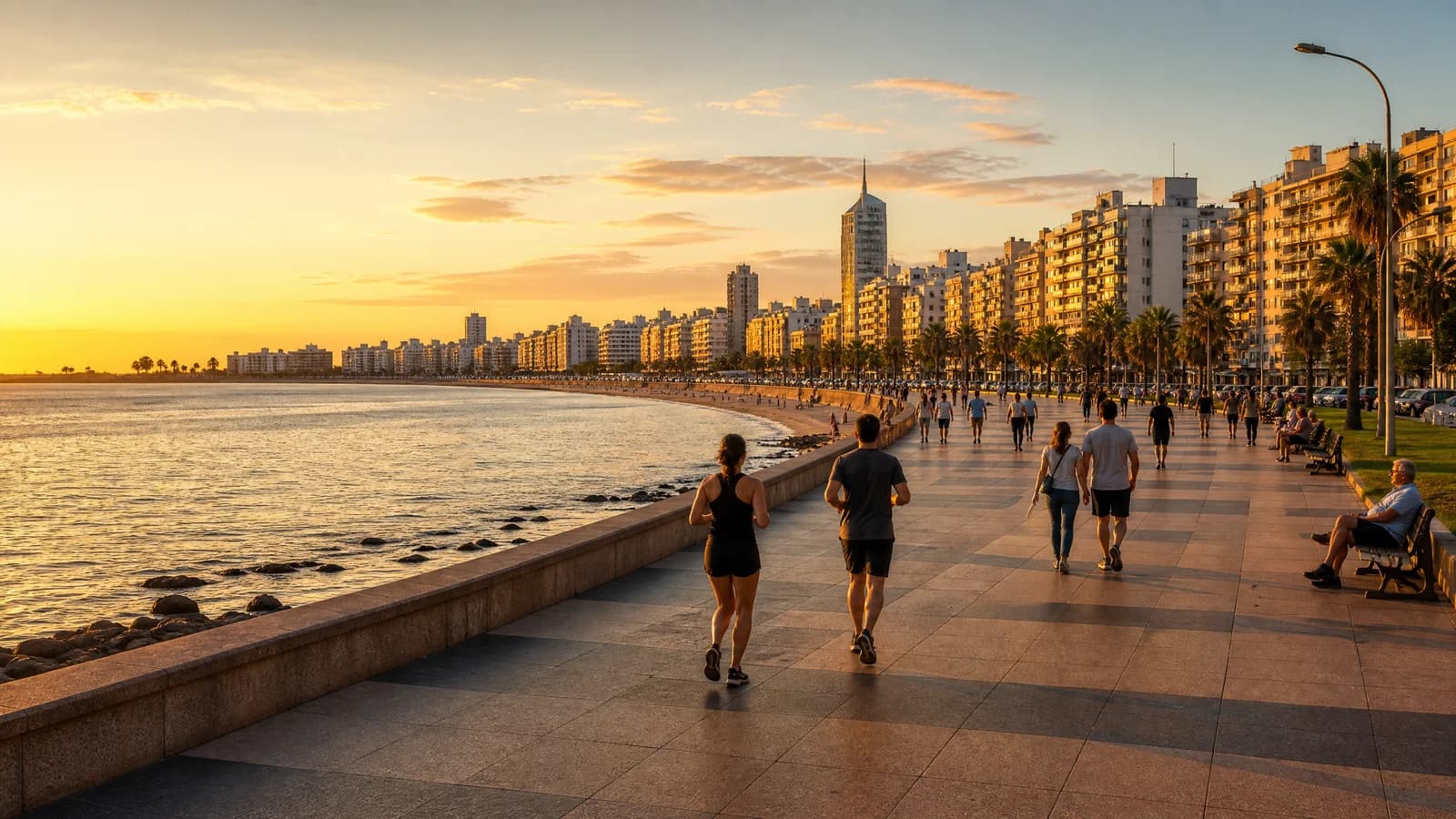

Where is Latin America really safe? From Uruguay's stability to Argentina's low murder rate: the honest ranking of the five safest countries in 2026, and why your neighbourhood counts for more than the statistics.
Hardly any topic makes my clients as uneasy as safety itself, because Latin America has a reputation that is often worse than the reality in the right neighbourhoods. The truth is nuanced: some countries in the region are as safe as a mid-sized European city, others have real problems, but these are usually heavily concentrated in particular zones. That concentration is the key to understanding safety in the region. Here is my ranking of the five safest countries, measured by the Global Peace Index 2026 and murder rates, and with the one principle that decides everything: your neighbourhood counts for more than the national statistics.
No. 1: Uruguay, the calmest harbour
The undisputed leader. Uruguay is the safest and most stable country in Latin America: it tops the region in the Global Peace Index and ranks solidly mid-table globally, in a league with many established democracies. The real value lies less in a single figure than in the reliability of the whole system: functioning institutions, predictable policing, modern hospitals and political stability unmatched in the region. Montevideo is regarded as the benchmark for safety and relaxed city life. As everywhere, the biggest everyday risk is pickpocketing, not violence. It is exactly this everyday predictability that makes Uruguay so popular with safety-conscious expats. If you are looking for calm, predictability and a first-world sense of safety, Uruguay is the clear number one. Many of my clients tell me they feel safer in Montevideo than in the European city they left behind.
No. 2: Chile, the stable economic power
Close behind comes the most prosperous country in the region. Chile ranks second in Latin America on the Global Peace Index and scores with a low murder rate of around 5.5 per 100,000, a strong rule of law and low corruption. Santiago offers modern infrastructure, reliable institutions and a high standard of living. In the upmarket districts, life is as safe and comfortable as in many European capitals. As in Uruguay, the main risk is pickpocketing in busy areas, plus occasional protests in the big cities. These protests are predictable and easy to avoid, and they change nothing about the fundamentally high level of safety in the country. Away from the big cities, Chile's most beautiful regions are remarkably calm. If you are looking for stability, legal certainty and the strongest passport in the region in one package, Chile is a first-class choice, and in safety terms a rock. The combination of economic maturity and institutional strength is rare in the region.
No. 3: Costa Rica, the democracy without an army
The classic among safe destinations. Costa Rica ranks third in the region on the Global Peace Index and owes its reputation to a democracy stable for over 75 years, which abolished its army in 1948 and put the freed-up money into education, health and social development. The national murder rate is higher than Chile's, but the violence is concentrated far from the expat areas, and in the popular residential areas violent crime against foreigners is rare. The main risk for visitors is petty theft. If you take the usual big-city precautions, you will experience Costa Rica as a remarkably relaxed country. Combined with excellent healthcare and the pura vida way of life, that makes Costa Rica one of the most reassuring places to land in the region. For the nature-loving, stability-minded expat, it is a top choice. It is no accident that Costa Rica has attracted North American retirees looking for safety and nature together for decades.
No. 4: Argentina, the lowest murder rate
A surprise for many. Despite its well-known economic turbulence, Argentina has the lowest murder rate in the region, only around 3.8 per 100,000, and the US State Department lists it at the most favourable travel advisory level. So violent crime is astonishingly low; the real issue is economic and political volatility, not personal safety. In Buenos Aires and Mendoza, established expat communities live comfortably, with the usual big-city precautions against pickpockets and scams. Argentina takes fourth place because it performs excellently on safety from violence, even if economic unrest has to be factored in. If violent crime is what you fear, you are safer here than the continent's reputation suggests. This gap between reputation and reality surprises almost everyone who visits Argentina for the first time. Many consider Buenos Aires one of the most liveable and, day to day, safest cities in the region.
No. 5: Panama, the stable hub
Fifth place goes to the dollar-based trading hub. Panama is politically and economically stable, dollarised and offers modern, well-secured expat districts that feel like a North American city. In Panama City, high-rise towers with security services and gated residential complexes create a strong sense of safety, while individual areas such as Colón should be avoided. The murder rate is in the moderate range, concentrated in particular areas away from where expats live. In the guarded districts of the capital, the sense of safety is correspondingly high. If you want to combine safety with dollar stability, international connections and urban comfort, Panama is a reliable choice that rounds off the top 5 well. For anyone coming from a North American environment in particular, Panama City feels familiar and protected.
The riser: El Salvador
No safety ranking in 2026 is complete without the most spectacular riser. El Salvador was long considered one of the most dangerous countries in the world, but under the state of exception in place since 2022, its murder rate has fallen to one of the lowest in the western hemisphere, and the US State Department now lists the country at the most favourable travel advisory level. That is a real, dramatic turnaround. Where whole neighbourhoods used to be no-go areas, public life is possible again today. There is another side to the picture: the state of exception comes with mass arrests, and human rights organisations criticise shortcomings in the rule of law. El Salvador does not make the top 5 because any fair assessment has to weigh this institutional debate, but on pure safety from violence it has catapulted itself into the ranks of the safest countries in the region. For anyone who appreciates the turnaround and can live with the institutional debate, it is a remarkable case.
The safest regions in South America
If you narrow the view from countries to regions, an even clearer pattern emerges, because the safest corners of South America lie almost all in the south of the continent, the so-called Southern Cone. Uruguay as a whole sits at the very top, with Montevideo, glamorous Punta del Este and the quiet colonial region around Colonia as consistently relaxed places to live. In Chile, the upmarket eastern slopes of Santiago around Las Condes and Vitacura and the quiet south around the Lake District are among the safest areas on the continent. And in Argentina, it is not only the well-to-do districts of Buenos Aires such as Recoleta and Palermo that surprise, but above all the vast, sparsely populated region of Patagonia and the wine region around Mendoza, with very low levels of violence.
Beyond the Southern Cone there are pockets of safety too: in Colombia, the green coffee region around Pereira, Manizales and Armenia is considered markedly calmer than the national average, and in the south of Brazil, the island capital Florianópolis has a reputation as one of the safest big cities in the country. The connecting principle is the same everywhere: safety in South America is a question of region and neighbourhood, not of compass direction alone. If you live in the right part of a fundamentally safe country, you live as calmly as in central Europe, and if you choose the wrong zone even in the safest country, you throw exactly that advantage away.
Why the statistics differ
One point that often confuses: different safety measures arrive at slightly different rankings, and for good reason. The Global Peace Index measures far more than crime alone; it also weighs political stability, militarisation and international relations. That is why a country like Uruguay can top the index even though its pure murder rate is higher than Argentina's, which in turn shines on violent crime but is weaker on economic stability. In practice: do not look at a single figure, but at the overall picture of safety from violence, institutional reliability and whether police, courts and hospitals work in an emergency. It is exactly this reliability, more than any single statistic, that makes daily life safe.
The principle that decides: your neighbourhood counts
One point I impress on every client matters more than any national statistic: in Latin America, your neighbourhood decides your safety, not the national average. A large part of violent crime is concentrated in particular zones linked to the drug trade, far from the areas where expats live. Daily life in a well-chosen neighbourhood of a stable country is closer to a mid-sized European city than to the dramatic national headlines, as analyses for expats also stress. Even in the safest countries there are individual districts and transit zones you avoid, and the locals will tell you exactly which ones. This local knowledge is worth its weight in gold, and a good adviser on the ground spares you expensive beginner's mistakes. If you choose your neighbourhood deliberately, stay alert and learn the local rules, you will live safely in almost any of these countries. So you make the most important safety decision not when choosing the country, but when choosing the street you live on.
Safety and structure go together
One principle comes before everything else. A safe destination is worth a lot, but it does not replace careful planning of the move. Moving abroad does not, on its own, end your tax residence at home, and whether leaving triggers an exit tax on shares you hold depends on where you come from:
Safety is one part of your quality of life, a sound tax and asset structure the other, and you need both. Structure decides, not the destination.
The ranking at a glance
The ranking is clear: Uruguay leads as the calmest, most stable harbour, Chile follows as the economic power with legal certainty, Costa Rica as the democracy without an army, Argentina surprises with the lowest murder rate, and Panama completes the top 5 as the stable dollar hub, while El Salvador is the most spectacular riser. Which one is right for you depends not only on the statistics, but on how safety, tax, costs and way of life fit together, and above all on how wisely you choose where you live. This trade-off is exactly what I go through with my clients before they commit.
If safety is at the top of your list, let's check together which country and which place really fit your life, your wealth and your goals, and how to structure your exit from home properly. Book a call with me, the link is right below.
👉 Book a consultation with Harley
Carpe Diem. Life is short and fleeting. One shot. Make it count.