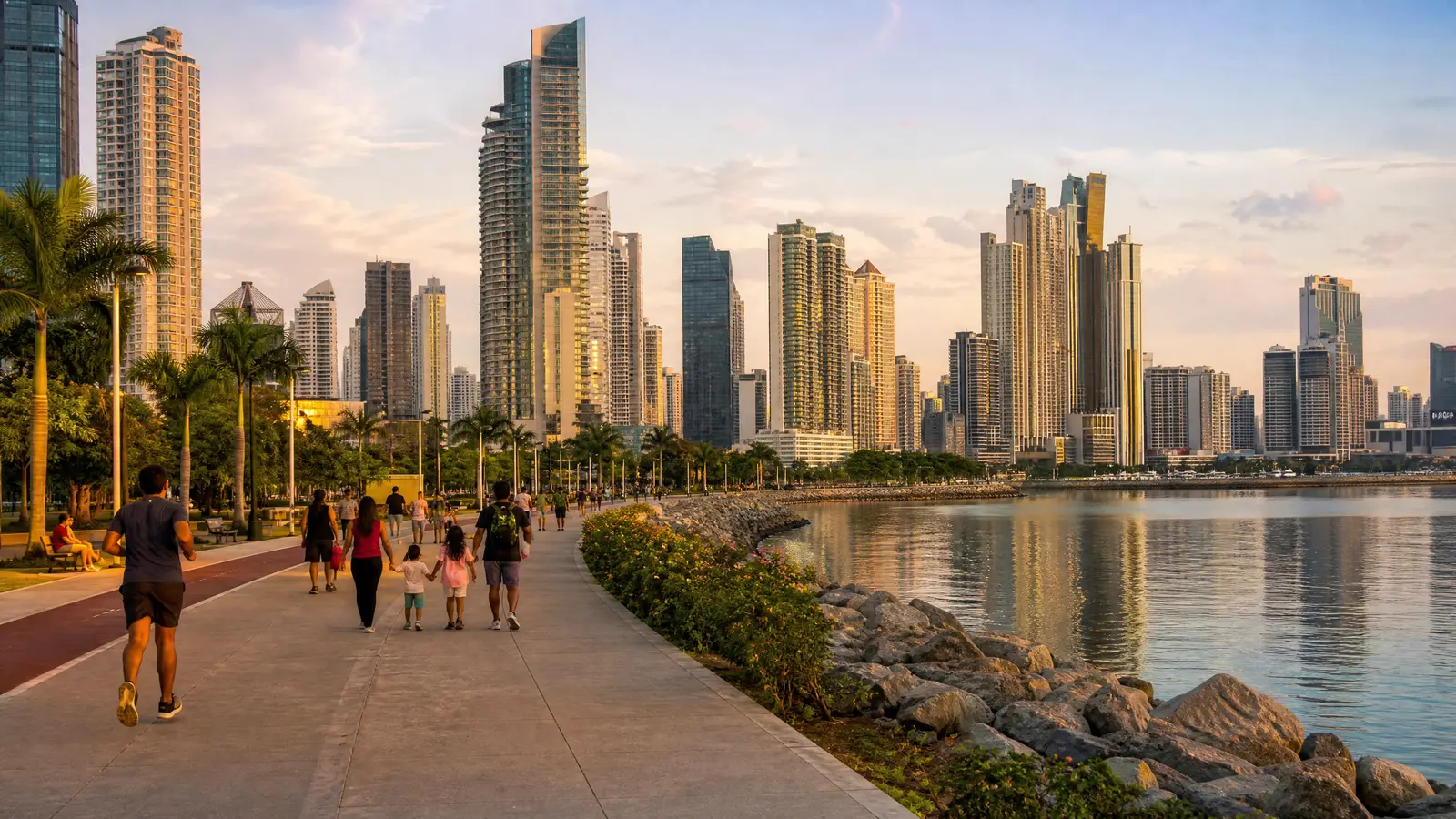

How safe is Panama really? A reality check for 2026: the real numbers, the safe neighbourhoods, the zones to avoid, and why where you live matters more than the national statistics.
When clients think about Panama, the question of safety almost always comes first, and rightly so. The answer is nuanced: Panama is one of the more stable and safer countries in the region, but it is not a crime-free paradise, and as everywhere in Latin America, the risk is heavily concentrated in certain zones. The continent's reputation is often worse than the reality in the right neighbourhoods, and Panama is a good example of that. So let's look at it properly, with the real numbers, the safe neighbourhoods and the areas you are better off avoiding. One point I stress to everyone up front: your neighbourhood determines your safety, not the national statistics.
The numbers: solid, not spotless
Let's start with the hard facts. Panama sits in the solid middle of the region in the Global Peace Index, politically and economically stable, with a murder rate in the moderate range of around 11 per 100,000. That is much lower than in the crisis countries of the hemisphere and below the Latin American average, but higher than in the very calm countries such as Uruguay or Chile. What matters is the concentration: a large share of violent crime clusters in certain areas, above all around the port city of Colón and individual barrios of the capital, far away from the neighbourhoods where foreign residents live. For the daily life of the typical newcomer, then, the relevant number is not the national average but the safety of their specific neighbourhood, as analyses of the region also stress.
The safe neighbourhoods: like a North American city
This is where the real good news lies. The popular expat neighbourhoods of Panama City feel like a modern North American city. In Punta Pacífica, Costa del Este, Marbella and El Cangrejo, high-rise towers with security services, gated complexes and well-lit, busy streets set the scene, and the sense of safety is correspondingly high. The retirement havens outside the capital, the mountain town of Boquete in the cool highlands and the coastal town of Coronado, are also considered exceptionally calm and safe. In Boquete people know their neighbours, and the village-like community creates a feeling of security that urban figures don't capture. Thousands of foreign residents live relaxed lives in these areas, with the usual big-city precautions but without a sense of constant threat. The dense presence of security staff in these neighbourhoods contributes noticeably to that feeling. Choose where you live wisely and you will find a Panama that has little to do with the continent's dramatic reputation. Many newcomers report that they feel safer in their neighbourhood than in the city they left behind.
The zones to avoid
Being frank also means saying clearly where caution is needed. The port city of Colón on the Caribbean side accounts for a considerable share of the country's violent crime despite ongoing regeneration efforts and should be avoided, apart from controlled excursions. In Panama City there are individual barrios such as El Chorrillo or Curundú that newcomers should not stray into. And the warning applies above all to the Darién, the dense jungle on the border with Colombia: this region is a dangerous smuggling and migration route, not a destination, and the US State Department lists it at its highest warning level. For someone moving to Panama, the Darién is simply irrelevant; it lies far from any place you would live. If you know these clearly defined zones and avoid them, you eliminate most of the real risk, because the danger is geographically tightly confined. Locals know these boundaries precisely and are happy to share them: ask, and you will be well informed.
Reading the travel advisory correctly
A word on reading the official travel advice, which unsettles many people. The US State Department advises increased caution for Panama as a whole, but raises the warning level specifically for problem zones such as the Darién and remote stretches of coast, while most of the country, where foreign residents actually live, is rated far less critically. Travel advisories like these often bundle a whole country under one headline, even though the reality is fine-grained. So when you read the advice, don't just look at the overall level but at the specific region. That is how to use these sources properly: as a map of zones, not as a blanket verdict on an entire country. Anyone who reads only the headline and skips the small print often draws the wrong conclusions.
Daily life: which risks really count
For the average foreign resident, the real danger is not headline violence but petty crime. Pickpocketing, scams and occasional street robbery in busy or touristy areas are the risks you actually need to factor in, as in any big city in the world. If you take the usual precautions, don't show off expensive valuables, use taxis or ride services at night in unfamiliar areas and stay aware of your surroundings, you lower your risk drastically. These rules hardly differ from those you would follow in any large European city. Locals and the established expat community know exactly which streets and times to avoid, and this local knowledge is the best protection. Panama rewards the alert resident, not the fearful one. With a little experience, the necessary caution becomes second nature and no longer gets in the way of daily life.
Why Panama is a safe place to live, all things considered
Put everything together and a clear picture emerges. Panama combines political stability, a working economy, the US dollar as its currency and modern, well-secured residential areas into an environment in which the foreign resident who chooses wisely feels very safe. The moderate national murder rate gives no sense of daily life in the expat neighbourhoods, which is far calmer than the figure suggests. On top of that, Panama City, as an international financial centre, has a cosmopolitan, businesslike atmosphere in which you quickly find your way. The large international community makes arriving easy and the sense of safety familiar. For anyone who avoids the problem zones and lives in one of the established areas, Panama is one of the most reassuring addresses in the region, especially for those coming from a North American environment.
Safety for families and solo travellers
One aspect clients often ask me about is safety for families, women and solo travellers. In the established residential neighbourhoods and the retirement havens, Panama is pleasantly straightforward in this respect: families with children live in gated complexes with good infrastructure, international schools are available, and daily life is relaxed. Especially for families coming from abroad, this familiar, orderly environment is a big plus. Women travelling alone move around the safe zones without problems if they take the usual precautions, as in comparable big cities worldwide. As everywhere, alertness and common sense are the best companions, especially at night and in unfamiliar areas. Panama gives no reason for special fears; it simply rewards the normal rules of urban caution. For most families and individuals, the sense of safety in the right neighbourhoods is high.
Panama compared with the region
Place Panama within the region and the picture becomes even clearer. It is safer than the countries hit by acute crises and below the Latin American average for violent crime, but it does not quite reach the calm of the safest countries such as Uruguay, Chile or Costa Rica. In return, Panama offers something many of these countries don't have: the US dollar as its currency, an international financial centre and modern, North American-style residential neighbourhoods that further raise the sense of safety in daily life. For anyone who wants to combine safety with urban comfort, dollar stability and international connections, Panama is therefore a particularly attractive combination, even if the raw statistics don't quite put it at the top of the region. This mix is why Panama has been one of the most popular destinations for international movers for years.
Safety and structure
One principle matters above all. A safe environment is of great value, but it does not replace careful planning of the move itself. Before you move to Panama, you first need to sort out your own side at home, including whether leaving triggers an exit tax on your assets or company shares. Panama's territorial tax system and its safety are two strong arguments, but both only deliver their full value with a sound tax structure behind them. Safety is one part of quality of life, structure the other, and you need both. The structure matters more than the destination. What your home country keeps taxing after you leave, and what the move itself triggers, depends on where you come from:
Safe overall, not spotless
The reality check is clear: all things considered, Panama is safe, but not spotless. The national murder rate is in the moderate range of around 11 per 100,000, concentrated in clearly defined zones such as Colón and the Darién, while the popular expat neighbourhoods from Punta Pacífica to Boquete feel like a calm North American city. The real everyday risk is petty crime, against which the usual precautions protect well. Avoid the problem zones, choose where you live wisely, and you can live safely and comfortably in Panama. This frank assessment, including the question of where exactly you should live, is what I go through with my clients before they commit.
If you are thinking about Panama and want to know where you would really live safely and well, let's look together at which area suits your life and how your home-country side fits in. Book a conversation with me; you will find the link directly below.
👉 Book a consultation with Harley
Carpe Diem. Life is short and fleeting. One shot. Make it count.