
In April 2026 the Inter-American Commission on Human Rights published a report stating that the state of Paraguay had been captured by drug traffickers. The country's own interior minister has admitted that the state has been infiltrated. That sounds like a country no sensible person would move to.
And yet day-to-day life in Paraguay is safer than in many large cities in Europe or North America. Both things are true, and that contradiction is the key to understanding safety in Paraguay. I am there regularly, I know the streets where people go for a relaxed evening run, and I know the names of the dead from the headlines. Let me break it down for you, without panic and without whitewashing.
Everyday life, which is 90% of your life
Let's start with hard numbers, not gut feeling. On the Global Peace Index Paraguay ranks 4th in South America, behind only Argentina, Uruguay and Chile. The homicide rate fell in 2025 to around 6.1 per 100,000, a drop of 18.6%, which puts it close to the level of the United States. The conflict monitoring service ACLED rates the level of conflict as low to inactive. For the ordinary person relocating here, the chance of becoming a victim of serious violence is low.
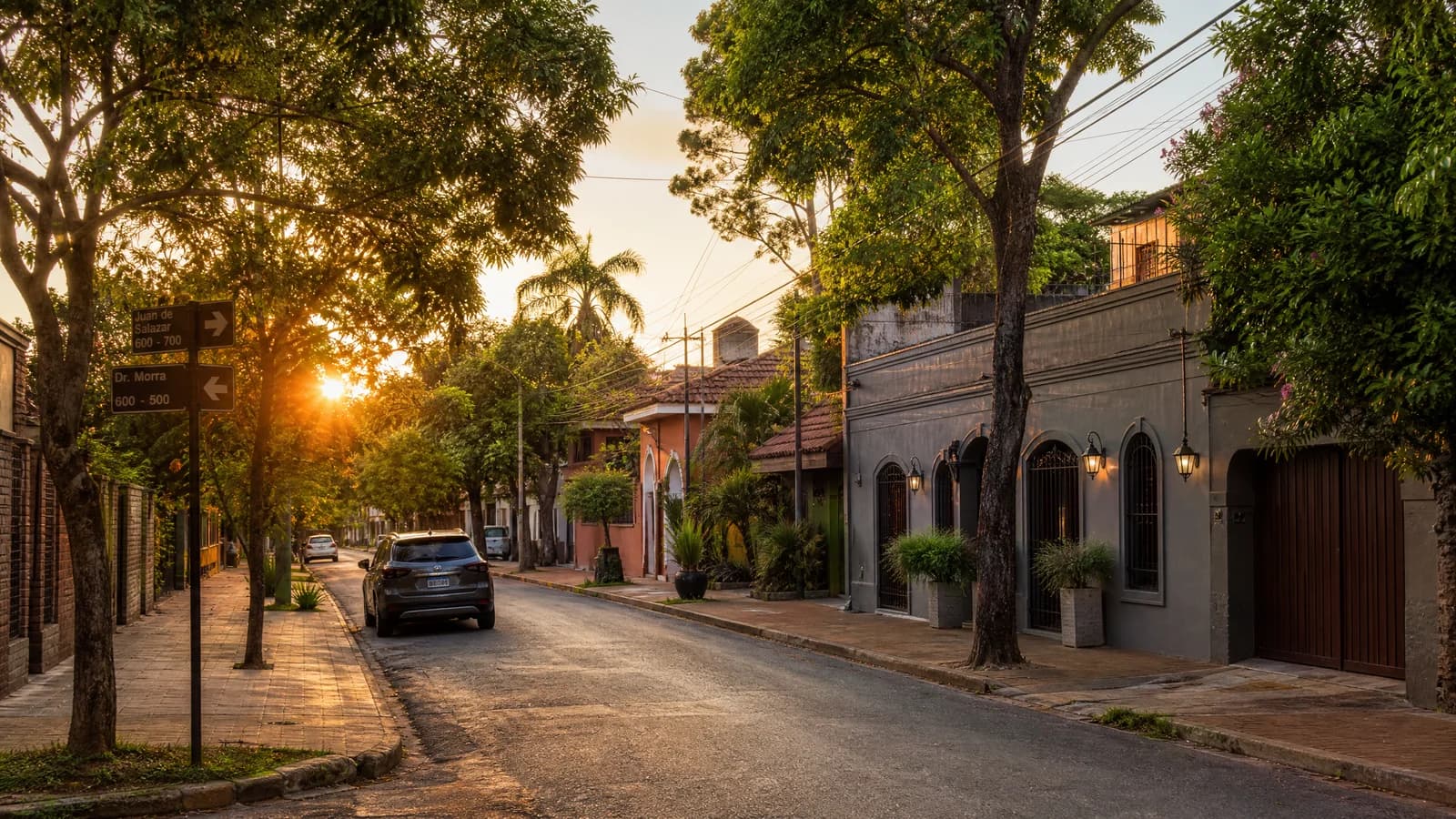
In Asunción, as anywhere, the neighbourhood makes all the difference. In the well-kept areas such as Villa Morra, Carmelitas, Recoleta, Las Mercedes and Manorá you can go for a walk in the evening, jog or take the dog out, and many expats feel safer there than in plenty of European cities after 10 pm. The biggest real everyday danger is not murder but the motochorro: the thief on a motorbike who grabs a phone, bag or necklace as he rides past. Keep your phone out of sight on busy streets, skip the showy watch, carry only the cash you need, and that risk drops sharply.
The neighbourhoods and places you avoid
To be fair, there is another side. In Asunción you avoid the Bañados, the poor flood-prone districts along the river, as well as Chacarita (Ricardo Brugada), Zeballos Cué and parts of Fernando de la Mora. That is where poverty and drug crime meet, and as an obvious gringo you are an easy target.
The real exception, though, is the border towns with Brazil: Pedro Juan Caballero, Ciudad del Este and Salto del Guairá. This is the country's drug corridor, and the rules are different there. The UK Foreign Office (FCDO) places most drug trafficking and arms smuggling along the eastern border from Pedro Juan Caballero down to Ciudad del Este and the Tri-Border Area, says violent crime is on the increase there and advises particular care in the departments that border Brazil, Amambay, Canindeyú and Alto Paraná among them. Most expats avoid this zone completely, and that is the right instinct.
The organised crime that shapes the country
Now for the big, uncomfortable part that glossy relocation videos leave out entirely. Within just a few years Paraguay has climbed to 4th place out of 193 countries in the Global Organized Crime Index, on a level with Colombia and Mexico and behind only countries such as Myanmar. In 2021 it was not even in the top 15. The reason: Paraguay is South America's largest marijuana producer, centred around Pedro Juan Caballero, and has become a central cocaine distribution hub, even though it produces no cocaine itself. Brazilian gangs such as the PCC and the Comando Vermelho, the local Clan Rotela, the Calabrian 'Ndrangheta and Colombian groups all fight over this trade.
The names of the dead show how deep it goes. Marcelo Pecci, Paraguay's top prosecutor for organised crime, was murdered in May 2022 on his honeymoon in Colombia. José Carlos Acevedo, the mayor of Pedro Juan Caballero, was shot dead the same year. Congressman Eulalio "Lalo" Gómez died in 2024 during a police raid over suspected money laundering. And the border region is so deadly for journalists that several reporters have paid with their lives, among them the Brazilian Léo Veras in 2020. In the north, in San Pedro and Concepción, the guerrilla organisation EPP also operates, attacking mainly police and the military.
I am not telling you this to frighten you. I am telling you because the same advisers who sell you Paraguay as pure paradise only show you half the country. The violence almost always stays within the criminal networks and along the borders; the expat in Villa Morra rarely sees any of it directly. But it shapes the country, its institutions and the question of whom you trust.
The corruption that really affects you
Which brings us to the issue that affects your daily life: corruption. Frankly, it is everywhere in Paraguay. You quickly get to know the harmless version, the coima, the bribe. The moveparaguay safety guide sums up the everyday form in one line: petty corruption is mostly traffic-stop bribes. Do not pay if you have done nothing wrong, write down the officer's number and the licence plate, and if in doubt call the emergency number 911.
You meet the dangerous version when things get serious, for example in a dispute over a property. People who know the system describe how, in a dispute, gifts flow to lawyers, prosecutors and judges. The human rights commission quoted at the start confirms that the judiciary has been infiltrated. In practice: whatever you do, keep everything above board and documented, work with reputable, independent advisers, and avoid every grey zone. Your best protection is never ending up in a situation where you need a Paraguayan court.
Natural hazards are the smallest problem
Now for some reassurance. In terms of nature, Paraguay is benign: no earthquakes, no volcanoes, no hurricanes. The real issue is the rainy season from November to April, with flooding and impassable roads, especially in the Chaco region, plus the extreme heat in the Chaco. You can plan for all of this. If you choose where you live with the flood situation in mind, you have the natural side under control.
What this means in practice
Let's turn this into action, because that is what matters. Choose your neighbourhood deliberately: Villa Morra, Carmelitas and similar areas, not the Bañados. Avoid the border towns of Pedro Juan Caballero, Ciudad del Este and Salto del Guairá unless you have specific business there. Protect yourself from motochorros with simple everyday habits. And, most importantly, keep everything above board and work with independent advisers in your dealings with authorities, businesses and property, because corruption is the danger most likely to hit an honest newcomer. If you take this to heart, Paraguay is, in daily life, exactly the calm, relaxed country many people are looking for.
These are exactly the questions of location and advisers, and the sound structure that keeps you well clear of the grey zones, that I plan with my clients before they decide.
If Paraguay is on your list, let's talk frankly about the right place to live and the right people on the ground. You can book a conversation with me using the link below.
How safety, costs, tax and residence fit together into a realistic overall picture is shown in the complete guide to moving to Paraguay.
👉 Book a consultation with Harley
Carpe Diem. Life is short and fleeting. One shot. Make it count.