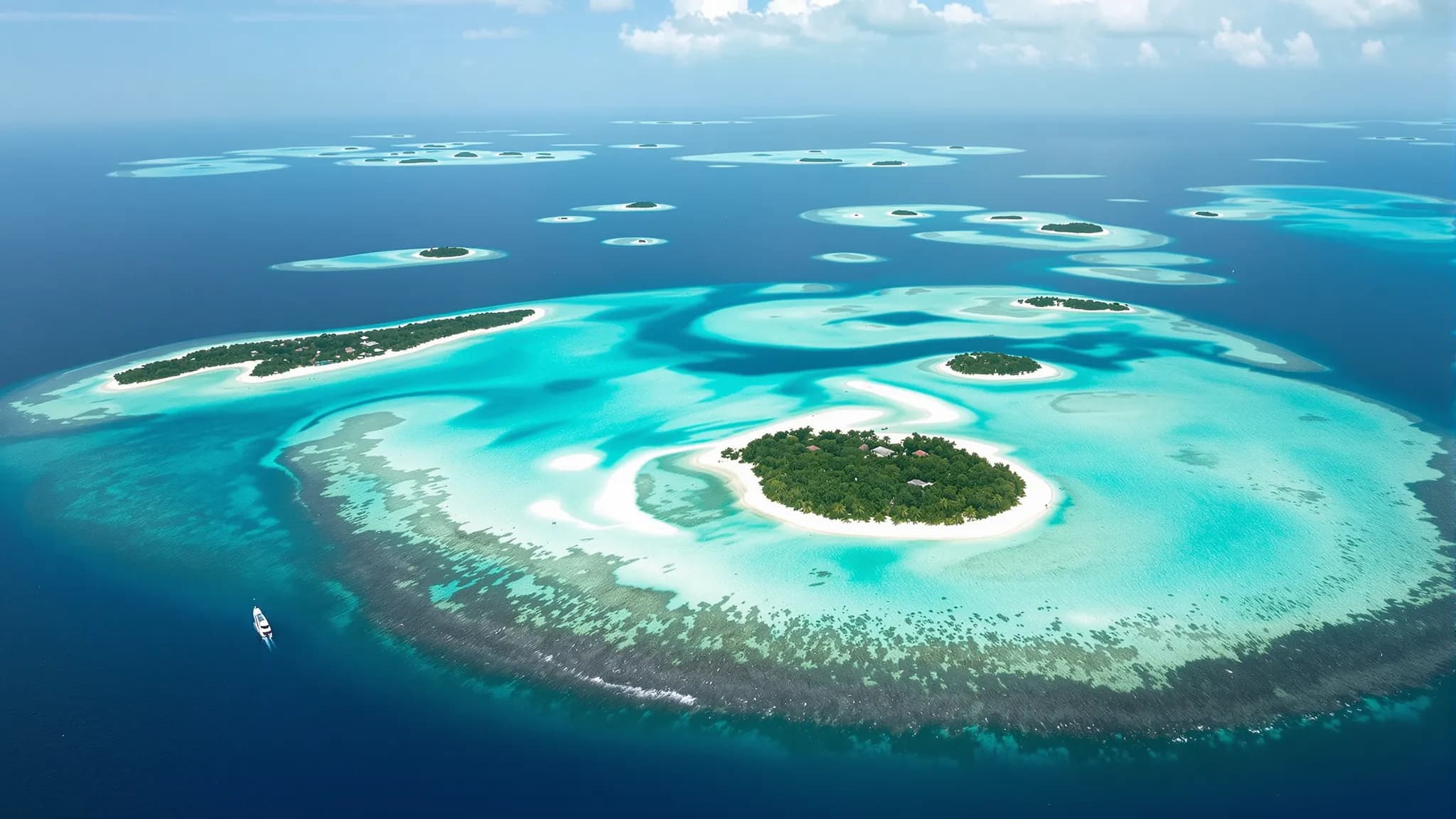

Turquoise sea, white beaches, 25 to 30 degrees all year round: for many people the Caribbean is the very picture of the perfect life. But between the dream of island life and the reality lies a decision you should not leave to gut feeling. After all, the Caribbean is not one place but more than 7,000 islands in more than 25 jurisdictions, and the differences could hardly be greater.
On one island you pay 0% income tax; on the neighbouring island French tax law applies. On one island you get a second passport through investment within a few months, on another you wait years for a simple residence permit. Some islands are very expensive, others cheaper than Portugal. If you want to move to the Caribbean, you should therefore answer three questions properly before you go: What residence status do I get? What taxes do I pay? And what does life on the ground cost me?
We answer exactly these three questions here for 19 islands and coastal states of the Caribbean, with all the relevant changes of recent years. And there have been several: the five citizenship by investment programmes of the Eastern Caribbean raised their thresholds in 2024 to a common minimum of USD 200,000. The Bahamas doubled the threshold for permanent residence through a property purchase to one million dollars. And the Cayman Islands closed their popular digital nomad visa altogether. Plan with 2022 figures and you will get it wrong.
A word on perspective: we look at the Caribbean here from the point of view of people relocating, entrepreneurs, remote workers and retirees from abroad. Statements on tax refer to the destination country. What happens in your home country when you leave (tax residence, exit tax, deregistration) is a separate subject that you should settle with professionals before the move, and it depends on where you come from:
How to find the right island for you
Before we start the list, a quick orientation. The 19 destinations in this article fall roughly into four categories:
The zero-tax classics: the Bahamas, the Cayman Islands, the Turks and Caicos Islands, the British Virgin Islands, Antigua and Barbuda, and St Barts levy no personal income tax. The price is usually high living costs and, in some cases, high investment hurdles for permanent residence.
The territorial taxers: the Dominican Republic (with a hybrid system), Belize and (with restrictions) Honduras tax mainly local income. Foreign earned income stays tax-free, and living costs are moderate to low. For entrepreneurs and remote workers this is often the best compromise between cost and benefit. You may already know the principle from our country guide to Panama, the best-known territorial tax country in Latin America.
The EU territories: Saint-Martin, Guadeloupe, Martinique and St Barts belong to France. For EU citizens that means: arrive, stay and work, with no visa and no application. In return, French tax law applies (except on St Barts). If you hold a non-EU passport, the regular French entry and residence rules apply instead. If you want maximum legal certainty and do not need tax optimisation, you will be happy here.
The passport programmes: Dominica, Grenada, St Lucia, and Antigua and Barbuda offer citizenship by investment: full citizenship including a passport in return for an investment from USD 200,000, usually without any residence requirement. That is less about relocating than about building a Plan B, and in that respect it is one of the most exciting options in the region.
And now: the 19 best Caribbean islands to move to in 2026.
1. The Bahamas
| Tax | 0% income tax, 10% VAT |
| Residence | BEATS digital nomad visa (1 year), annual residence permit, permanent residence from a USD 1 million investment |
| Cost of living | Very high |
The Bahamas consist of around 700 islands, fewer than 30 of them inhabited. The centre is the capital Nassau on New Providence, where around two thirds of the roughly 400,000 inhabitants live. The big advantage of the location: Miami is only 30 minutes away by air, the Bahamian dollar is pegged 1:1 to the US dollar, and the legal system is based on English common law.
On tax, the Bahamas have been a fixture for decades: no income tax, no capital gains tax, no inheritance tax, no wealth tax. The state finances itself through customs duties and a value added tax that now stands at 10% (reduced to 5% on basic foods and medical products).
There are three realistic routes to residence. First, the digital nomad programme BEATS (Bahamas Extended Access Travel Stay): one year of residence for remote workers and students, applied for entirely online, a USD 25 application fee plus USD 1,000 for the permit (USD 500 per family member), usually processed within a few days. Second, the classic annual residence permit with proof of income. Third, Economic Permanent Residence: since January 2025 the minimum investment is BSD 1,000,000 in residential property or government bonds (previously 750,000), to be held for at least ten years.
The catch is the price of paradise: the Bahamas are among the most expensive countries in the western hemisphere. Almost everything is imported and subject to duty. If you move here, you should bring a solid six-figure annual income. The official language is English.
2. Dominican Republic
| Tax | Hybrid system: 0% on foreign earned income, foreign investment income taxable from the third year |
| Residence | Residencia Temporal, then Residencia Permanente; naturalisation 2 years after permanent residence |
| Cost of living | Low |
The Dominican Republic shares the island of Hispaniola with Haiti and is by far the largest and most economically dynamic destination for people relocating to the Caribbean. Beaches, mountains, rainforest, a stable government, a growing middle class and international airports with direct connections to Europe: you reach New York in three and a half hours, and Frankfurt and Zurich nonstop in around ten.
On tax, the country uses a largely territorial, hybrid system: in principle, only what is earned in the country is taxed. Foreign income of private individuals generally stays tax-free (for foreign investment income, tax liability only starts after the third year of tax residence). For entrepreneurs, freelancers and remote workers with clients in Europe or the US, this is one of the most attractive set-ups in the region, comparable to the model we know from Paraguay.
On residence, too, the Dominican Republic is surprisingly liberal. With a residence visa you first apply for temporary and later permanent residence. For retirees (from a monthly pension of USD 1,500) and people with stable foreign income (from USD 2,000 a month), there are fast-track programmes that lead directly to permanent residence. And then the bonus: naturalisation is possible two years after you receive permanent residence, without having to give up your current citizenship. Hardly any country in the world grants its passport so quickly by the regular route.
Living costs are well below Western European and North American levels. The official language is Spanish, but in the expat centres of Punta Cana, Las Terrenas and Santo Domingo you can get a long way with English.
3. Cayman Islands
| Tax | 0% on everything: no income, corporate, capital gains or wealth tax |
| Residence | Work permit, Cayman Enterprise City (SEZ), residence through investment; GCCP digital nomad visa expired in 2024 |
| Cost of living | Extremely high, among the most expensive places in the world |
Grand Cayman is something like the Switzerland of the Caribbean: one of the world's most important financial centres, first-class infrastructure, the fastest internet in the region, and a wide choice of restaurants, property and international schools. As a British Overseas Territory, the Cayman Islands offer political stability and legal certainty of the highest order.
On tax, the Caymans are the purest example: there are simply no direct taxes. No income tax, no corporate tax, no capital gains tax, no recurring property tax, no wealth tax. The state finances itself through import duties, fees and licence charges.
Note for your planning: the digital nomad visa that was popular during the pandemic, the Global Citizen Concierge Programme (GCCP), is history: last extended at the end of 2023, it finally expired in 2024 and was not relaunched. If you want to move to the Caymans today, you need either a local employer with a work permit, a residence permit through a substantial property investment (for the permanent version on Grand Cayman we are talking about around CI$ 2 million) or the entrepreneur route: through the special economic zone Cayman Enterprise City you can set up a zone company and receive a five-year, renewable work and residence visa, which can become permanent residence after eight years. For tech entrepreneurs and fund managers in particular, this is an established path.
The price: the Cayman Islands regularly rank among the ten most expensive places in the world. The official language is English.
4. Aruba
| Tax | Regular income tax (progressive), not a tax-saving model |
| Residence | One Happy Workation (up to 90 days), regular residence permits; advantages for Dutch citizens |
| Cost of living | High |
Aruba lies off the coast of Venezuela and outside the hurricane belt, a point not to be underestimated: while further north people study the weather models every year from June to November, here it stays dry, sunny and windy. The constant trade wind also makes Aruba one of the best windsurfing spots in the world.
The island is among the most modern and developed in the Caribbean: reliable power and water supply, good medical infrastructure, a growing tech and start-up scene, and a cuisine that mixes around 90 nationalities. The architecture with its pastel-coloured Dutch gables gives the capital Oranjestad its unmistakable look.
Because Aruba is an autonomous country within the Kingdom of the Netherlands, however, there is no EU freedom of movement here. Even as an EU citizen you need a permit for permanent residence; Dutch nationals enjoy particular advantages. For remote workers there is the One Happy Workation programme, but it is more an extended workation stay of up to 90 days on a tourist basis than a real digital nomad visa. With progressive rates of over 50%, Aruba is explicitly not a tax-optimisation destination but a lifestyle destination.
The official languages are Dutch and Papiamento, and practically everyone speaks English and Spanish.
5. Saint-Martin / Sint Maarten
| Tax | North: French tax law; south: its own tax system |
| Residence | North: EU freedom of movement for EU citizens; south: its own admission rules |
| Cost of living | High, roughly at French levels |
Saint-Martin is a curiosity: the island, only 87 square kilometres in size, has been divided between France and the Netherlands since 1648, making it the smallest landmass in the world permanently shared by two states. There is no real border, only boundary stones and a welcome sign.
For people relocating, the distinction is crucial all the same. The French northern part (Saint-Martin) is a French overseas collectivity within the EU: as an EU citizen you can enter without a visa, live and work here permanently, you pay in euros, and essentially French law applies, including social security. The Dutch southern part (Sint Maarten), by contrast, is, like Aruba and Curaçao, an autonomous country within the Kingdom of the Netherlands: its own immigration rules, its own currency (the Caribbean guilder) and no automatic rights for EU citizens.
If you want to combine EU legal certainty with a Caribbean climate, you choose the northern side and accept French taxes in return. Most of the natural highlights, from Pic Paradis to the bays of Grand Case, are there anyway. The south scores with the international airport, casinos and nightlife. Living costs are noticeably above Western European levels, roughly comparable to mainland France plus an island premium.
6. Dominica
| Tax | Regular income tax for residents; CBI passport with no residence requirement |
| Residence | Citizenship by investment from USD 200,000; "Work in Nature" digital nomad visa |
| Cost of living | Moderate, roughly at Western European levels |
Dominica (not to be confused with the Dominican Republic) fully deserves its nickname "Nature Island of the Caribbean": volcanoes, more than 365 rivers, hot springs, the second-largest boiling lake in the world, and rainforest where other islands have built resorts. If you are looking for authentic island life close to nature, you will find no better place in the Caribbean. The island is also known as one of the countries with a remarkable number of centenarians.
Internationally, Dominica is best known for its citizenship by investment programme, one of the oldest and most respected in the world. Factor this in: the days of the USD 100,000 passport are over. In July 2024 the five CBI states of the Eastern Caribbean agreed on a common minimum, and since then the entry threshold has been USD 200,000 as a contribution to the Economic Diversification Fund (alternatively USD 200,000 in approved property projects). In return you receive full citizenship within a few months, with no residence or stay requirement, and visa-free access to more than 140 countries.
For anyone who actually wants to live on the island and work remotely, there is also the "Work in Nature" digital nomad visa, valid for up to 18 months, one of the most generous in the region. Living costs are roughly at Western European levels, and the official language is English.
7. Guadeloupe
| Tax | French tax law |
| Residence | EU freedom of movement: live and work without a visa |
| Cost of living | Roughly Western European levels plus an island premium |
As a French overseas department, Guadeloupe is a full part of France and therefore of the European Union. What that means in practice can hardly be overstated: if you hold an EU passport, you pack your bags, fly there and stay. No visa, no application, no investment, no proof of wealth. You stay within the EU health-cover system, pay in euros and even vote in European elections. For EU citizens this is the simplest route into the Caribbean in bureaucratic terms.
The butterfly island (its two main wings, Basse-Terre and Grande-Terre, are separated only by a narrow channel) offers astonishing variety in return: the active volcano La Soufrière, waterfalls in the national park, dream beaches such as the Plage de la Caravelle and a lively Creole culture between sugar cane, rum and zouk music.
The flip side of EU membership is the French tax and social security system in full. If you move here, in tax terms you are moving to France, not to a tax haven. In return you get functioning state structures, hospitals at European standards and a school system that produces qualifications recognised throughout Europe. The official language is French, and Creole dominates everyday life.
8. Belize
| Tax | No tax on foreign income for QRP participants and non-residents |
| Residence | Qualified Retired Persons programme, digital nomad programme, regular residence |
| Cost of living | Low to moderate |
Belize is not an island but a small country on the Caribbean coast of Central America, and it has a unique selling point that tips the balance for many: it is the only country in Central America with English as its official language. A British legal system, contracts in English, dealings with the authorities in English. Add to that the second-largest barrier reef in the world right off the coast, Maya ruins in the jungle and, with Ambergris Caye, one of the most popular expat islands in the entire region.
On tax, the most interesting feature is the Qualified Retired Persons programme (QRP): if you can show a monthly foreign income of at least USD 2,000, you receive a permanent residence status and pay no tax in Belize on any of your foreign income, plus customs exemptions for household goods, a car and even a boat or light aircraft. Despite the name, the programme is not aimed only at classic retirees. For remote workers, there is also a separate residence programme on an annual basis.
Living costs have risen in recent years, especially on Ambergris Caye, but are still well below Western European and North American levels. On the mainland you live considerably more cheaply again. If you want to compare it with its Spanish-speaking neighbour, our guide to Mexico shows how the two countries differ for people relocating.
9. Turks and Caicos Islands
| Tax | 0% income tax, no capital gains or inheritance tax |
| Residence | Temporary residence, residence through property investment |
| Cost of living | Very high |
The Turks and Caicos Islands are a British Overseas Territory south-east of the Bahamas, and with Grace Bay Beach on Providenciales they have a beach that regularly ranks first in global rankings. Accordingly, a wealthy, well-established international community has settled here, and the property market is among the most dynamic in the Caribbean.
On tax, the TCI play in the zero-tax league: no income tax, no capital gains tax, no inheritance tax, no wealth tax. The US dollar is the official currency, which makes financial planning pleasantly simple.
For most people, the route to residence runs through capital: as a financially independent person you can get a temporary residence permit relatively easily, while long-term residence is linked to property investment (on Providenciales in the order of about USD 1 million and up, less on the quieter islands). If you prefer something more relaxed than touristy Providenciales, take a look at South Caicos, only 20 minutes away by air and still largely undiscovered.
Living costs are high, since almost everything is imported. The official language is English.
10. Honduras (Roatán)
| Tax | Territorial system: foreign income generally tax-free |
| Residence | Rentista and investor residence with low hurdles |
| Cost of living | Very low, among the cheapest in the region |
With its Caribbean coast and the offshore Bay Islands, Honduras counts as part of the Caribbean, even though it lies on the Central American mainland. What matters most for people relocating is Roatán: a 60-kilometre-long island on the second-largest barrier reef in the world, with one of the largest and most active expat communities in the region, an international airport and a world-class diving scene.
The biggest trump card is cost: Honduras is among the cheapest countries in the entire Caribbean. On a budget that would barely cover the rent in Nassau, you live comfortably with a sea view on Roatán. Add to that a territorial tax system that generally leaves foreign income untouched, and residence programmes for retirees and investors with comparatively low income hurdles.
A special topic we have covered several times is Próspera on Roatán: a privately developed special economic zone with its own regulation, which has attracted international attention as a model project for free private cities. In fairness, its legal status has been disputed since Honduras repealed the underlying ZEDE law in 2022, and an international arbitration is under way over the protection of existing rights. Próspera remains fascinating to watch, but it is currently not suitable as the sole basis for a decision to relocate.
The official language is Spanish, and English is widely spoken on the Bay Islands.
11. Barbados
| Tax | Regular income tax; Welcome Stamp holders pay no local income tax |
| Residence | Welcome Stamp (12 months, renewable), Special Entry Permit for retirees |
| Cost of living | High, well above Western European levels |
In 2020 Barbados became one of the first countries in the world to introduce a real digital nomad visa, setting the standard by which all others are measured. The Barbados Welcome Stamp allows twelve months of living and working remotely on the island, can be renewed as often as you like (with a 25% discount on the renewal fee) and has been extended by the government until at least the end of 2026. The key figures: USD 50,000 in proven annual income, a fee of USD 2,000 for individuals and USD 3,000 for families, usually processed within a week. The best part: during your Welcome Stamp period you pay no Barbadian income tax on your foreign income.
The island impresses beyond the visa, too. As a former British colony and today a republic in the Commonwealth, Barbados is one of the safest and best-organised countries in the Caribbean: stable institutions, good schools, fast internet, a low crime rate and a large British-influenced community. Tourism, the most important sector of the economy, also creates real business opportunities for entrepreneurs.
The price of so much order in paradise: living costs are well above Western European levels, and property is expensive too. For wealthy retirees there is the Special Entry Permit as an alternative, which is often tied to home ownership from about USD 300,000. The official language is English.
12. British Virgin Islands
| Tax | 0% income tax (only a payroll tax on local employment) |
| Residence | Work permit or residence for the financially independent, processes rather slow |
| Cost of living | Very high |
If you sail, you know the British Virgin Islands: more than 60 islands and cays in a tight space, a constant trade wind, sheltered anchorages within sight of each other. The BVI are simply the best sailing area in the Caribbean, and for quite a few people relocating that is exactly the plan: buy a boat, live on it, and move between Tortola, Virgin Gorda and Jost Van Dyke.
As a British Overseas Territory and one of the world's most important offshore financial centres (more than 350,000 registered companies for around 31,000 inhabitants), the BVI offer 0% income tax; only a payroll tax is levied on local employment. The islands are also regarded as one of the safest corners of the entire Caribbean, with a quiet, almost village-like atmosphere that also attracts retirees.
In practice, though, permanent relocation is slow going: work permits are tied to local employers, and residence procedures for the financially independent exist, but are slow and subject to quotas. The BVI are therefore more a destination for the wealthy with patience (or with a boat) than for spontaneous movers. The most famous example: Richard Branson, who secured his private island Necker Island back in 1979 for USD 180,000. Unthinkable today: living costs and property prices are among the highest in the region. The official language is English.
13. Antigua and Barbuda
| Tax | 0% personal income tax |
| Residence | Citizenship by investment from USD 230,000; NDR digital nomad visa ended on 15 November 2025 |
| Cost of living | High |
Antigua advertises 365 beaches, one for every day of the year, and once you have sailed around the island, you believe the number immediately. Add to that first-class rum, the historic Nelson's Dockyard (a UNESCO World Heritage Site) and, with Antigua Sailing Week, one of the most important sailing events in the world.
On tax, Antigua has a strong argument that many overlook: the country abolished personal income tax back in 2016. If you become resident here, you pay 0% on your income, with no special programme and no time limit.
For residence, one route stands out above all: the citizenship by investment programme. Since the regional price harmonisation, the entry point is USD 230,000 as a contribution to the National Development Fund, and that covers a family of up to four, which makes Antigua on paper the cheapest CBI option for families (alternatives: USD 260,000 for the University of the West Indies fund for six people or more, or USD 300,000 in property; a special feature is a minimum stay requirement of five days within the first five years). The former digital nomad visa Nomad Digital Residence (NDR) for remote workers (two years of residence from an annual income of USD 50,000), on the other hand, was officially ended by the government on 15 November 2025. If you are weighing up Barbados alongside Antigua, compare the two sections of this guide directly before you decide.
Living costs are above Western European levels. The official language is English.
14. Saint Lucia
| Tax | Regular income tax; no tax on foreign capital income for non-domiciled residents |
| Residence | Citizenship by investment from USD 240,000, including a government bond option |
| Cost of living | Moderate, slightly below Western European levels |
The two Pitons, two volcanic cones rising steeply out of the sea and a UNESCO World Heritage Site, make Saint Lucia perhaps the most photogenic island in the entire Caribbean. Behind them: rainforest, cocoa plantations, sulphur springs and a lively Creole culture with French and British roots.
Saint Lucia runs the youngest of the five Eastern Caribbean citizenship by investment programmes (since 2016) and has quickly earned a reputation for well-run processes. Since the price harmonisation, the entry point through the National Economic Fund is USD 240,000. The special feature of the programme is the government bond option: USD 300,000 in interest-free government bonds, repaid after a five-year holding period. If you would rather park your capital than donate it, this is the only repayable CBI route in the Caribbean. The passport opens visa-free access to around 145 countries, including the Schengen area and the United Kingdom.
For anyone who actually wants to live on the island, living costs are pleasantly moderate and slightly below Western European levels. The official language is English, and in everyday life you hear the French-influenced Kwéyòl everywhere.
15. Curaçao
| Tax | Regular income tax, special regimes for retirees and investors possible |
| Residence | @HOME in Curaçao (6 months, renewable), investor residence |
| Cost of living | Moderate to high |
Willemstad, with its pastel-coloured Handelskade, is a UNESCO World Heritage Site and the most urban piece of the Caribbean south of San Juan: restaurants, galleries, a growing art scene, international schools and one of the largest expat communities in the region. At the same time, like Aruba, Curaçao lies outside the hurricane belt, which is easier on insurance premiums, property and nerves. Direct flights from Amsterdam make the island easy to reach from Europe.
For remote workers, Curaçao has its own programme, @HOME in Curaçao: six months of residence, easily renewable, with a lean online application. If you want to stay longer, you go down the regular residence permit route; for investors and retirees there are simplified procedures and special tax regimes (such as the Penshonado status for retirees, with heavily reduced taxation of foreign pension income). As with Aruba: Curaçao is an autonomous country within the Kingdom of the Netherlands, and EU freedom of movement does not apply.
Living costs are, as almost everywhere in the region, higher than on the Latin American mainland, but lower than on the zero-tax islands. The official languages are Dutch, English and Papiamento, and many people also speak Spanish.
16. Grenada
| Tax | No tax on foreign income of non-resident citizens; a largely territorial system |
| Residence | Citizenship by investment from USD 235,000, with no residence requirement |
| Cost of living | Moderate, roughly at Western European levels |
Grenada, the "Spice Island", produces a considerable share of the world's nutmeg harvest, and you can literally smell it when you walk through the markets of St George's, one of the most beautiful harbour towns in the Caribbean.
For strategically minded people relocating, though, Grenada is interesting above all because of two special features. First, the citizenship by investment programme: since the price harmonisation, the entry point is USD 235,000 in the National Transformation Fund (for families of up to four people), with no residence or stay requirement at all, and citizenship is granted directly once the procedure is complete. Second, and no other CBI country in the Caribbean has this: Grenada has an E-2 investor treaty with the United States. With a Grenadian passport you can build a business in the US through an E-2 visa and live there with your family. Citizens of countries that already have their own E-2 treaty with the US have that door open anyway, but for many other nationalities it is worth its weight in gold, and it makes the Grenadian passport the most sought-after second passport in the region for international families.
Add to that above-average medical care for the region, not least thanks to St George's University, one of the largest private medical universities in the hemisphere. Living costs are roughly at Western European levels. The official language is English.
17. Puerto Rico
| Tax | US territory with the Act 60 special regime (4% corporate tax, 0% on capital gains for residents) |
| Residence | US immigration law: no permanent residence without US status |
| Cost of living | Moderate by US standards, high compared with the Caribbean |
Puerto Rico is a territory of the United States and is in a league of its own when it comes to residence law: US immigration law applies. If you are a US citizen, you can simply move there. Without a green card, a US passport or a US work visa, all that remains is visa-free stay under ESTA (90 days). For most people relocating from elsewhere, Puerto Rico is therefore not a direct option but one that only becomes interesting with US status.
With it, though, the island becomes very interesting: through the Act 60 tax regime, Puerto Rico offers resident entrepreneurs and investors terms that exist nowhere on the US mainland, including 4% corporate tax on export services and 0% on certain capital gains for bona fide residents. That is exactly why thousands of American entrepreneurs, traders and crypto investors have moved to San Juan in recent years.
And beyond the tax table, the island has a lot to offer: the only tropical rainforest in the US National Forest System (El Yunque), the colonial old town of Old San Juan, US infrastructure, US banks and direct flights to all the major cities on the East Coast. The official languages are Spanish and English.
18. Cuba
| Tax | Practically irrelevant for foreigners, since hardly any permanent immigration is possible |
| Residence | Tourist visa up to 90 days (renewable); permanent residence only in special cases |
| Cost of living | Very low (with an unreliable supply situation) |
Cuba is the largest island in the Caribbean and culturally a continent of its own: Havana with its crumbling colonial splendour, the classic cars, the music, the rum, the cigars, and people who are among the most open and warm you will meet on your travels. The crime rate is remarkably low by regional standards.
As a destination for relocating in the narrower sense, though, Cuba calls for a frank assessment: permanent residence (Residencia Permanente) is very hard for foreigners to obtain and in practice limited to narrow special cases such as study and work assignments. In practice, life here happens in stages: the tourist visa allows up to 90 days and can be extended locally, and many long-term fans of the island commute in this rhythm.
As a remote work base, too, Cuba is a special case: the internet is slower and less stable than anywhere else on this list, the supply situation fluctuates, and payments and getting cash require planning. If you can handle that, you are rewarded with an everyday life more authentic than anywhere else in the Caribbean, at living costs that are among the lowest in the region. The official language is Spanish.
19. Saint-Barthélemy (St Barts)
| Tax | No income tax after 5 years of tax residence |
| Residence | EU freedom of movement: live and work without a visa |
| Cost of living | Extremely high, the most expensive island in the Caribbean |
To finish, the Caribbean's luxury address: St Barts (officially Saint-Barthélemy) is a French overseas collectivity and the winter quarters of the international superyacht scene. Around the capital Gustavia you find designer shops, Michelin-starred restaurants and villas whose weekly rents would pass for an annual salary elsewhere.
What is really interesting about St Barts is the combination of two things that otherwise never come together. First: as an EU citizen you can live and work here permanently without a visa, just like that. Second: the island has a special tax status within France. If you have been tax resident on St Barts for more than five years, you pay no income tax, and there is neither wealth tax nor inheritance tax on the island. EU legal certainty plus a zero-tax prospect: in the Caribbean, only St Barts offers this combination.
The entry price is accordingly high: living costs and above all property prices are the highest in the entire Caribbean, housing is extremely scarce, and the island, while easy to reach with an eight-minute flight from Saint-Martin, is tiny. If you have a high income or substantial wealth and do not want to do without European standards, you will nevertheless find one of the most elegant solutions in the region here. The official language is French.
Which island suits which profile?
After 19 islands, here is the short version for your decision:
For entrepreneurs and remote workers focused on tax: the Dominican Republic and Belize offer the best combination of territorial taxation, low costs and achievable residence rights. If you think bigger and bring substance, look at the Cayman Islands (through Cayman Enterprise City) or the Bahamas.
For digital nomads on a temporary basis: Barbados (Welcome Stamp), the Bahamas (BEATS), Dominica (Work in Nature) and Curaçao (@HOME) have mature programmes. The Barbados Welcome Stamp remains the gold standard. Antigua's Nomad Digital Residence, by contrast, was ended on 15 November 2025, and the digital nomad visas of the Caymans (GCCP, expired in 2024) and Bermuda (Work From Bermuda, ended at the end of February 2025) no longer exist either.
For Plan B with a second passport: the four CBI programmes of Dominica (USD 200,000), Antigua and Barbuda (USD 230,000), Grenada (USD 235,000) and St Lucia (USD 240,000) deliver full citizenship without any obligation to move. Grenada stands out with E-2 access to the US, St Lucia with the repayable bond option.
For maximum simplicity as an EU citizen: Guadeloupe, Martinique and Saint-Martin (northern side) are France with palm trees: fly there and stay. If you also want the zero-tax prospect and have the necessary budget, choose St Barts.
For retirees: the Dominican Republic (rentista programme, low costs), Belize (QRP with tax and customs exemption) and Grenada (good medical care) are the most pragmatic options. How the retiree routes on the Latin American mainland compare is covered in our guide to the best Latin American countries for retirees.
Your next step towards the Caribbean
A move to the Caribbean rarely fails because of the choice of island. It fails because of what many people skip: winding things up properly at home and the right structure in the destination country. Exit tax, existing shareholdings, property at home, health insurance, company structure: all of this needs to be settled before the container is packed.
That is exactly where we support you. Our team has been advising clients on relocation, moving their residence and international structuring for more than two decades, together with our local partners, licensed attorneys in each country, from the first analysis to implementation on the ground. If you want to know which of the 19 islands (or which of our twelve countries in Latin America) suits your situation, book your consultation now.
👉 Book a consultation with Harley
Carpe Diem. Life is short and fleeting. One shot. Make it count.