
In 2023 Panama's migration authority granted more than 15,000 residence visas, around 1,500 of them to Europeans. At the same time, in 2025 the same country went through its toughest wave of protests in decades, with general strikes, a state of emergency in an entire province and a US president publicly musing about taking back the Panama Canal. Both are Panama in 2026: Latin America's most reliable infrastructure hub, and a country under domestic and geopolitical pressure. I have known Panama for many years, I have settled clients there and built their structures, and here is the full, honest picture, without gloss and without panic, because both distorted pictures end up costing you money.
Why Panama: four trump cards no neighbour holds together
First, the US dollar, legal tender since 1904: no exchange rate risk, no capital controls, no inflation roulette as in Argentina; your savings stay in dollars and keep their value. Second, the territorial tax system: only what is earned in Panama is taxed, and foreign income stays at zero, with no special regime and no expiry date, unlike reformed Uruguay, where the window has just closed. Third, location: Tocumen airport is the hub of the continent, with direct flights to Europe and to almost every capital in the Americas; the canal makes the country a logistics and banking centre, and the Colón Free Zone is the second largest in the world. Fourth, geography: Panama lies outside the hurricane belt, an advantage nobody can sell you in Florida or the Caribbean, where storms destroy billions every year. Add a curiosity that matters: since the US invasion of 1989 and its abolition in 1990, Panama has had no army, a country that puts its resources into trade and services rather than the military.
The country: a world city and three escapes
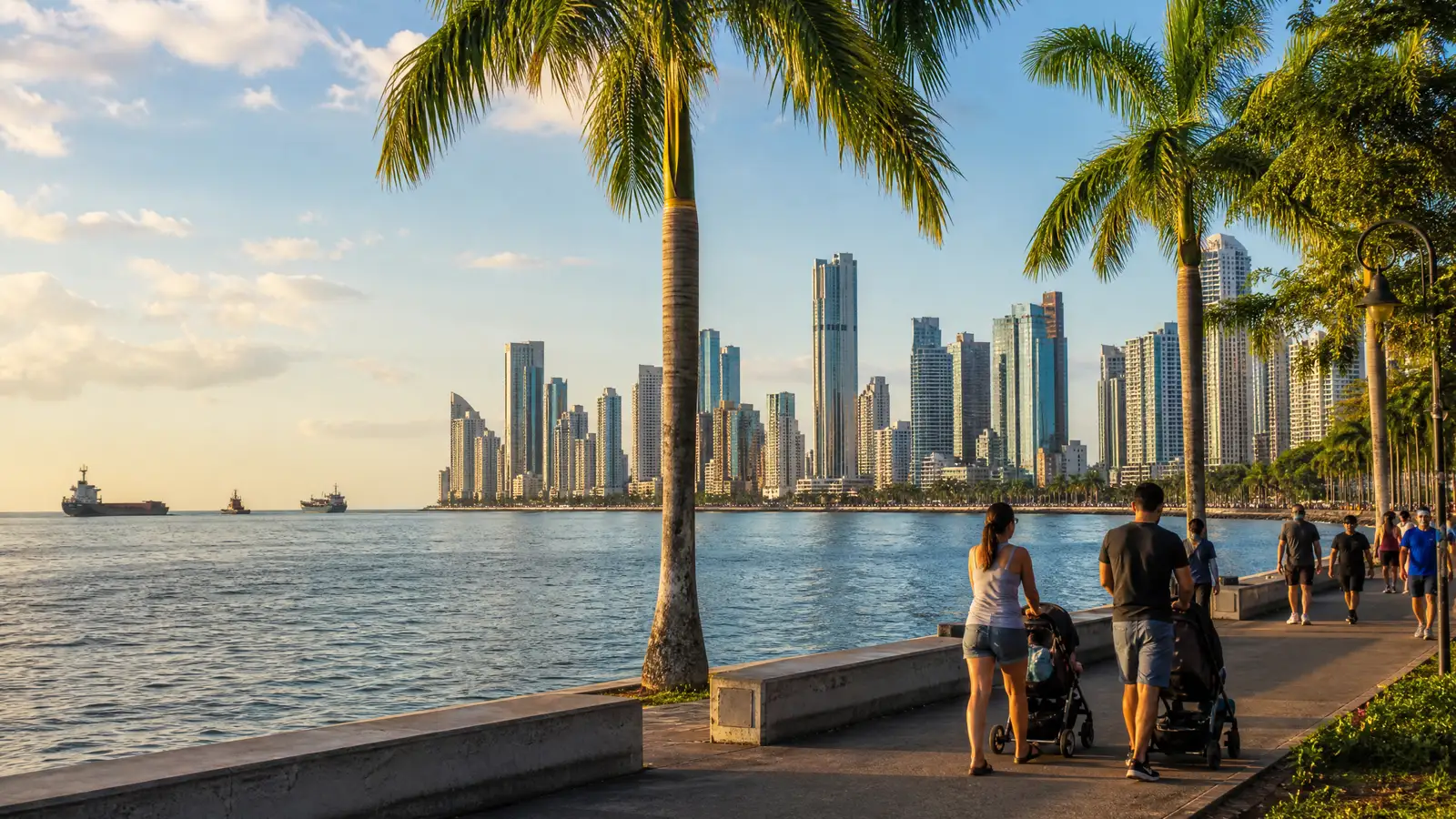
Panama City surprises every first-time visitor: a skyline like Miami, the "Dubai of Latin America" with bank towers and glass façades, plus the restored UNESCO old town Casco Viejo with boutique hotels and rooftop bars, and the Amador promenade looking out at the waiting container ships. If you do not want the capital's bustle, there are three classic escapes: Boquete in the Chiriquí highlands at around 1,200 metres, eternal spring at 18 to 28 degrees Celsius, coffee farms, flowers and the largest expat community in the country; the Pacific coast around Coronado, an hour's drive from the capital, with beaches and golf courses; and Caribbean Bocas del Toro, island life with a dropout vibe, plus El Valle in its green volcanic crater. In all four you will find established international communities, German-speaking ones among them, but Panama is not Paraguay: there are no closed foreign colonies, your daily life runs in Spanish and, in the capital, partly in English, which is more widespread in international circles than in most neighbouring countries.
Working in Panama in 2026: the hub wants professionals, but protects its market
The reality: the local job market is tight for foreigners, a work permit is mandatory and tied to your residence permit, and many professions (law, medicine, some trades) are reserved for Panamanians by the constitution or require lengthy recognition. Demand is for specialists in logistics, IT, engineering, banking and tourism, and anyone working for international firms around the canal and ports or in one of the multinational headquarters zones earns decently. But the truth for most of my readers is the same as everywhere in the region: Panama pays off if you bring your income with you, as an entrepreneur with an international structure, a remote worker or a retiree. For freelancers with foreign clients, the combination of dollar, territorial tax and a world-class airport is hard to beat, because you earn tax-free and still live in fully functioning first-world infrastructure. The digital infrastructure keeps up: fibre in the cities, a decent mobile network, and a power supply more stable than almost anywhere in Central America, with noticeable weaknesses only in remote areas such as the Bocas islands.
What life costs: Panama is not a budget country
Let's clear up the biggest misconception spread by relocation videos. In the expat neighbourhoods, Panama City runs at Southern European price levels: flats in Punta Pacífica, Costa del Este or San Francisco cost rent like in a large Western European city, upscale restaurants likewise, and everything imported carries a mark-up. When buying, prices per square metre in the capital are around EUR 1,500 to 4,000, in Boquete EUR 800 to 2,000. Panama only becomes cheap outside the hotspots and with local spending habits: if you shop at the market, eat local produce and live in the interior, you live considerably more cheaply than in Western Europe. For a comfortable life as a couple in the capital, realistically plan for USD 2,500 to 3,500 a month rather than the fantasy figures in some YouTube videos, and noticeably less in the interior. Purchase costs on property are pleasantly low at 2% to 5%, but I unpick the real traps of the market (titled land versus Rights of Possession) in the property article, because that is where foreigners lose the most money.
Healthcare and family: the quiet trump card
For medicine and schools, Panama plays in a league of its own in the region. Panama City offers excellent private clinics with US-oriented standards; many doctors trained in the United States, some hospitals are affiliated with renowned US clinics, and costs are far below US levels. International health insurance is still a must, because outside the centres care thins out quickly. For families there is a dense network of international and bilingual schools with American or British curricula, and homeschooling is legal in Panama, which makes the country a quiet favourite among families from countries with strict compulsory school attendance who want to educate their children on their own terms. With children, Panama works remarkably well: short distances, a dollar-based daily life, direct flights to grandparents in Europe and North America, a warm climate and a family-friendly culture in which children are welcome everywhere.
Residency and tax, in brief
The details are in my dedicated articles; here is the map to get your bearings. On residency, Panama's Friendly Nations visa makes it one of the fastest reputable countries in the world for citizens of the countries on its list: an economic tie (property or a fixed deposit from around USD 200,000, local employment or setting up a company), two years of temporary residence, then permanent. Alongside it are the legendary Pensionado programme for retirees and the Qualified Investor visa from a USD 300,000 property investment (new build bought from the developer; resale USD 500,000) with permanent residence from day one. Almost everything requires a lawyer, which costs money but also secures the quality of the process. On tax, the core remains simple and strong: territorial, 0% on foreign income, no inheritance tax, plus the Panamanian private foundation as an internationally proven asset protection classic. The rule of thumb is the same everywhere: leave your home country properly first, then arrive, and if you hold companies, check how your home country treats foreign companies in a low-tax jurisdiction before you rely on Panama's territorial tax. If you are ready to take on the Friendly Nations visa, the way we carry out the process on the ground together with our local partners, licensed attorneys in each country, from the economic tie to the conversion to permanent residence, is set out on the service page Panama Friendly Nations visa.
What your home country keeps taxing after you move, and how it treats a Panamanian company or foundation, depends on where you come from:
The advantages at a glance
Panama holds four trump cards that no neighbour offers together. First, the US dollar economy: the dollar has been legal tender for more than a hundred years, which means zero currency risk and no devaluation dramas. Second, territorial tax: foreign income generally stays untaxed. Third, fast, reputable residence: permanent from day one on the investor routes, and permanent after two years of temporary residence on the Friendly Nations visa. And fourth, first-world infrastructure: the best flight hub in the region with direct connections to Europe and both Americas, excellent private clinics at US standard, an established international banking centre and a dense network of international schools, along with legal homeschooling. A special case for retirees is the Pensionado programme, which, with a proven pension, grants not only fast permanent residence but also substantial statutory discounts on medicine, flights, restaurants and much more, a model hardly any other country offers in this form. On top of that, the economy around the canal, logistics and finance is internationally oriented and dollar-stable, which makes Panama a reliable base for working across borders. For the internationally positioned entrepreneur, the investor and the retiree with a solid budget, that is a rare combination. If you are torn between the territorial-tax countries, you will find the clear-eyed side-by-side comparison in Paraguay vs Panama, and the country overview on the Panama country page.
The disadvantages, honestly, including 2025
I am not going to skip the chapter the relocation videos leave out. Panama had a hard year in 2025. From April, teachers, construction workers and the Chiquita workforce went on strike against the pension reform (Law 462); the banana company dismissed thousands of workers and halted production in Bocas del Toro, the Mulino government twice declared a state of emergency there and cracked down hard on the construction workers' union SUNTRACS. Then there is the fiscal position: the deficit at times reached 7% of GDP, Fitch downgraded Panama to junk, and the closure of the huge Cobre Panamá copper mine hangs over the budget as a multi-billion-dollar arbitration. And above it all, geopolitics: Trump's canal rhetoric, a security memorandum with a US military presence and Panama's exit from China's Belt and Road Initiative. Where does that leave you? The fundamentals (dollar, canal, territorial tax, banks) are rock solid, but the country has become more expensive, more nervous and more political than the Pensionado brochure of 2015 promised. Add the everyday issues: a hot, humid coastal climate, a rainy season from May to December, sluggish authorities despite a digital façade, and traffic in Panama City that frays your nerves. I unpack the security situation, with its two faces, in a separate article.
Who Panama really suits in 2026
Let's be precise, because fit is what separates success from disappointment. Panama is strong for the internationally positioned entrepreneur and investor who wants dollar banking, territorial tax, a first-class flight hub and fast, reputable permanent residence, and for the retiree with a solid budget looking for first-world medicine in the tropics and the Pensionado discounts. It is strong for families who value legal homeschooling and international schools. It is the wrong country for the pure cost optimiser (who is better served in Paraguay), for the employee without remote income hoping for a local job, and for anyone expecting political calm and a tropical idyll without friction. Panama against Paraguay against Costa Rica, the city against Boquete, the Friendly Nations visa against the investor visa: that is exactly the weighing up I work through with my clients before the first lawyer is instructed and the first dollar moves.
If Panama could be your destination, let's go through it properly, with your numbers, your structure and your family situation. Book a conversation with me; you will find the link right below.
👉 Book a consultation with Harley
Carpe Diem. Life is short and fleeting. One shot. Make it count.