
Moving to Panama in 2026: residency routes, territorial tax freedom, costs, healthcare, the best places to live and the one truth about your home country you need to know before you leave. For the full list of strengths and weaknesses, read the honest pros and cons of moving to Panama.
Panama has been one of the world's most popular destinations for people relocating abroad for years, and for good reasons: territorial tax freedom, the US dollar as its currency, an international financial centre and straightforward residency. But a move abroad needs planning, and between the dream and the execution lie concrete questions: which residency route fits, what does tax really look like, what does life cost, where is the best place to live? This guide walks you through the key points honestly, with the real numbers and the one truth about your home country that many think about too late. One remark up front: Panama is strong, but it only works with a sound structure behind you.
Why Panama? The hard advantages
Let's start with what makes Panama so attractive. The country taxes territorially: your genuine foreign income stays tax-free and does not even have to be declared to the Panamanian tax authority. It uses the US dollar as legal tender, so there is no exchange rate risk. Panama City is a genuine financial hub with a large, international banking sector, and after its removal from the FATF grey list in October 2023 and from the EU list in spring 2024, the jurisdiction's reputation has noticeably recovered. Add to that no wealth tax and no inheritance tax, plus a modern, capable healthcare system. This combination of tax advantages and quality of life is the core of Panama's appeal. If you want to combine tax freedom with dollar stability and international connections, Panama is one of the strongest options anywhere. Hardly any other country in the region combines so many tangible advantages in one place.
The residency routes at a glance
Panama offers several routes to a residence permit, and the right one depends on your situation. The most famous is the Pensionado, the retiree visa: it requires a lifetime pension of around USD 1,000 a month, grants permanent residence immediately and comes with legendary discounts of 25% to 50% on many expenses. For wealthier applicants there is the Qualified Investor visa, which ties residence to an investment, for example in real estate; since Executive Decree 17 of 8 September 2026, the thresholds are USD 300,000 for a new-build property bought directly from the developer and USD 500,000 for a resale property, with no cut-off date. For location-independent workers there is a remote worker visa for up to 18 months, from a monthly income of around USD 3,000. It is ideal if you want to try Panama first before committing for good. And citizens of many countries can use the Friendly Nations visa. Which route fits is the first question I settle with every client. The wrong choice costs time and money; the right one opens the shortest path to residency.
Tax: territorial, but not automatic
Panama's territorial principle is strong, but it needs to be understood properly. Genuine foreign income is tax-free, meaning income that does not come from activity carried out in Panama, as the tax summaries confirm. Income earned locally, on the other hand, is taxed, at progressive rates of up to around 25%. The decisive point if you are relocating from a high-tax country: tax freedom in Panama only helps if your home country no longer treats you as tax resident, which is why properly ending your old residence is part of the model. Panama also offers the Fundación de Interés Privado, the private foundation under the 1995 law, a proven instrument for asset protection and estate planning. Territorial tax freedom is a powerful tool, but only as part of a sound overall structure. Keep that principle in mind and the territorial system becomes real, lasting tax freedom.
Costs: moderate, with room to manoeuvre
What does life in Panama cost? The honest answer: moderate, with a wide range depending on where you live and your lifestyle. Panama City is the most expensive place to live, but still cheaper than comparable North American or European cities, and in return it offers urban comfort at a high level. In the retirement hubs outside the capital, life is considerably cheaper. The US dollar keeps prices stable and makes budgeting simple for anyone whose savings or income are in dollars, since there is no exchange rate risk on the Panamanian side. If you use the Pensionado discounts, you lower your running costs noticeably on top of that. Overall, Panama gives you a comfortable life at a reasonable price, with the advantage that you plan your budget in a stable currency. That predictability in dollars is an often underestimated advantage over countries with a fluctuating local currency.
The best places to live
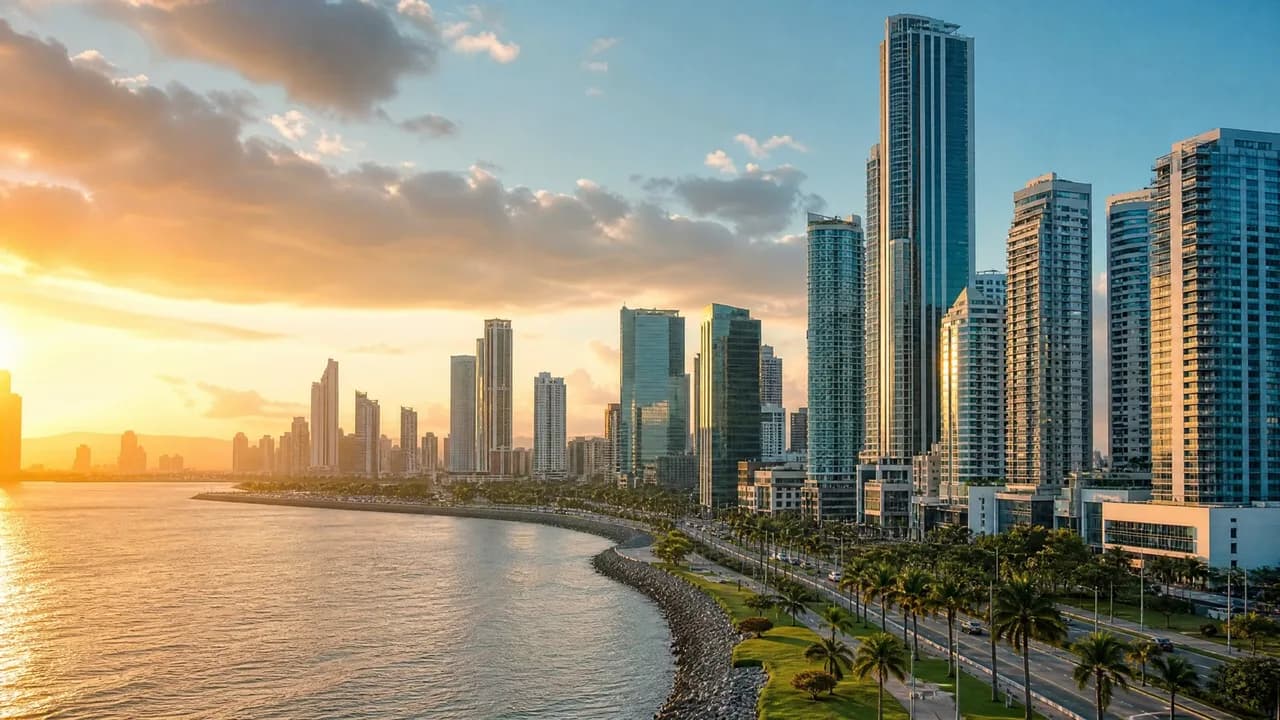
So where should you live in Panama? It depends on your lifestyle. Panama City is the urban, international heart, with modern residential towers in neighbourhoods such as Costa del Este and Punta Pacífica, ideal if you value the financial centre, infrastructure and nightlife. Boquete in the cool highlands is the retirement hub par excellence, with a pleasant climate, a lively expat community and nature on the doorstep. Coronado on the Pacific coast offers beach life within easy reach of the capital. And the islands of Bocas del Toro on the Caribbean side offer tropical island life and an English-speaking culture. If you want English in everyday life, Panama is one of the most accessible countries in the region anyway, especially in the capital's financial world. This variety of places to live makes it easy to find exactly the setting that suits your lifestyle.
Healthcare, banking and daily life
A few practical points decide how daily life feels. Healthcare in Panama City is excellent, with modern private clinics at international standard and doctors who were often trained in the US, at considerably lower cost. Banking is capable, as you would expect from a financial centre, but new clients face thorough checks, so allow time and have your paperwork in order. Daily life benefits from the dollar, good infrastructure in the urban areas and a large, helpful expat community that makes the start easier. If you tackle these practical building blocks early, you will settle in Panama quickly and smoothly. It is a country that offers a great deal of comfort to the well-prepared newcomer. Settle the practical questions early and you will enjoy Panama from the first week.
The road to a passport
If you think long term: in Panama, the road to naturalisation opens five years after you are granted permanent residence. Pensionado and Qualified Investor holders are permanent from the start; Friendly Nations begins with two years of provisional residence, so it takes seven years in total on that route. One important point: Panama generally requires naturalised citizens to give up their previous citizenship, unlike many neighbouring countries. So if you are aiming for a Panamanian passport, you have to weigh that consequence against the value of your current citizenship. For many people relocating, the passport is not the main goal anyway; permanent residence with its tax advantages and discounts is entirely enough for them. But if you want citizenship, build this renunciation point into your planning from the start. It is a conscious decision, not a side issue. If you value holding several passports, permanent residence alone may well be the smarter choice.
Your first steps: the right order
To turn the dream into a plan, a clear order helps. First, settle your home side: whether and when your tax residence there ends, any exit tax, and if needed restructuring your company. Second, choose the right residency route, Pensionado, Qualified Investor, remote worker or Friendly Nations, depending on your age, income and assets. Third, prepare your documents, often apostilled and translated, and file the application. Fourth, sort out banking, health insurance and where you will live on the ground. This order prevents the most common mistake, namely moving first and only thinking about the tax side afterwards, when important decisions have already been made. A structured approach saves time, money and nerves.
What your home country does when you leave depends on where you come from:
The most common mistakes
I see three mistakes among people moving to Panama again and again, and each one is avoidable. First, ignoring the home side and believing the move automatically ends your old tax obligations, when in reality the rules of your home country can keep reaching you after you leave. Second, misunderstanding the territorial principle and wrongly assuming that income earned locally is tax-free. Third, overlooking the renunciation point when naturalising and only realising late that the Panamanian passport requires you to give up your previous citizenship. Know these three and plan for them from the start, and you turn Panama's advantages into real, lasting freedom.
Leave properly first
One principle comes first, the same one I put at the start of every plan: before Panama's tax freedom can take effect, the home side of the move has to be dealt with. If you hold shares in companies or significant assets, check before you go whether your home country taxes your departure and how long it keeps a claim on you afterwards. Panama's advantages are worth nothing if your departure from a high-tax country is not properly structured. The beautiful new home is one part; making a proper tax break with home is the other. Structure decides, not the destination.
The three decisions that make Panama work
Panama is rightly one of the most popular destinations: territorial tax freedom, the US dollar, an international financial centre, straightforward residency routes such as the Pensionado, moderate costs and attractive places to live, from the financial metropolis to the mountain town of Boquete. The road is very doable if you make the right decisions: the right residency route, a sound tax structure and, if the passport matters to you, a conscious decision on renunciation. If you plan both together, life in Panama and a proper break with home, you make a smart decision. That is exactly the planning I go through step by step with my clients.
If Panama is your goal, let's work out together which residency route suits you, what your tax structure should look like and how your affairs at home fit in. Book a conversation with me; you will find the link right below.
👉 Book a consultation with Harley
Carpe Diem. Life is short and fleeting. One shot. Make it count.