
On 28 October 2025, 2,500 police officers moved into the Penha and Alemão favela complexes in the north of Rio, against the Comando Vermelho. At the end of Operação Contenção the state counted 121 dead, among them four police officers, the deadliest police operation in Brazilian history; Amnesty International called it a massacre, the governor a necessary success against the gangs. In the same year the country reported the lowest number of murders since modern record-keeping began, and the state of Santa Catarina, historically the heart of German immigration to Brazil, remained the most peaceful in the country.
Both are Brazil, at one and the same time. Try to boil the country down to a single safety verdict and you are judging a whole continent in one word; you are bound to get it wrong. Instead, I will give you the map, the numbers and the rules that make the real difference, candid in both directions, because safety in Brazil is not a number but a question of place.
The numbers: better than their reputation, worse than Europe
First the hard data, not gut feeling. Brazil recorded 38,075 homicides in 2024, 6% fewer than the year before, the lowest level in modern statistics; at the peak in 2017 there were almost 64,000, so the decline is massive and real. The national rate is around 20 per 100,000, but the trend has pointed clearly downwards for years. What matters for you is not the average but the distribution, and it is extreme: the Atlas da Violência 2026 (with data up to 2024) places 17 of the 20 most violent cities in the Northeast, led by Maranguape in Ceará with 87.2 and Jequié in Bahia with 79.4 murders per 100,000; among the state capitals, Salvador leads with 52.7. At the other end of the scale: São Paulo as the safest metropolis, with rates in the single digits to low double digits, and the south, above all Santa Catarina as the safest state, with cities such as Blumenau, Joinville and Florianópolis whose figures approach European levels. Rio de Janeiro sits in the middle of the table with 21.1, which surprises many who assume Rio is the most dangerous place in the country.
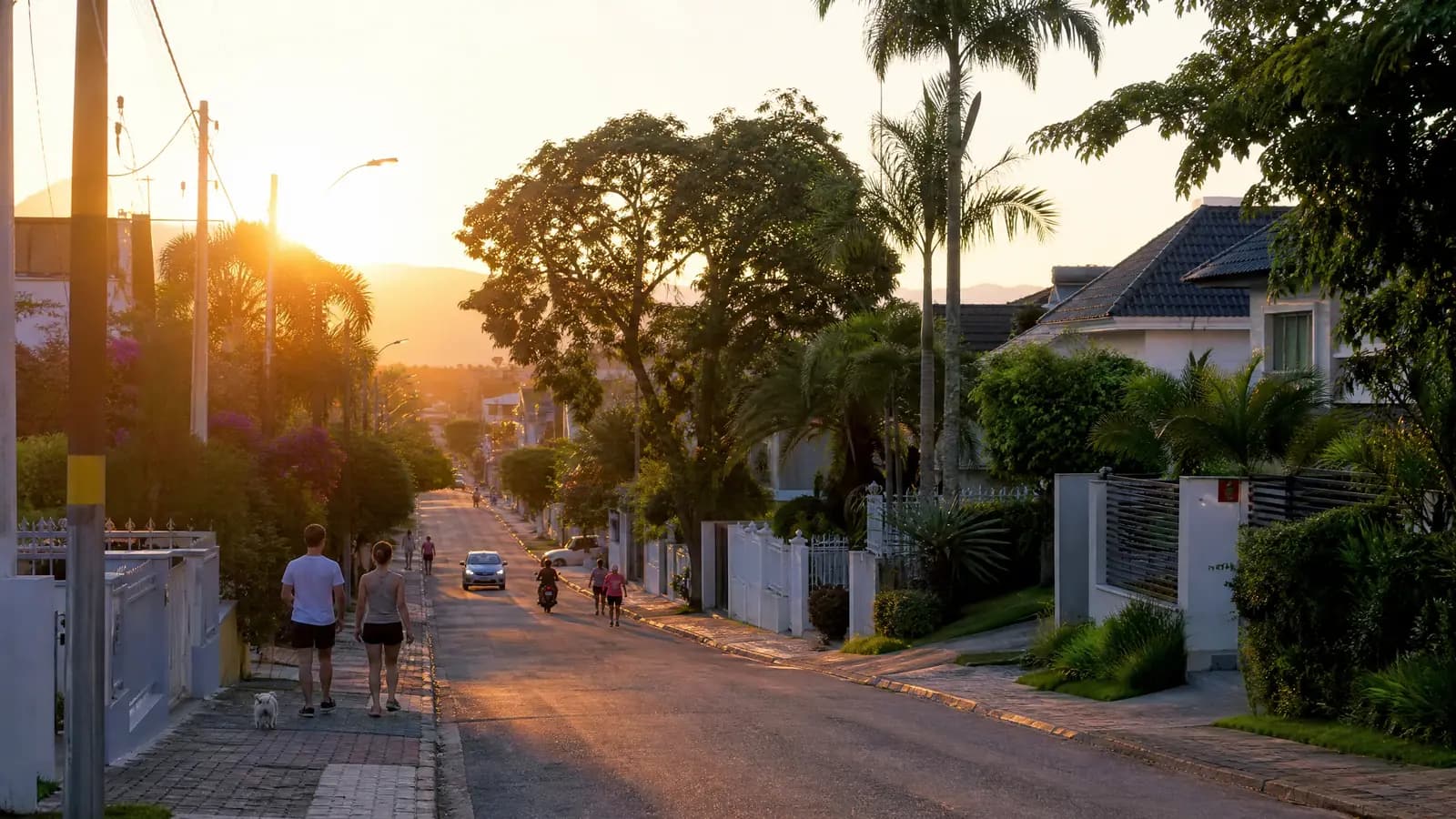
The rule to remember for all your planning: in Brazil, you choose your safety reality when you choose your state and your neighbourhood. Moving to Santa Catarina puts you in a different safety country from Salvador or a small town in the Northeast, even though both go by the name of Brazil.
The factions: a war that is not yours
At the core of the violence statistics are two names: the PCC from São Paulo and the Comando Vermelho from Rio, two criminal factions that have gone national in recent years and fight over ports and smuggling routes, down to small port and border towns; that is exactly why violence is, paradoxically, rising in towns you have never heard of while the big metropolises grow calmer. Since May 2026, Washington has designated both as global terrorist organisations; Argentina and Paraguay did so earlier. In Rio the militias add a third force, half security service, half criminal organisation, along with a police force that is itself part of the death toll: in the Rio metropolitan area alone, at least 460 people died in police operations in 2025, according to the monitoring group Fogo Cruzado. What does that mean for you in practice? These wars are fought in territories that you, as a foreign resident, simply never enter: favelas, outskirts, port zones, drug distribution points. The factions have no business model involving foreigners; you are of no interest to them. Your real contact with that world is limited to closed roads on operation days and headlines in the morning, provided you follow the rules on where to live.
Daily life: the rules that really count
The real everyday danger for you is not murder but robbery: phone snatching, hold-ups at red lights, theft on the beach, occasionally at gunpoint. What helps are the rules every Paulistano and Carioca knows by heart. Location first: good neighbourhoods in Rio's South Zone (Leblon, Ipanema with vigilance), Jardins, Pinheiros or Moema in São Paulo, or simply the calm south. Phone discipline: never stand typing on your phone in the street; it is the number one invitation to theft. Car and traffic lights: windows up, nothing visible on the seats, and at night at red lights in risk zones locals roll through slowly instead of stopping completely. No resistance in a robbery: hand over your valuables without a word and stay alive; no phone is worth a human life. Favelas are not a tourist attraction, not even with a guide, not even the ones considered pacified. And Uber at night instead of walking through empty streets. Follow these simple rules and you bring your risk down to a level at which millions of middle-class Brazilians lead perfectly normal, free and good lives. In the south you half forget the rules after a while, because everyday life there is simply calm and European.
The political situation: stress test passed, election year ahead
An honest picture has to include politics. Since 2022 Brazil has been through the toughest democratic stress test in its recent history, from the storming of the government buildings in Brasília in January 2023 to the criminal proceedings over the attempted coup around former president Bolsonaro, and the institutions, above all the Supreme Court, held in the end. The country is deeply polarised, there is an election in October 2026, tax reform is a campaign issue, and the tone between Brasília and Washington swings with Trump's trade policy. But, and this is what matters for anyone moving there: no expropriation debates, no capital controls, an independent judiciary, a free and loud press, peaceful transfers of power. For a foreign resident, Brazilian politics is exhausting to follow and harmless to live with. Treat demonstration days and election weeks as dates in the diary, not as threats, and avoid large rallies, and the polarisation will not touch your daily life.
Corruption: systemic at the top, rarer at street level than you think
Brazil's corruption scandals are famous the world over, from Operation Lava Jato to the militias, and the problem sits where politics, big contracts and organised crime meet; in Rio, organised crime now regulates the lives of almost half the city's population, from gas canisters to internet connections. In a foreign resident's daily life, on the other hand, the street bribe is rarer than in Paraguay; your real contact with the problem comes through bureaucracy, permits and courts, where connections, patience and the length of the procedure are the real currency. The rules are the same as everywhere on the continent: documented, above-board routes, your own independent lawyers, no grey zones, and never pay a "facilitator". Stay above board and avoid shortcuts, and that level of the problem never reaches you.
Natural hazards: no hurricanes, but water
Brazil has no hurricanes and practically no earthquakes, a real advantage over the Caribbean or the Andes. Its threat is water, both too much and too little. The disaster in Rio Grande do Sul in May 2024 was the worst flood in Brazilian history: at least 181 dead, 540,000 displaced, the Guaíba river in Porto Alegre a quarter of a metre above the 1941 record, the airport closed for months. Add to that the classic landslides on the mountain slopes (Petrópolis, the Serra regions) after heavy rain, and droughts in the Amazon and south-eastern systems that hit waterways and agriculture. For you, these risks can be planned for and are not an existential threat: check slopes and proximity to rivers, read the municipal flood maps in southern Brazil, choose solid construction and respect the rainy season. Anyone who has watched river floods in Europe in recent years knows the lesson: the right location is half the battle.
São Paulo vs Rio: two cities, two safety worlds
Many people moving to Brazil hesitate between the two big metropolises, so a direct comparison helps. São Paulo is the economic capital and, though few people know it, the safest of the big metropolises: since the 2000s the state of São Paulo has achieved one of the steepest falls in murder rates in the world, and the PCC, paradoxically, controls violence in the underworld through its dominance. In Jardins, Pinheiros, Vila Madalena and Moema you live an urban, culturally rich and comparatively safe life. Rio de Janeiro is more beautiful, more relaxed and more dangerous all at once: the South Zone (Zona Sul) with Ipanema, Leblon and Copacabana is world-class by day but demands more vigilance, because favelas and wealthy neighbourhoods border each other directly and the militias are present. My recommendation: if you lean towards a metropolis and put safety first, choose São Paulo; if beach and lifestyle come first and you follow the rules with discipline, you can choose Rio, but be aware of the higher baseline tension. Both lose to the south if maximum calm is the goal.
What this means in practice
Let's turn this into actions, because actions are what count. Choose your state as you would choose a safety level: Santa Catarina and the south for maximum calm, São Paulo and Rio only with strict neighbourhood discipline, the Northeast as a holiday decision rather than a place to live unless you know it closely. Follow the simple everyday rules against robbery; they make all the difference between worry and peace of mind. Put the headlines in context: operations like Contenção are tragedies in a world that yours, as a foreign resident, never touches, as long as you live in the right place. And check the slope, the river and the history of every property, because in Brazil water is natural hazard number one, not earthquakes or storms. This location decision, state, city, neighbourhood and plot, is exactly what I go through with my clients before they sign a contract, because in Brazil choosing the right place is literally the most effective safety decision of all.
If Brazil is an option for you, let's talk honestly about the right place to live for your personal need for safety. Book a call with me; the link is right below.
👉 Book a consultation with Harley
Carpe Diem. Life is short and fleeting. One shot. Make it count.