
Hardly any country in our Latin America series gets as many questions as Mexico, and hardly any country is so sweepingly misjudged from abroad. Some think it is a war zone because the news is full of cartel stories. Others ignore the risks completely because Cancún felt safe on holiday. Both are wrong. I'm a realist, not a salesman, and the honest answer is this: Mexico is not one uniform security risk, but a country with extremely different regions. If you take five minutes before your move, or before choosing a location, to tell cartel strongholds apart from established expat regions, you reduce your personal risk drastically without having to give up on Mexico.
What official travel advice says right now
As of 20 October 2026, the UK Foreign Office (FCDO) advises against all but essential travel to all or most of seven Mexican states (Chihuahua, Colima, Guerrero, Michoacán, Sinaloa, Tamaulipas and Zacatecas) and to parts of four more: the cities of Tijuana and Tecate in Baja California, south-western Guanajuato, parts of Jalisco and the strip of Chiapas along the border with Guatemala. It does not advise against all travel to any part of the country. Classic destinations for foreign residents such as Yucatán, Quintana Roo with the Riviera Maya, Baja California Sur and Mexico City are not among the areas it warns against, although it notes drug-related crime in Baja California Sur, including Los Cabos, and clashes between rival gangs in and around Cancún which, it says, have not targeted tourists but could affect anyone nearby. The core message: what matters is which state you are in, not whether you are in Mexico.
Organised crime: the biggest danger
According to official travel advice, the greatest threat to Mexico's internal security comes from organised crime, not from petty crime against tourists. That is an important difference: travellers and foreign residents are rarely the direct target, but in certain regions they can get caught between rival gangs, or between cartels and the security forces. Since September 2024, Sinaloa has been going through a bloody internal cartel war between the Chapitos and Mayitos factions, with homicides up by around 66% in 2025 and an even sharper rise in femicides, while the national murder rate fell slightly over the same period. This discrepancy shows how important a regional rather than a national view is. According to the FCDO, Michoacán is one of Mexico's most violent states, Zacatecas is extremely dangerous because of battles between organised crime groups, and in Guanajuato organised crime activity is rampant, particularly in the south of the state. Everyday crime such as robbery, fraud or extortion, by contrast, is captured by a quite different statistic, the ENVIPE survey, which interestingly shows lower figures in some cartel strongholds, simply because fewer crimes are reported there and many organised offences never fall into this category in the first place.
In practice: avoid driving between cities at night away from the toll motorways (cuota), stop only at busy service areas, don't resist in a robbery, not even verbally, and check the current situation on your planned route before any longer journey. The FCDO also advises travelling during daylight hours where possible and, if you suspect someone is following you, driving to a police station or another safe place rather than acting yourself. It adds that you should be alert on public transport, at airports and in bus stations, where theft is common. These rules sound dramatic, but in practice they are simple to follow when you move within the established expat and tourism corridors, and they largely match the common sense you would apply in other large cities around the world.
Corruption
Mexico scores 26 out of 100 points in Transparency International's Corruption Perceptions Index, well within the bottom third of the global ranking according to the latest survey, which places Mexico in a category with noticeable everyday corruption at public offices and in some cases among police forces too. Politically, little has changed under recent administrations; the national transparency institute INAI was at times made unable to act through blocked appointments, as political observers have pointed out critically. Official advice explicitly notes that police officers or uniformed security staff may occasionally be involved in crimes themselves and that criminals sometimes pose as police. In practice: handle important dealings with the authorities and documents transparently and, where possible, with a receipt, make larger purchases such as property or company formations only with a reputable, locally recommended notary or lawyer, and stay calm and cooperative at a genuine police check, without negotiating in cash. According to the FCDO, criminals also target people using ATMs and bureaux de change, so it is better to withdraw cash in daylight inside shops, malls or bank branches rather than at free-standing machines.
Natural disasters
Mexico lies on the Pacific Ring of Fire and is one of the most tectonically active regions on earth. Off the Pacific coast, the Cocos Plate is pushing beneath the North American Plate, which results in regular earthquakes and active volcanism. The most devastating earthquake in recent history struck on 19 September 1985 with at least 10,000 deaths; the most recent severe quake hit Mexico City on the 32nd anniversary of that disaster in 2017, with around 250 deaths. Mexico City itself sits on a former lake bed with particularly poor ground for building, which amplifies earthquake damage there. The Popocatépetl volcano, only around 60 to 70 kilometres from Mexico City and Puebla, is practically permanently active and is monitored around the clock by the national disaster prevention centre CENAPRED, with a graded alert system that in an emergency can lead to airport closures and the evacuation of surrounding towns. On the Caribbean and Pacific coasts there is also the hurricane season, which officially runs from June to November and in recent years has repeatedly produced storms of the highest category.
For you as a resident, that means: if you choose a coastal region, plan for a home with solid construction and an evacuation plan for the hurricane season, which officially runs from June to November and in recent years has repeatedly produced Category 5 storms, such as the record Hurricane Otis, which in 2023 intensified within a few hours off Acapulco into one of the strongest Pacific storm systems ever measured. If you live in Mexico City or Puebla, familiarise yourself with the local earthquake warning systems and rules of conduct that are now part of everyday life there, such as the sirens that give a few seconds' warning before stronger quakes, and the annual nationwide earthquake drills on 19 September, the anniversary of the 1985 and 2017 disasters. Important for property buyers and tenants in earthquake-prone areas: it always pays to look at the build quality and the year of construction, because building codes were tightened considerably after 1985.
Where foreign residents live most safely right now
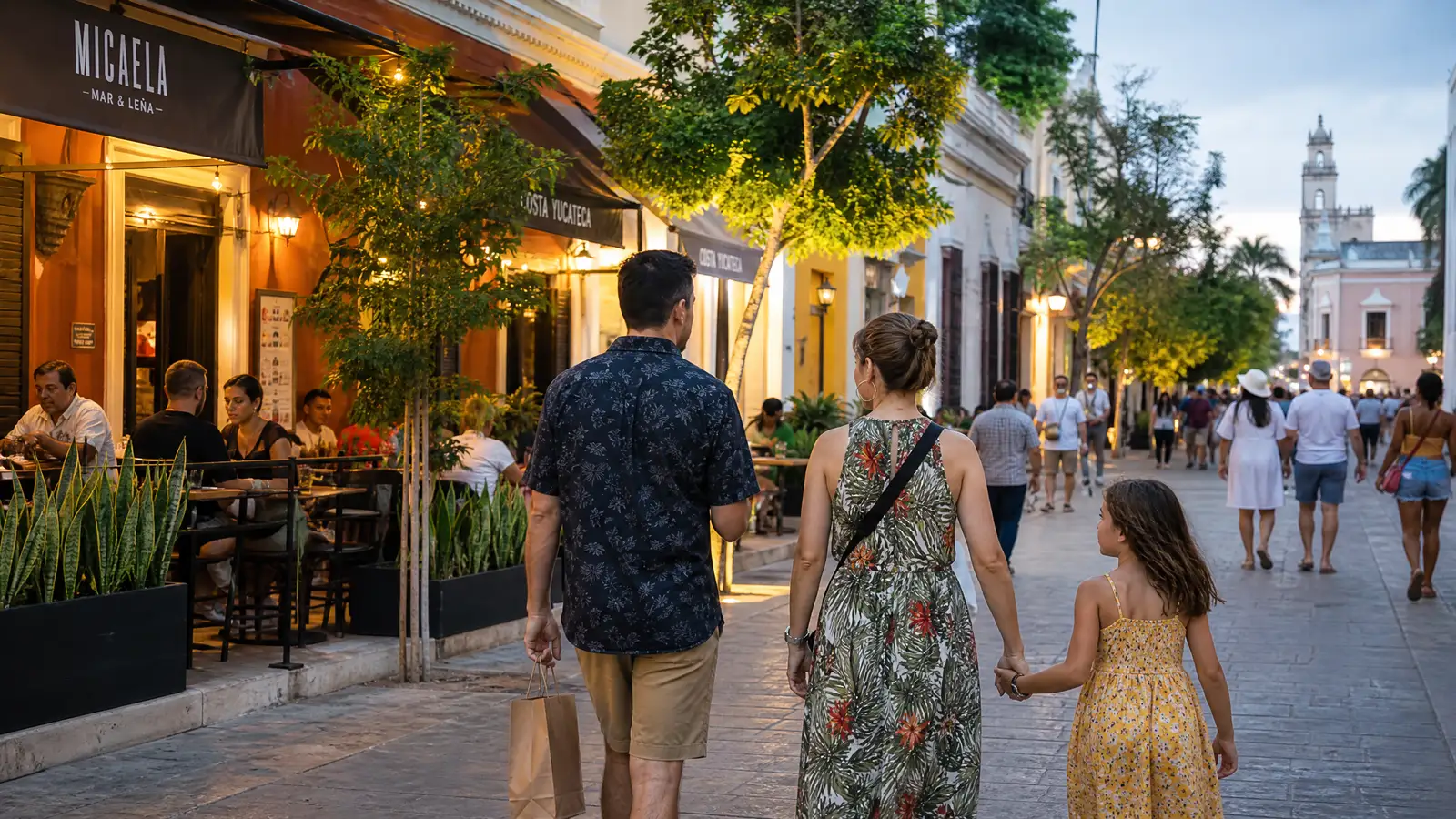
Combining official travel advice ratings, crime statistics and first-hand accounts from the expat community, a few regions emerge that, as of 2026, consistently rank among the safest for foreign residents: the Yucatán Peninsula with Mérida at its centre, which records practically no cartel-related violence and is regularly named as one of the safest cities in Latin America; Baja California Sur around Los Cabos; the region around Querétaro and San Miguel de Allende in central Mexico; and the established expat neighbourhoods of Mexico City such as Condesa, Roma, Polanco or Coyoacán. These are not guarantees, but they are reliable starting points if you are moving to Mexico for the first time and have not yet developed your own feel for the regional differences. Conversely, states such as Sinaloa, Guerrero, Michoacán, Tamaulipas or Zacatecas are currently not recommended for a first move without existing local contacts and knowledge of the area, regardless of how cheaply property is offered there. If you nevertheless have family or business ties to one of these regions, discuss security explicitly before the move with someone who knows the current situation on the ground, not only with an estate agent who has an interest in the sale.
Geopolitics: Mexico between the US and the cartels
Mexico's security situation cannot be viewed separately from its big neighbour to the north. A large share of the international drug trade runs across the shared border in both directions, fentanyl and cocaine northwards and US-made firearms southwards, which official advice names as one of the main drivers of the ongoing cartel violence in several states. At the same time, the USMCA agreement ties Mexico closely to the US and Canada economically, which makes investment in security infrastructure, such as the expansion of the National Guard (Guardia Nacional) under the Sheinbaum government, politically relevant, because trading partners have an interest in stable supply chains and safe economic zones. For foreign residents with ties to the US, such as cross-border commuters or people with business links there, it is relevant that political tensions between Washington and Mexico City, for example over tariffs or migration policy, have in the past also affected border regions such as Tijuana or Ciudad Juárez, with temporarily tightened checks. For life in central or southern Mexico, where most foreign residents actually end up, this dynamic plays a much smaller role in daily life than the local security situation.
In an emergency: the key contacts
Mexico's national emergency number is 911, and calls are handled increasingly reliably, although response times vary greatly by region. Note down the emergency number of your embassy in Mexico City before you move, as well as the contact details of the nearest honorary consulate if you live outside the capital. Register with your embassy, or with your foreign ministry's traveller registration service where one exists, and install your government's travel advice app or alerts if it offers them, so that current security notices reach you automatically: a simple habit that can save valuable time in an emergency.
Everyday safety: practical rules that really help
Beyond the big cartel issue, it is usually everyday property crime that foreign residents actually come into contact with, and a few habits reduce it considerably. A flat in a guarded, or at least easily overlooked, building with a working entry system is standard in most cities and not an overreaction. Don't leave valuables and important documents visible in a parked car, a classic among opportunistic thefts. Women should take particular care in Mexico, because violence against women, including sexual assault, remains a real issue according to official advice even in established tourist and expat regions, so journeys at night are best made in company or with a verified ride service rather than a taxi hailed on the street. When hiking in nature reserves, it is advisable not to go alone and not without first checking with people who know the area, because isolated robberies have been documented there too. For the 2026 FIFA World Cup in Mexico City, Guadalajara and Monterrey, expect a visibly increased police and military presence at the venues, which may mean more checks and traffic restrictions for residents of these cities in the short term, but is more of a security plus than a risk in the longer term.
In the end it comes down to a sober assessment: Mexico is neither the disaster zone that sensational headlines suggest nor the carefree paradise that some relocation videos promise. Millions of foreigners live there, work there and raise children there, and the vast majority of them in regions that do exactly what you expect from a place to live, namely function quite normally. The trick is to know the map before you commit, rather than learn it the hard way after the move, and expensively if things go wrong. That is exactly why an independent, current assessment is worth more than any sweeping second-hand verdict.
If you want to know which region suits your specific situation, and how to actively reduce your security risk through the right choice of location, residence permit and everyday behaviour, it is worth talking it through one to one before you commit.
👉 Book a consultation with Harley
Carpe Diem. Life is short and fleeting. One shot. Make it count.