
In 2024 Uruguay granted 16,870 residence permits, a historic record and a jump of 74% on the previous year. Just over a thousand of them went to Europeans, and the number is rising; even the tech billionaire Peter Thiel has secured land on the Río de la Plata. At the same time, on 1 January 2026 the country brought in its toughest tax reform in decades and made its famous newcomer deal far more expensive. Put the two together and you have the truth about Uruguay in 2026: the country is more sought after than ever, and more selective than ever. I have known Uruguay for years, I have accompanied clients there and back out again, and here is the full, honest picture, without the gloss of the promotional videos and without the blanket dismissal of those who only look at the price.
Why Uruguay at all: the Switzerland of South America
The nickname is more than a hundred years old and no marketing gimmick. At the start of the 20th century President José Batlle y Ordóñez explicitly modelled his reforms on the Swiss constitution. Uruguay became one of the first countries in the world to introduce the eight-hour day, women's suffrage and a secular welfare state, and that laid the foundation for what Uruguay still is today: a stable, boring, functioning democracy of around 3.4 million people, with an independent judiciary, a free press and a banking system that even Argentines and Brazilians trust with their money. The Economist regularly counts Uruguay among the few Latin American countries rated a full democracy, and Transparency International lists it as the least corrupt country on the subcontinent. That is exactly why tens of thousands of wealthy Argentines crossed the river after Argentina's 2020 wealth tax, and exactly why hardly anyone chooses Uruguay for the price. If you move here, you are not buying the cheapest location in South America but the most predictable one: a country where governments change from left to right and back again without anyone even thinking about expropriation, capital controls or frozen accounts. For anyone leaving a Europe or a North America that has become too unstable, too intrusive or too unpredictable for them, that boredom is the actual product.
The country: small, flat, empty, green
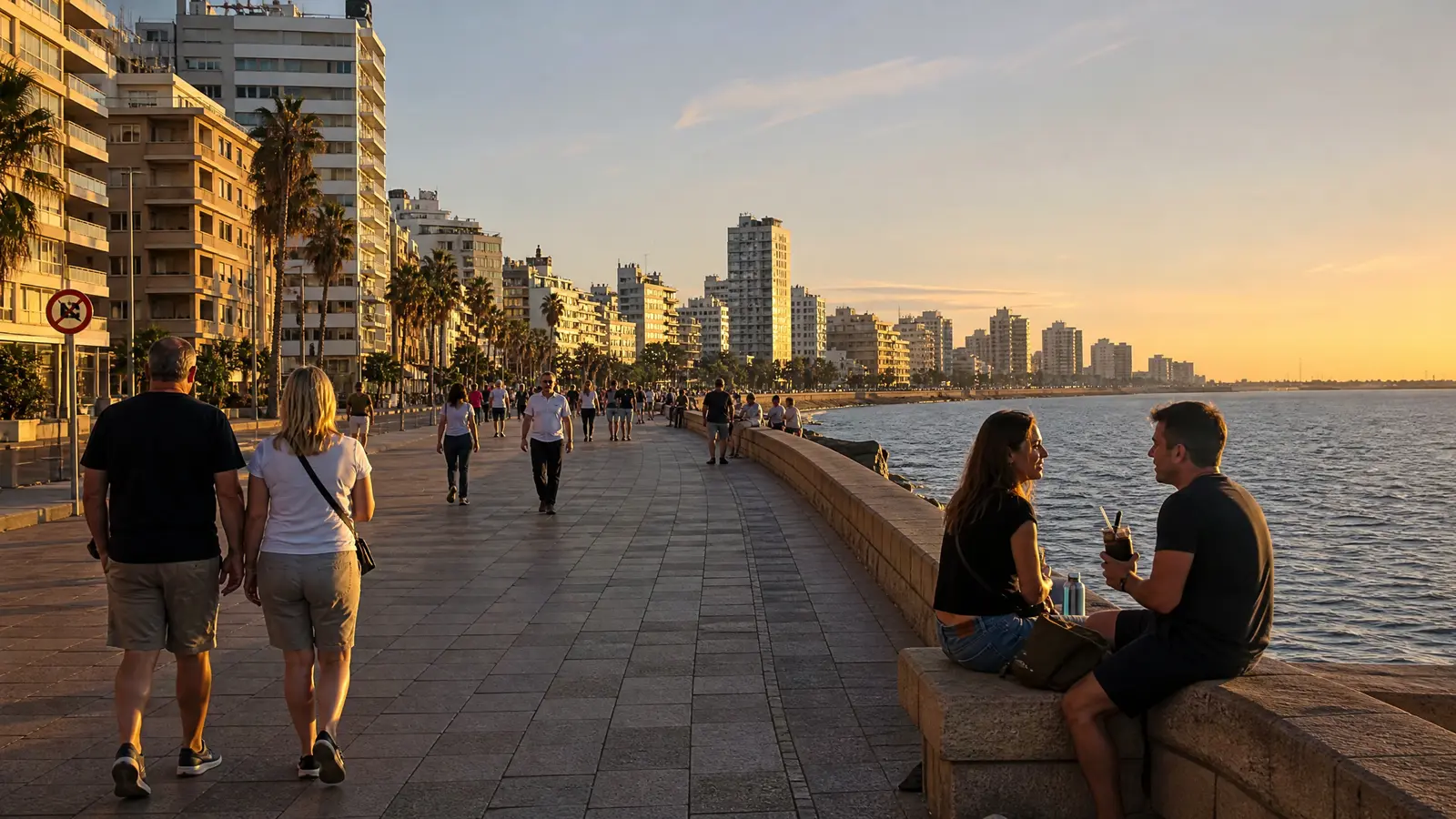
Uruguay is a little larger than England and Wales together: flat, green and almost empty, with gentle hills, endless cattle pastures and 660 kilometres of Atlantic and river coastline. Half the population lives in greater Montevideo, alongside glamorous Punta del Este, colonial Colonia del Sacramento directly opposite Buenos Aires, and a wide, quiet interior with small towns such as Carmelo, Mercedes or Durazno. The climate is temperate with four real seasons: summers around 28 degrees, winters around 6 to 15 degrees, humid and windy, which many people underestimate when they arrive with Caribbean images in their heads. The Uruguayan winter is not cold by Northern European standards, but poorly insulated houses and the sharp wind off the river make it less comfortable than the temperature table suggests. If you come from Europe, you will find a landscape closer to Tuscany or Ireland than to the Amazon, and a noticeably slower pace of life.
Uruguay's European roots: older than the German Empire
Uruguay has a long European, and especially German-speaking, history. The Deutsche Schule Montevideo (the German School) was founded as early as 1857, the German Club in 1866, and in the 1930s and 1940s around 10,000 German-speaking Jews found refuge from Nazism in Montevideo. The Swiss wrote their own chapter: in 1862 Swiss-German families founded the colony of Nueva Helvecia (Colonia Suiza), 120 kilometres west of Montevideo, and brought dairy farming to the country; to this day around three quarters of Uruguayan cheese comes from descendants of those settlers, and the town still celebrates its Swiss roots with its own festival (more in our piece on Nueva Helvecia). Today about 10,000 Germans and around 40,000 people of German descent live in the country, with some estimates far higher, concentrated in Montevideo, plus four Mennonite colonies such as El Ombú and Gartental in the interior. This is not a closed parallel society like parts of Paraguay, but an old, well-integrated layer with a school, clubs, a chamber of commerce and church communities. Uruguay has a long history of welcoming Europeans, and yet one plain truth still applies: you will live in Uruguay in Spanish, because outside these circles other languages count for little, and even English is far less widespread than in Northern Europe.
What life costs: the most uncomfortable number first
This is where Uruguay parts company with almost all its neighbours, and I will tell you straight: Uruguay is the most expensive country in South America. In Numbeo's city comparison for 2026, Montevideo tops the continent with an index of 57.2, almost three times as expensive as Asunción in Paraguay. A single person in Montevideo needs around USD 1,000 a month excluding rent, and a 50-square-metre flat costs EUR 400 to 900 in rent depending on the area. Rents are well below Western European levels, but anything imported, from electronics and cosmetics to cars, costs European prices or more because of high import duties and a tight import oligopoly. A VW Golf costs around EUR 36,000, a new iPhone well above European levels, and the weekly supermarket shop comes as a shock to newcomers from Paraguay or Argentina. Arrive with Paraguay expectations and the checkout will be a nasty surprise. Arrive with London, Paris or Amsterdam expectations and you will smile and live noticeably more cheaply than at home, with far more calm. So the truth lies not in the absolute price level but in your point of reference: Uruguay is expensive for South America and cheap for Western Europe, and both sentences are true at once.
Work and the economy: bring your income with you
The local job market is small, salaries are far below Western European levels, and without fluent Spanish practically nothing works. Uruguay pays off for people who bring their income with them: the entrepreneur, the remote worker, the retiree with a pension from abroad. The free zones are interesting, such as Zonamerica near Montevideo and the new services free zone in Punta del Este, where internationally active companies operate largely tax-exempt and where software firms, call centres and financial service providers have settled in recent years; per head, Uruguay is one of the largest software exporters in Latin America. For remote workers there is also a straightforward digital nomad permit for six months, extendable to twelve, a good way to test the country without risk before you commit. The wider economy rests on agriculture (beef, soy, milk, wool), tourism, forestry and, increasingly, renewable energy: Uruguay now generates well over 90% of its electricity from wind, water and sun, which makes it more energy-independent than almost any of its neighbours. None of that changes the basic truth for you: as a local employee you will not get rich in Uruguay; as a newcomer with foreign income you live well.
Residency: surprisingly accessible
When it comes to residence, Uruguay remains one of the most open countries in the world. With most Western passports you enter visa-free for 90 days and apply in the country for Residencia legal permanente, straight to permanent residence, without the years of temporary permits that many other countries require. The responsible authority is the Dirección Nacional de Migración (DNM): the application starts on the government portal gub.uy and is then completed in person at the Departamento de Residencias in Montevideo. As soon as you have residente en trámite status you receive the cédula (the national ID card), can open accounts, rent and live normally; final approval takes anywhere from a few months to about a year depending on the workload. And the road to a passport is short: five years of legal residence, with a genuine centre of life and demonstrable roots, applied for at the Corte Electoral; you must not leave the country for more than six months at a stretch, or the clock starts again. I go through the details, documents and pitfalls in the Uruguay residency article, because between the simple basic rule and day-to-day practice at the authorities lie the usual traps that unprepared applications fall into.
The application step by step: from apostille to cédula
To give you the whole process at a glance, here is the route as it works in practice, in the order in which the mistakes happen. First, get your documents at home before you fly. You need your birth certificate, your marriage certificate if a spouse is moving with you (no older than one year), and a police certificate from your country of origin and from every country you have lived in during the last five years. Each of these papers must carry an apostille, and you can only obtain the apostille in the issuing country; if you only discover in Montevideo that your birth certificate is worthless without one, you end up arranging the paperwork expensively through your embassy and relatives back home. Realistically, allow several weeks for obtaining and apostilling. Translation is done afterwards by a sworn public translator in Uruguay, not in advance at home. Second, enter as a tourist, quite normally with your passport. Third, the application: submitted online, followed by the in-person appointment at the DNM; the official fee is 557.30 Unidades Indexadas, the equivalent of under EUR 100, and the real cost lies in translations, notaries and, if you use it, professional support. Fourth, the evidence on site: the health certificate (Carné de Salud) from an approved provider together with proof of vaccination, plus proof of your means of support (medios de vida), depending on your profile as an employee, self-employed person, business owner or retiree. There is no minimum amount fixed by law; the authority checks whether your means cover your living costs, and in practice the proof is prepared by a notary. Fifth, the cédula: once the application is running you receive the ID as residente en trámite, and your Uruguayan daily life begins long before the file is formally closed. If you want to test the country first without applying, use the digital nomad permit (hoja de identidad provisoria, 180 days, renewable once), which is applied for entirely online.
Accounts and money: banking basics for the start
Uruguay is the heir to the region's financial centre, and you notice it in daily life: US dollar accounts are standard, property prices and rents are often quoted in US dollars, and foreign exchange moves freely, without the capital controls that drive Argentines across the river. With the cédula, even the provisional one, the banks open their doors; the usual set-up is a peso account for everyday spending and a dollar account for savings and larger payments. Expect thorough compliance checks when you open an account (proof of the origin of funds, tax status); this is not distrust of you but the price of a banking system that half the region trusts with its money. Transfers from Europe work reliably but are slower and more expensive than within the euro payment area, so keep your international set-up diversified and do not close your banking relationships at home too quickly. More on this in our guide to opening a bank account in Latin America.
Tax: the old deal is dead, the new one is more honest
Now the part that changed everything in 2026, and that many relocation sites still get wrong. At its core Uruguay taxes on a source basis, foreign pensions remain tax-free, and until now newcomers enjoyed a legendary deal: an eleven-year tax holiday on foreign investment income, available with a property from around USD 590,000 and 60 days of presence. That window has closed. Under the budget law Ley 20.446, from 1 January 2026 foreign investment income and capital gains of tax residents are in principle subject to 12% IRPF (personal income tax), and the tax holiday is only available to those who genuinely live in the country for more than 183 days a year, invest around USD 2 million in property or contribute USD 100,000 a year to the national innovation fund. Anyone who became tax resident before 2026 and actually exercised the option is grandfathered, for the full remaining term and extended to the newly covered foreign rents and capital gains; what counts is the option exercised, not an application date. Two points other sites still get wrong: the permanent 7% option on foreign investment income has expired for new arrivals, and only existing cases keep it. And if you do pay the 12%, you should know the 8% final withholding where a Uruguayan agent withholds the tax, and the ficto option for capital gains, which uses 20% of the sale price as the tax base and so effectively costs 2.4%. What this means in detail for retirees, investors and entrepreneurs, and why the reform does not ruin Uruguay but repositions it, is dissected in my separate article on the Uruguay tax reform 2026. The rule of thumb here: Uruguay no longer sells cheap tax residence. It sells the rule of law, and that now has a price.
What does not change is the order: leave your home country properly first, arrive second. Moving to Uruguay does not, on its own, end your tax residence at home, and whether exit rules or a tax treaty come into play depends on where you come from:
Healthcare, daily life, safety
The healthcare system is among the best on the continent. Through the mutualistas, private health associations with their own clinics and networks of doctors, you are fully covered for manageable monthly contributions, and top-level medicine is concentrated in Montevideo and meets international standards. Tap water is drinkable, the internet is fast and nationwide; Uruguay was one of the first countries in the region with fibre to the home and a working state digital system including electronic signatures and a widely used payment system. On safety: by regional comparison it is one of the safest countries in Latin America, and it is the only country in the region that the United States places on its lowest travel advisory level, but there is a real drug and crime problem in parts of Montevideo, which I unpack in my safety article with figures, neighbourhoods and the case of the drug boss Marset. The short version for this guide: the coastal strip from Pocitos to Carrasco is a safe and relaxed place to live; the north-western outskirts of the capital are another world, one you as a newcomer will simply never enter.
The honest downsides
I will list them for you, because the glossy videos do not. Prices: South America's most expensive country, full stop. The winter: damp, windy, many houses poorly insulated and without central heating, so rooms turn clammy in July. The distance: around 12,000 kilometres from Europe, expensive and long flights, no spontaneous weekend visits to family. The job market: small and poorly paid, unsuited to local careers. The slowness: authorities and tradespeople work to their own, slow rhythm, and the seasonal economy swings with tourism and agriculture; in the Uruguayan summer half of Montevideo is in Punta del Este, and in winter Punta del Este is a ghost town. And since 2026: the tax, which has turned the bargain into a premium product. None of this rules Uruguay out. All of it argues for planning with clear numbers instead of daydreams, and that is exactly the difference between a successful move and an expensive disappointment.
Who Uruguay really suits in 2026
To put it more sharply: Uruguay is strong for people who want to buy stability, the rule of law and quality of life and can afford to: the wealthy retiree who spends a tax-free foreign pension by the sea; the entrepreneur looking for a safe, predictable second home with a short route to a passport; the family that wants a European way of life without European politics; and the asset protector who needs a location to trust in the next crisis too. If, on the other hand, your priority is to optimise costs, you are better off in Paraguay, and if you are looking for the old, cheap tax deal, you are simply two years too late. Uruguay against Paraguay, grandfathered status against the new rules, residence against tax residence: that is exactly the weighing up I work through with my clients before a single document is apostilled, because getting the order right can be worth tens of thousands and several years.
If Uruguay could be your destination, let's go through it properly, with your numbers, your timeline and your situation. Book a call with me; the link is right below.
👉 Book a consultation with Harley
Carpe Diem. Life is short and fleeting. One shot. Make it count.