
On the night of 28 September 2025, two men broke into the home of Mónica Ferrero, Uruguay's top public prosecutor. They fired two shots and buried a grenade in the garden. The attackers are believed to belong to the circle around Los Albín, the armed wing of drug lord Sebastián Marset. An attack on the head of the justice system, in the middle of Montevideo, in the country that has been considered the safest in South America for decades.
And yet the US rates Uruguay at Level 1, its lowest warning level and the same as Denmark; no other country in the region gets that rating. Both things are true, and that contradiction is the key to understanding safety in Uruguay. I know Montevideo, I know the Rambla in the evening and the headlines in the morning, and I will unpick it here, without panic and without whitewashing.
Everyday life, which is 90% of your life
Let's start with the hard numbers. In 2025 Uruguay recorded 369 murders nationwide, a rate of 10.3 per 100,000 inhabitants, the first clear decline in years, and 13 of 15 recorded crime categories fell, robberies by more than 10% and thefts by a good 8%. To be fair, that needs context: it is far below Brazil or Colombia, and on the Global Peace Index Uruguay traditionally ranks at the very top in Latin America. What matters to you as a newcomer is the structure of this violence: 57% of murders in 2025 were score-settling between criminal groups, concentrated in a few neighbourhoods. A foreigner living along the coast practically never comes into contact with that world. Their real risks are phone snatching, pickpocketing and car break-ins.
Montevideo: a coastal strip and a different world behind it
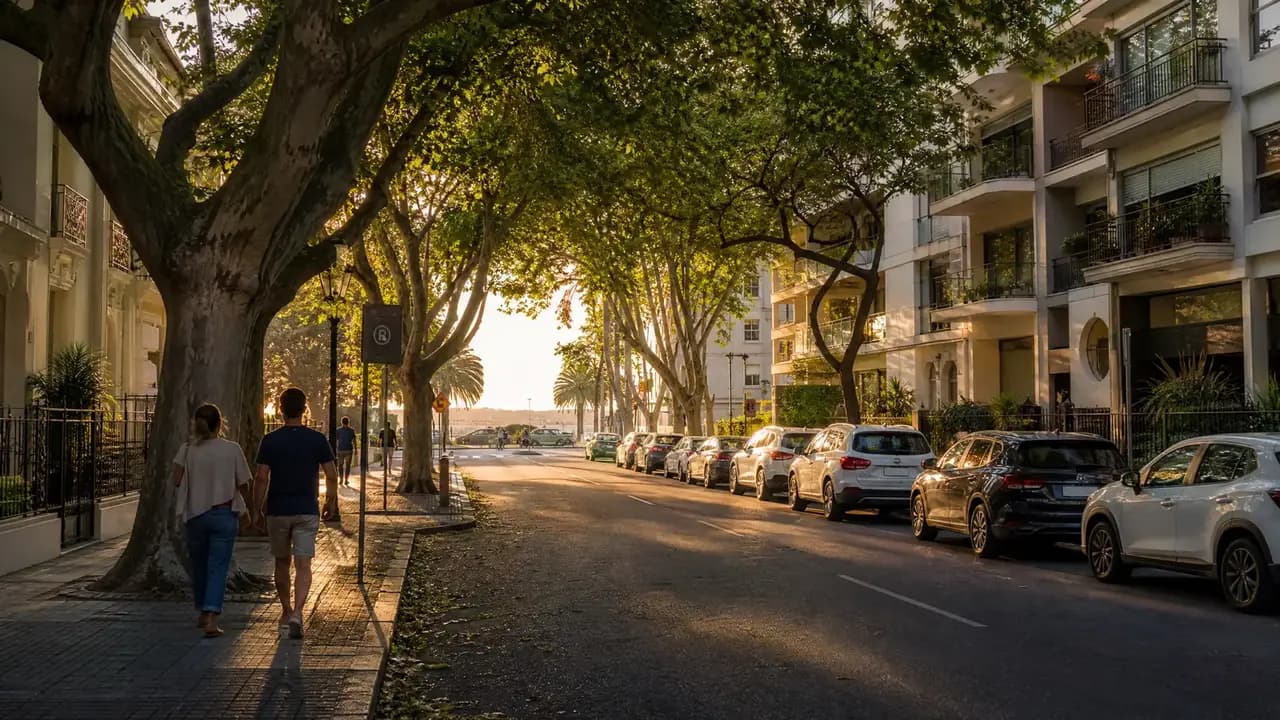
In Montevideo, as in any big city, it all comes down to the neighbourhood, only more so. Foreigners' lives play out along a coastal strip about 16 kilometres long: Pocitos, Punta Carretas, Parque Rodó, Buceo, Malvín and upmarket Carrasco, plus the old town by day. This strip is well lit, busy, patrolled and safe by any reasonable standard; people jog along the Rambla well into the evening. The Canadian government, which tends to err on the side of caution, names the critical neighbourhoods plainly: Casavalle, Cerro, La Teja, Marconi, Tres Ombúes, Hipódromo, Malvín Norte and Villa Española, all in the north and west of the city. There, in police district Seccional 24 in the west, the murder rate reaches 57.5 per 100,000, while along the coastal strip it is a fraction of that. You have no reason ever to enter these neighbourhoods, and geographically they are far from anywhere you would live, work or invest. The old town (Ciudad Vieja) is a special case: worth seeing by day, empty and uncomfortable after 10 pm, as is the area around the Tres Cruces bus terminal at night.
The everyday rules are the same as everywhere on the continent: do not hold your phone openly on the big avenues, leave nothing visible in the car, not even in Carrasco, and take an Uber at night rather than walking through empty streets. Do that, and you will live more easily in Montevideo than in many big cities back home, and in Punta del Este, Colonia or the interior the risk drops further still.
The organised crime that has changed the country
Now the big, uncomfortable part that the sunshine videos leave out. Over the last fifteen years Uruguay has become a cocaine hub for Europe. The route runs from Bolivia and Paraguay down the rivers to the port of Montevideo, and from there by container to Hamburg, Antwerp and Rotterdam. The figures are documented: in 2019, four and a half tonnes of cocaine shipped from Montevideo were seized in Hamburg, and further record seizures followed in Barcelona, Rotterdam and Hamburg again. Interpol estimates that 80 to 85% of shipments get through undetected.
The face of this development is Sebastián Marset, a Uruguayan from Montevideo who presented himself as a music producer and professional footballer and, in the background, built up the Primer Cartel Uruguayo, which according to US investigators smuggled at least 16 tonnes of cocaine to Europe. His story shows how deep the problem reaches into the state: arrested in Dubai in 2021 with a false passport, he received a genuine Uruguayan passport while in custody, handed over through Uruguay's own embassy, a scandal that in 2023 cost the foreign minister and other senior officials their posts. Only on 13 March 2026 was Marset caught in Bolivia and promptly extradited to the United States. Then there is the case of the Calabrian 'Ndrangheta boss Rocco Morabito, who lived undisturbed in Punta del Este for 13 years and escaped in 2019 through a hole in the prison roof. In 2025 Interior Minister Carlos Negro spoke openly of "epidemic" murder rates, and in polls insecurity, at 38%, has become Uruguayans' biggest concern, ahead of the economy.
Why am I telling you all this if the violence hardly affects you directly? For two reasons. First, because the same advisers who sell you Uruguay as simply the Switzerland of South America keep half the picture from you, and I am a realist, not a salesman. Second, because there is a crucial difference from countries such as Paraguay: in Uruguay the state is visibly fighting back. After the attack on Ferrero, government and opposition stood together within hours, several of those involved were caught and charged within a few weeks, a money laundering reform is on its way, and the port has new scanners. The institutions are under pressure, but they work. That is the difference between a country with a crime problem and a captured state.
Political stability: the most boring chapter, thankfully
For Uruguay, this is the quickest part to tell, and that is exactly its value. Peaceful transfers of power between camps, most recently in 2025 from the centre-right government of Lacalle Pou to the left-wing Frente Amplio government under Yamandú Orsi, without expropriations, capital controls or constitutional coups even being discussed. Independent courts, a free press, a functioning administration. Demonstrations are generally peaceful. For wealthy people looking for a predictable legal framework in the region, Uruguay remains the first choice, and no reform of recent years, not even the 2026 tax reform, was designed to be retroactive or confiscatory.
Natural hazards: the smallest problem
In terms of nature, Uruguay is benign: no earthquakes, no volcanoes, no hurricanes. The real issues are storms, flooding and droughts: the pampero sweeps across the coast in winter with violent gusts, heavy rain floods low-lying neighbourhoods, and the once-in-a-century drought of 2022 to 2023 pushed Montevideo's drinking water reserves to the limit, until the tap water at times tasted brackish. These are factors you can plan for: choose your location with the flood maps in mind, and look for a solidly built house that keeps out wind and damp. That is all. Anyone used to European storms and floods will find nothing new to fear here.
What this means in practice
Here is what to do. Choose the coastal strip: Pocitos, Punta Carretas, Malvín, Carrasco, or go straight to Punta del Este, Colonia and the interior. Avoid Montevideo's north-western periphery and the old town at night. Stick to the everyday rules against phone snatching and car break-ins. And put the headlines in perspective: the narco violence is real and it shapes politics, but it plays out in a world that does not touch yours as a newcomer, as long as you choose your home and surroundings deliberately. These questions of location, and the weighing of Uruguay against its neighbours, are exactly what I go through with my clients before they decide.
If Uruguay is on your list, let's talk honestly about the right place to live and how much security you need. You can book a conversation with me using the link below.
👉 Book a consultation with Harley
Carpe Diem. Life is short and fleeting. One shot. Make it count.