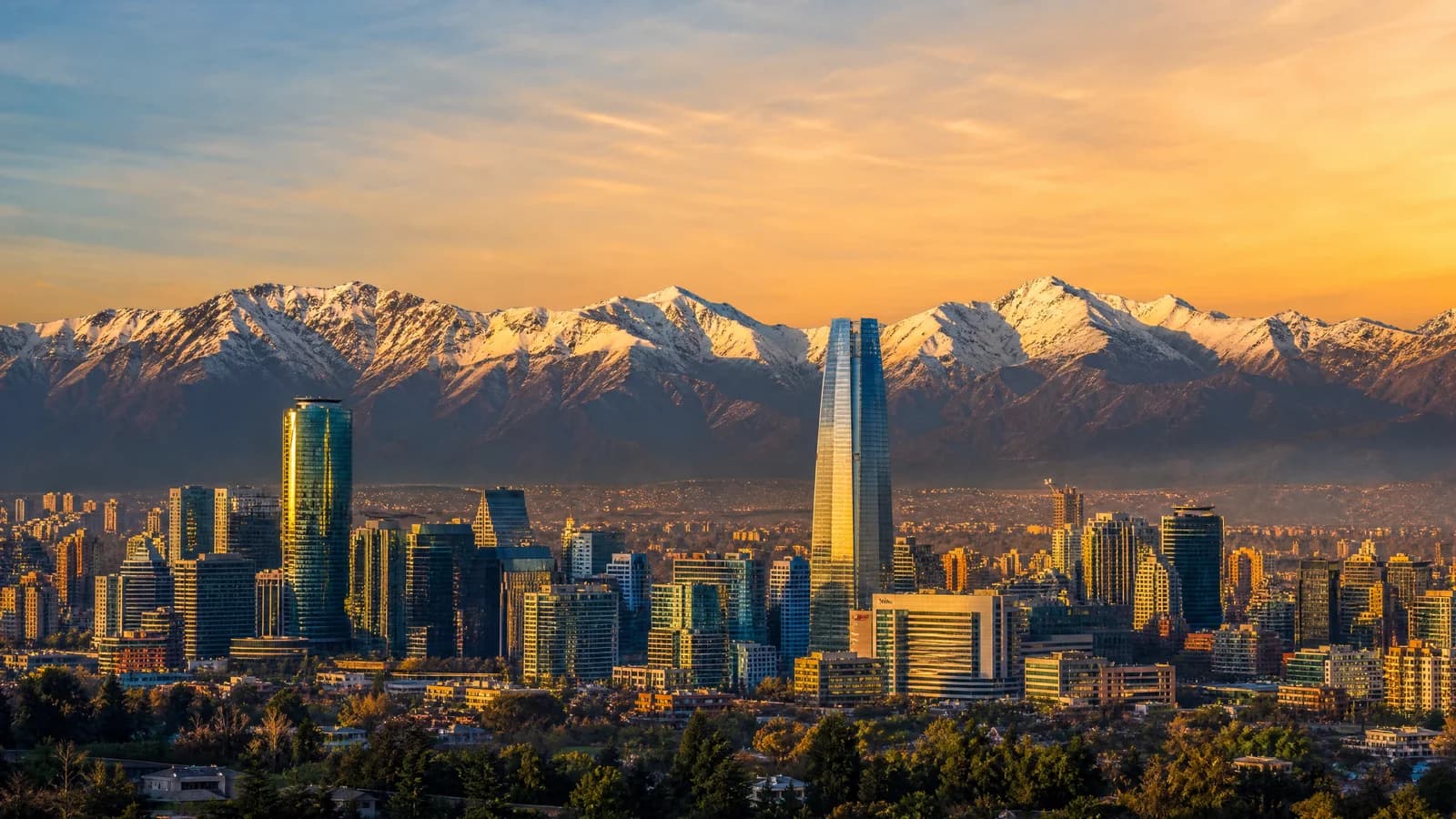

Chile has the only passport in Latin America with ESTA access to the United States, first-world infrastructure and a tax regime built for newcomers. Here is what it really costs you, explained honestly.
If Latin America had a first class, Chile would be sitting in the front row. It is the country that tops almost every ranking in the region: income per head, legal certainty, infrastructure. Chile is a member of the OECD, the exclusive club of developed economies, and you notice it everywhere, from the roads to the government offices. But Chile's real treasure is its passport, and surprisingly few people talk about it, even though it is genuinely one of a kind.
The golden key to the United States
Chile is the only country in Latin America whose citizens can travel to the US without a conventional visa. Under the US Visa Waiver Program a simple ESTA registration is enough, and a Chilean walks straight in, where Argentines, Brazilians and everyone else in the region have to go through a regular visa. On top of that, the Chilean passport gives visa-free access to the Schengen Area, Canada, Japan and much of the world, around 175 destinations in total, and it ranks in the Henley Passport Index as the strongest passport in the region, at around 13th place worldwide. For anyone who regularly needs to get into the world's largest economy, for business or for family, this passport is simply in a league of its own.
The tax regime for newcomers
In principle Chile taxes its tax residents on their worldwide income, but with a remarkable exception for new arrivals. When you become resident, your foreign income is exempt, initially for three years, extendable on application to the tax authority (SII) to six years in total. During that window, foreign dividends, capital gains, rents and pensions stay outside Chile's reach, and only income from Chilean sources is taxed. After that, the regular system applies, with progressive rates of up to around 40%, so get to know the basics of the tax system before you decide. As a rule you become tax resident after 183 days in the country. A welcome side note: Chile has no general wealth tax, only a special levy on certain luxury goods. Six years of tax holiday is shorter than Uruguay's eleven, but the entry bar is more forgiving and the country is first-rate in every other respect.
The route: residence and naturalisation
Legally, everything runs through the modern Migration Law 21.325 of 2022 and the online platform of the migration service, SERMIG. The usual route is temporary residence of up to two years, with different categories depending on your profile: the Rentista for people with passive income, the Jubilado for retirees, or the investor category from around USD 500,000. Then comes permanent residence (the Residencia Definitiva), and after five years of legal residence, counted from the stamp of the temporary residence that led to it, naturalisation opens up. Chilean citizenship allows dual citizenship on Chile's side, so Chile does not ask you to give up your existing one, and the naturalisation test is a conversation in Spanish, not a written exam.
The price: putting down real roots
Chile is not a country for a paper residence you never use. It is built for people who genuinely put down roots. The strong passport comes after five years, and the road there requires that you actually live there, build something during the tax-exempt years and settle in. The presence rules are no formality: during temporary residence, more than two months abroad pushes back your permanent residence, and once you hold it, more than two years away in one stretch costs you the status. On top of that, the cost of living is higher than in the cheaper neighbouring countries, and Santiago is closer to European levels than to Paraguayan ones. Chile is not selling you a cheap second residence, but a world-class new home, and it asks for the commitment that goes with it.
Safety and daily life
A word on safety, because it is often misjudged. Chile counts as one of the safest countries in the region, and the Santiago neighbourhoods popular with expats, Providencia, Las Condes, Vitacura and Ñuñoa, are quiet around the clock. As in any big city, normal caution applies in the centre and at night, and the coastal towns and the Lake District in the south are mostly relaxed. Chile does have real natural hazards, though: the country sits on the Pacific Ring of Fire, earthquakes are part of life, and modern building standards and emergency plans are not a luxury here but the norm. If you know how to live with that, you live in Chile as safely and comfortably as in southern Europe.
Common mistakes I see
I see three pitfalls with Chile again and again. First, crossing the 183-day line by accident and becoming tax resident before your structure is in place: if you want to make the most of the exemption, count your days carefully. Second, forgetting to extend the exemption from three to six years: it does not happen automatically, you have to apply to the tax authority. Third, underestimating the presence rules of temporary residence and pushing back the clock to permanent residence and naturalisation with long stays abroad. All three cost time or money, and all three can be avoided with careful planning from day one. Chile rewards people who go about it in a structured way and punishes those who improvise.
The cost of living, honestly
Chile is the most expensive of the classic Latin American relocation destinations, and that needs saying plainly. In Santiago, rents, groceries and services are closer to southern European levels than to Paraguayan ones. A single person lives comfortably in the capital on a monthly budget in the mid four figures in US dollars, depending on standards, and considerably cheaper in the regions and smaller towns. In return you get something the cheaper neighbours do not offer: reliable infrastructure, clean drinking water, good private clinics, functioning public offices and a banking system at developed-country level. When you run the numbers, do not judge Chile on rent alone, but on the whole package of quality, safety and passport value. If you are used to Western price levels anyway, the difference barely registers.
Chile compared with the region
Get Chile's place in the region right and you will make the right choice. Argentina and Paraguay grant residence faster and more cheaply. Uruguay offers the longer tax holiday, up to eleven years. Chile sits between those extremes, with the strongest institutions, the most transparent banking and company infrastructure and the most useful passport at the end of the road. If speed and low costs are your priority, you are better off elsewhere. If you put quality, legal certainty and ESTA access to the US first, Chile offers the most complete package in the region. It is the choice for people looking not for the cheapest new home, but for the best one.
The advantages at a glance
Chile's strengths are those of a developed country that happens to be in South America. The passport is the strongest in the region and the only one with ESTA access to the US as well as visa-free Schengen travel, a real boost to your mobility. The infrastructure is first-world: reliable power, fast internet, good roads, modern clinics. Chile is an OECD member, has the lowest corruption and the strongest institutions in South America and counts as safe by regional standards. For tax purposes newcomers get a window: foreign income gets favourable treatment for the first years before regular taxation applies. Add to that a solid healthcare system of public Fonasa and private Isapres, a high level of education and a geography that stretches from the Atacama Desert through Santiago and the wine regions to Patagonia. The full process is in the guide to moving to Chile, and the country overview is on the Chile country page.
The disadvantages, honestly
The price of this level is real. Chile is expensive: Santiago is one of the costliest cities in Latin America, and imported goods are especially steep. The newcomer tax window runs out: after that, Chile taxes your worldwide income, so it is not a permanent zero-tax solution and requires careful planning of the transition. The road to the strong passport is no fast track: naturalisation requires years of real roots and real presence, not a paper residence. Geographically Chile is far from everything: flights to Europe are long and expensive, and the time difference makes staying connected with home harder. The north is desert, the south rainy and cool, and Santiago suffers from smog in winter because of its basin location. The country is also earthquake-prone, centralised and bureaucratic, and the political situation has recently been more turbulent than the stable image suggests (constitutional debates, social protests). Without Spanish, a lot stays hard work. And moving to Chile does not, on its own, settle your tax position at home. What your home country still taxes when you leave, and whether an exit tax applies, depends on where you come from:
There is friction in daily life, too. The healthcare system is good, but the private Isapres are expensive and quickly become unaffordable in old age or with pre-existing conditions, while the public Fonasa means longer waiting times. The private pension system (AFP) has been under fire for years and is being restructured politically. The migration service is slow, residence procedures drag on for months, and in winter Santiago loses quality of life to smog and traffic. Rents and imported cars are at European levels. And anyone who romanticises the desert in the north or rough, rainy Patagonia in the south often underestimates how much real life is concentrated in the expensive, centralised capital region.
Who Chile is made for
Chile is the country for people who want the strongest passport in the region and its unique ESTA access to the US, and who are willing to actually live there for it. For people who put first-world infrastructure and legal certainty above the last dollar saved, and who use the tax-exempt years deliberately to put down roots and get their structure in order before worldwide taxation kicks in. It does not suit people who want to park a cheap backup with minimal presence: the region has leaner options for that. But for anyone looking for a genuine new home at world-class level, with the strongest set of keys on the continent, Chile is hard to beat.
This is exactly the trade-off, speed against quality, tax holiday against putting down roots, that I go through with my clients before they commit. I help you use the tax exemption correctly from day one, choose the right residence category and plan the presence rules so that you end up with the strongest passport in the region and not with a clock that has been reset. If Chile is on your list, let us take a clear-eyed look at it together. Book a call with me, the link is right below.
👉 Book a consultation with Harley
Carpe Diem. Life is short and fleeting. One shot. Make it count.