
Among the Latin American destinations, Chile has a special reputation: it is considered one of the safest and most stable countries in South America, with working institutions and low corruption. That assessment still holds, but it has developed cracks. I am a realist, not a salesman, and the honest 2026 version is this: Chile is safe by regional standards, but it is experiencing a noticeable rise in crime and a political change of course that responds to exactly that. Add to this a geological reality that no other destination in this series faces with the same intensity. In this article I therefore go through three things separately: the political and criminal security situation, which still compares well in the region; corruption, where Chile outperforms almost all its neighbours; and the natural hazards, which are Chile's real challenge.
The political change of course in 2026
To understand the current situation, you have to know the politics. On 14 December 2025 José Antonio Kast of the Republican Party won the presidential run-off with around 58% against the candidate Jeannette Jara, and on 11 March 2026 he succeeded Gabriel Boric. Kast built his campaign around a hard line on crime, a stricter migration policy and stronger public security, themes that resonated with broad groups of voters. Observers expect a clear shift of policy to the right, including stricter border controls, a tougher approach to irregular migration and lower corporate taxes. What matters for you as a foreign resident is that security and migration will remain the defining domestic issues of the coming years, and further tightening of migration law can be expected. Specifically, the new government has announced stricter border controls, the criminalisation of irregular entry and the construction of new prisons. For people who immigrate legally and properly, this changes little in substance; on the contrary, a country that puts more focus on its borders and its internal security may even become more attractive to safety-minded newcomers. What matters, though, is to handle your residence process properly and by the book from the very beginning, because in such a climate the administration tends to check more strictly and more closely. If you follow the rules and submit complete documents, you have nothing to fear; if you rely on grey zones, you risk more under the new line than before.
Crime: perception and reality
A closer look pays off here, because perception and statistics diverge. Chile is still one of the safer countries in the region, yet surveys show that around 63% of adult Chileans worry about the security situation, more than in Mexico or Colombia, for example, where actual crime is considerably higher. This gap is explained by a real rise in certain offences, starting from a low level, by the greater visibility of organised crime, and by immigration, whose share has recently risen to around 10% of the population, mostly from Venezuela, a country in crisis. For foreign residents, the practical upshot is this: Chile is not a dangerous country, but the days when it was seen as practically crime-free are over. The usual caution in big cities, keeping valuables out of sight, choosing busy routes at night and using verified ride services instead of hailing taxis, is advisable, but as a rule no more than that. A newer phenomenon shaping the public debate is the appearance of criminal gangs operating across borders, which are linked to the Venezuelan migration wave and whose suppression was a central campaign theme. The areas most affected are certain outlying districts of the big cities and some northern border regions, while the residential areas favoured by foreign residents are barely touched. In Chile, perceived insecurity is considerably greater than the actual danger, an important difference to keep in mind when you read the headlines.
What foreign ministries say
The UK Foreign Office (FCDO) does not advise against travel to any part of Chile, but its travel advice is more specific than the country's reputation suggests. It warns that pickpocketing, mugging and thefts from vehicles are very common throughout Chile, and that muggings in Santiago and Valparaíso increasingly involve weapons such as guns and knives. It also points to a risk of violent protest in Santiago and other cities, particularly on Friday afternoons and evenings, and to nationwide protests on significant dates such as 29 March, 1 May and 11 September. Even peaceful protests can turn violent and police use tear gas and water cannon, so keep well away from them. The social uprising that began on 18 October 2019 paralysed the country for weeks and triggered the subsequent constitutional process, which ultimately failed twice; proof that, for all its stability, Chilean society has deep social fault lines. In the Araucanía, Biobío and Los Ríos regions, according to the FCDO, individuals or groups claiming to represent indigenous communities have carried out attacks, mainly against state actors and businesses; behind this lies a long-running conflict over the land rights of the indigenous Mapuche. These areas are not off limits to foreign residents across the board, but they call for attention to the local situation. In the summer months there are also extensive forest and bush fires, about which the civil protection agency SENAPRED provides information. In dry years these fires can affect whole stretches of land and temporarily disrupt power, transport and communications, so if you live near forest or scrubland, plan for the seasonal fire risk and possible evacuation routes from the outset.
Corruption: Chile's great strength
One area where Chile clearly outperforms almost all its neighbours: together with Uruguay, Chile is among the least corrupt countries in Latin America and scores in the upper range of Transparency International's Corruption Perceptions Index, far above Mexico or Colombia and at a level more reminiscent of southern and central European countries. For context: while Mexico scores only around 26 and Colombia around 37 out of 100 points in the index, Chile sits well above them, in the range of the better-rated European states. For foreign residents this is a tangible everyday advantage: dealings with authorities, the police and business deals generally run without the everyday corruption that is a constant source of friction elsewhere in the region. Nobody asks you for money at government offices, police checks are conducted correctly, and contracts are enforced in court. Legal certainty and reliable institutions are one of the main reasons why many foreign residents prefer Chile to other Latin American countries despite its higher costs. This institutional quality also showed in the orderly, democratic way the most recent change of power took place: the outgoing president congratulated the winner and the handover went smoothly, something by no means taken for granted in the region, and a sign of Chile's democratic maturity.
Quality of life and everyday life
Beyond crime and natural hazards, Chile offers a high quality of life by Latin American standards. Healthcare in the cities is good, public life works reliably, and the mix of indigenous traditions and European, particularly German, influences shapes a distinctive, cosmopolitan culture. Chileans are known as hospitable and usually welcome newcomers warmly. Good food and wine matter a great deal, and shared meals are important social occasions. Quality of life varies considerably by region, though: Santiago offers the broadest cultural range, the south closeness to nature and a calmer pace, while everyday life as a whole involves a somewhat slower working pace and more flexible schedules than many newcomers from northern Europe or North America are used to. If you embrace that, you will find in Chile an environment that combines stability and zest for life in an unusual way.
Natural hazards: the real challenge
And now to the risk that really sets Chile apart from other destinations. Chile lies in one of the most seismically active zones on earth. Off the coast, the Nazca Plate is pushing beneath the South American Plate at around seven centimetres a year, which makes the country one of the most earthquake-prone in the world. The scale is historic: the strongest earthquake ever recorded struck near Valdivia on 22 May 1960, with a moment magnitude of 9.5, and triggered a tsunami with waves up to 25 metres high. On 27 February 2010 a magnitude 8.8 earthquake near Concepción destroyed around 1.5 million homes; in 2014 came a magnitude 8.1 earthquake near Iquique, and in 2015 a magnitude 8.3 earthquake near Illapel with another tsunami. Between 1950 and 2015 there were 28 earthquakes of magnitude 7 or more. Smaller, noticeable tremors are part of everyday life in Chile. For newcomers this takes some getting used to at first, but most foreign residents report that you adjust to the frequent light tremors over time, precisely because buildings are designed for them and Chileans themselves take them in their stride.
Then there are active volcanoes, including Villarrica and Calbuco, which erupted spectacularly in 2015, and the risk of tsunamis along the long Pacific coast. Chile counts nine active and potentially dangerous volcanoes, several of them in the popular Lake District in the south, where Puerto Varas and Frutillar lie within sight of the cones of Osorno and Calbuco. What decisively sets Chile apart from many other earthquake-prone countries, however, is that it has learned from its history and has world-leading seismic building standards, a good early warning system and well-practised tsunami evacuation routes along its coasts. Modern buildings in Chile are designed to withstand strong earthquakes, which is why even severe quakes there often claim comparatively few lives relative to their strength. The magnitude 8.8 earthquake of 2010, for example, despite its enormous force, claimed far fewer lives than the much weaker Haiti earthquake of the same year, direct proof of the value of good building codes. In practice: check the construction and the year of build of any property you buy or rent, familiarise yourself with your region's evacuation routes, and take the regular earthquake drills seriously. If you live near the coast, learn the tsunami warning signs and head for higher ground immediately in an emergency; if you live near forest, plan for the fire risk in summer. Good buildings and contents insurance with earthquake cover is a basic necessity in Chile, not an optional extra.
Where foreign residents live well
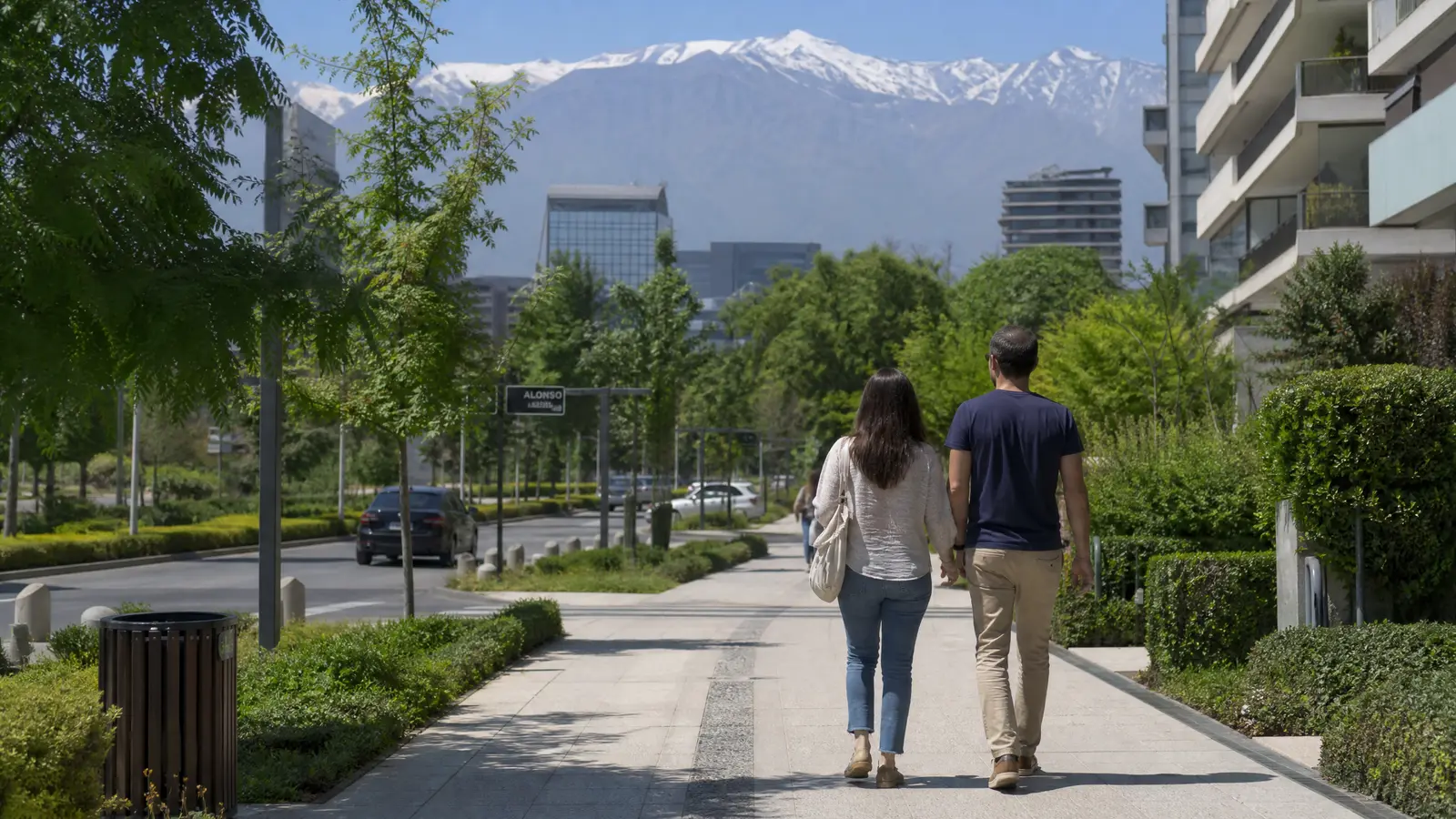
Taking the security situation, infrastructure and residents' experience together, a few favoured regions stand out: the well-kept neighbourhoods of Santiago such as Providencia, Las Condes or Ñuñoa, the coastal area around Viña del Mar, and above all the south shaped by German settlement around Valdivia, Puerto Varas, Frutillar and Puerto Octay, which combines a mild lake climate, a high quality of life and an established international community. These regions offer a very safe, European-feeling everyday life. If you avoid the Mapuche conflict zones of the deep Araucanía and certain outlying districts of the big cities, you will live in Chile as safely as almost anywhere else in Latin America. For orientation after arrival, it makes sense to move to one of these established regions, spend a few months developing your own feel for neighbourhoods and streets, and not forget to sign up for your home country's crisis registration service for citizens abroad, which many countries run, so that your embassy can contact you quickly in an emergency, whether a major earthquake or another crisis.
In the end the balance is clear: Chile's biggest safety issue is not crime, which remains moderate by regional standards, but geology, which can be managed well with the right construction and the right behaviour. Accept that, and you will find in Chile one of the most stable and liveable countries on the continent. Put differently: in most Latin American countries the biggest risk is people; in Chile it is nature, and nature follows predictable rules that you can prepare for with solid construction, insurance and preparation.
If you want to know which region suits your situation and how to weigh safety, natural hazards and everyday life realistically, talk it through with me before you commit.
👉 Book a consultation with Harley
Carpe Diem. Life is short and fleeting. One shot. Make it count.