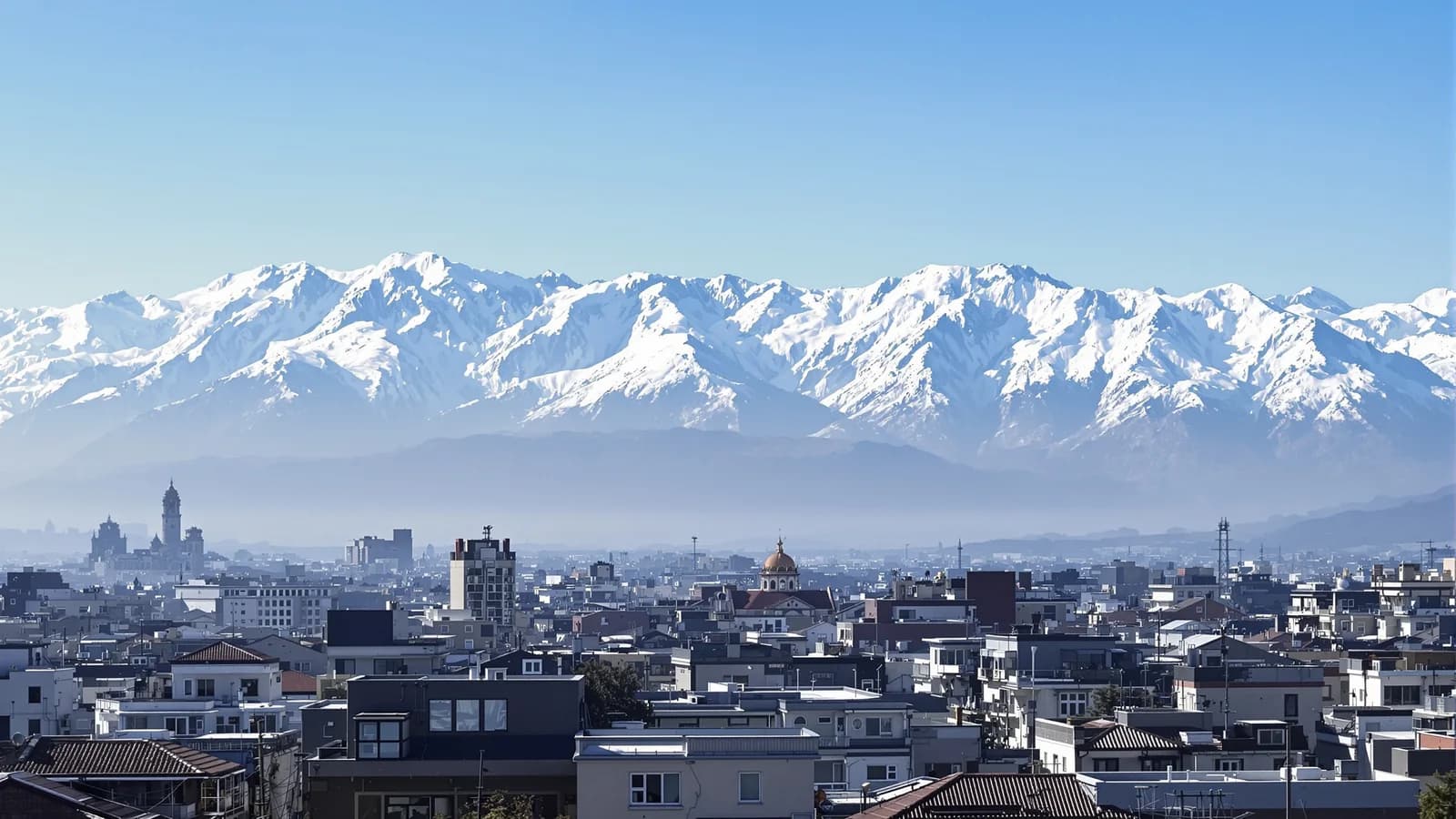

Chile is the special case among Latin America's relocation destinations. It was the first South American country to join the OECD, counts as one of the most developed and stable countries on the continent, and is at the same time the most expensive. I am not here to sell you anything, so here is my honest take: if you move to Chile, you trade the bargain prices of other Latin American countries for stability, functioning institutions and one of the biggest legal tax advantages any relocation destination in the world offers. Whether that trade is worth it for you is what this guide sets out to answer.
In 2026 Chile offers a unique tax advantage, a modern country with infrastructure that feels European, and spectacular geographical variety from the Atacama Desert in the north to the glaciers of Patagonia. At the same time, immigration is bureaucratically demanding, the cost of living is high by Latin American standards, and the country lies in one of the most seismically active zones on earth. A fair assessment has to cover all of that.
The tax advantage: up to six years almost tax-free
Let's start with what makes Chile so interesting for wealthy newcomers and entrepreneurs. For new arrivals, Chile applies a modified territorial system: in the first three years of residence, extendable to six, you pay no Chilean tax on foreign income. Worldwide income, capital gains, dividends and rental income from abroad stay tax-free during this window, even if you transfer them to Chile. Only Chilean-source income is taxed. Only once the window closes does the regular progressive income tax scale of 0 to 40% apply. For early retirees, entrepreneurs with foreign income and anyone looking for a planned, multi-year transition, that is a tangible advantage, which I break down in detail in the guide to the Chilean residence permit. One thing up front: Chile is still not a low-tax country; the advantage lies in the time-limited window, not in permanently low rates. For comparison: at company level, corporate tax is 27%, and 12.5% for small and medium-sized companies in the preferential regime, and Chile has no general capital gains tax; capital gains and dividends are taxed at your personal income tax rate. The exception: gains on listed shares that meet the stock-market presence test still carry a one-off 10% tax in 2026 and become tax-free from 1 January 2027 under Law 21.850. If you use the window cleverly, you can legally realise considerable amounts tax-free in the first years, for example by selling foreign assets or restructuring portfolios, which is why careful timing of this window almost always pays off.
The visa system: Ley 21.325 and SERMIG
Since 12 February 2022 Chile has had a fundamentally reformed immigration law, Ley 21.325, administered by the National Migration Service, SERMIG (Servicio Nacional de Migraciones). Most Western passport holders enter visa-free for tourist stays of up to 90 days. For anything longer you need a residencia temporal, which comes in several forms: for employees with a contract, for retirees and people with passive income (the rentista visa), for investors and entrepreneurs, for students, and for the dependants of people already resident. As a rough financial guide, a monthly income of around EUR 600 is often quoted as proof of sufficient means, but the exact amount depends on the visa category and family size and should be checked for your own case before you apply.
There is one central point you need to understand early, because it shapes the whole process: the new law generally no longer allows you to enter as a tourist and then apply for a residence visa locally. Most visas must be applied for from abroad before entry, through Chilean consulates or the SERMIG online system. If you arrive as a tourist hoping to convert your status later, you will run into this rule. After the temporary stay, and once you meet the requirements, usually after two years on temporary status, you can apply for the residencia definitiva, the permanent residence permit. After five years of residence, with the time on temporary status counting, the path to citizenship opens; more on that in my guide to Chilean citizenship. Incidentally, the permanent residence permit lapses after more than two years of continuous absence, with a one-off extension of a further two years through a Chilean consulate (applied for 60 days before the deadline), a point internationally mobile residents should keep in mind.
After arrival you register with the civil registry (Servicio de Registro Civil e Identificación) and receive your RUN (Rol Único Nacional), the Chilean identification number you need for almost every everyday transaction, from a bank account to a mobile phone contract.
Working in Chile
Chile's economy is strong but specialised: the country is the world's largest copper producer, plus agriculture, wine, forestry, fish farming and a growing services sector. For foreigners, however, finding a job is not easy. Specialised professionals have the best chances, but salaries are well below Western European levels, and without solid Spanish the job search becomes difficult. If you work as an employee, you are a residente sujeto a contrato and need an employment contract; the status extends to your spouse and children. The standard working week is 45 hours and is being reduced gradually to 40 hours by 2028. For most people moving from abroad, the rule that holds across Latin America applies here too: if your income is location-independent or comes from abroad, you start from a far more comfortable position than someone who has to live on a local salary. If you work remotely for a foreign employer, you need the matching visa category; a simple tourist entry does not cover it. A practical note on recognition: if you want to work in a regulated profession such as medicine, law or engineering, you need to have your foreign qualifications recognised in Chile, a process that runs through the University of Chile or bilateral agreements and takes some time.
Cost of living: the most expensive country in the region
This is the biggest surprise for many newcomers. By Latin American standards, Chile is not a cheap country but one of the most expensive. In Santiago many prices are already at Western European levels. A one-bedroom flat in Santiago costs roughly EUR 400 to 600 a month, EUR 200 to 400 in smaller cities. Food is cheaper in principle, imported products expensive, and in rural regions long transport routes can even push food prices up. A factor many underestimate: Chile has a higher inflation rate than most European countries, which can erode the purchasing power of savings and pensions over time. Public transport, simple restaurants and bus travel, on the other hand, are much cheaper than in Western Europe, so with a local lifestyle you can save noticeably in Chile too. But if you keep up a fully Western consumer standard with lots of imported products, you will end up paying about as much as in Europe.
Regions and the European trail in the south
Santiago is the urban centre, with more than six million people in the metropolitan region, modern infrastructure, the biggest job market and the widest cultural offering, but also the heaviest traffic and the worst air pollution in winter. The coast around Valparaíso and Viña del Mar offers the sea and a mild climate. The south around Valdivia, Osorno, Puerto Montt, Puerto Octay and Frutillar is especially appealing to many Europeans, because the traces of 19th-century German immigration are still visible here, from the architecture and the food to clubs and schools. The north with the Atacama Desert is dry, sunny and thinly populated; the far south with Patagonia is spectacular but rough and remote. This enormous north-south stretch of around 4,300 kilometres means you can choose almost freely between desert, a Mediterranean central valley, the rainy lake district and sub-polar Patagonia. German immigration to Chile has a long history: it gathered pace from the middle of the 19th century, when the Chilean government deliberately brought German settlers into the then sparsely populated south. The result still shapes the region today: places such as Frutillar with its music festival, Puerto Varas at the foot of the Osorno and Calbuco volcanoes, or Valdivia with its brewing tradition feel familiar to many Europeans and make arriving considerably easier.
The downsides, honestly
I would rather list what really grates than idealise Chile. Bureaucracy and the strict immigration law are the most common source of frustration: documents must be precisely translated, apostilled and complete, and if an application has gaps you often have only 10 to 60 days to fix them, otherwise the whole application is deleted from the system and has to be started again. The fact that most visas must be applied for from abroad makes planning even more demanding. The high cost of living and inflation put the supposed Latin American price advantage into perspective. The language barrier is real: without Spanish, daily life is hard work. Natural hazards, above all earthquakes, are part of life in Chile, covered in detail in my Chile safety article. And the rise in crime in the urban areas is an issue that has kept Chilean politics busy recently. If you know these points in advance and plan for them, you will have fewer nasty surprises. Another often underestimated drawback is distance: Chile is at the other end of the world, there are only a few direct flights to Europe, and a flight time of around 14 to 15 hours makes spontaneous visits home expensive and time-consuming.
Homeschooling, schools and family
If you come with children, you will find good German and international schools in Santiago and in the south, for example the German schools (Colegios Alemanes) in Santiago, Valparaíso, Concepción, Valdivia and other cities. If you are considering homeschooling instead: homeschooling and unschooling are possible in Chile. Children can be taught at home and have their education validated through the state examinations, the exámenes libres, at the Ministry of Education, which keeps the way open to secondary schools and universities. Clarify the exact handling with the local education authority, as requirements can change. You can bring pets to Chile with the required vaccinations, a veterinary health certificate and timely registration; I cover the detailed entry rules separately. Overall Chile counts as a family-friendly country where family values and shared meals matter a great deal, which makes social integration easier for many families who move there.
Banking, digital infrastructure and insurance
You need a Chilean bank account for rent, salary and daily life, and opening one usually requires the RUN and a residence permit. The digital infrastructure is very good by Latin American standards, with fast internet, good mobile coverage and growing 5G coverage in the cities, a subject I will cover separately. For health insurance you choose between the public system, FONASA, and the private insurers, the ISAPRE; for most newcomers private or international cover makes sense, and you have to prove adequate health cover for the residence permit anyway. Chile has also implemented the automatic exchange of information under the OECD's Common Reporting Standard (CRS), which matters for planning your bank accounts and asset structure and is one more reason to prepare the move properly from a tax point of view. Moving to Chile does not, on its own, end your tax residence at home; what your home country keeps taxing depends on where you come from:
Who Chile suits
Chile is a particularly good fit for people who put stability, functioning institutions and a high degree of legal certainty above pure price advantage, who can benefit from the multi-year tax window, and who want a country with a European-feeling daily life combined with spectacular nature. Chile is less suitable for anyone mainly looking for a cheap country, or who would have to build a local income without Spanish and without location-independent earnings. For people who need to be close to Europe and visit home often, Chile is also rather impractical, with a flight time of around 14 to 15 hours and few direct connections. But if you are prepared to engage with a more demanding yet stable and legally secure environment, you will find in Chile the destination that comes closest to European standards in terms of institutions, infrastructure and predictability.
If you want to build a realistic roadmap for your move to Chile now, from choosing the right visa and using the tax window to picking a region, let's talk before you sign the first contracts.
👉 Book a consultation with Harley
Carpe Diem. Life is short and fleeting. One shot. Make it count.