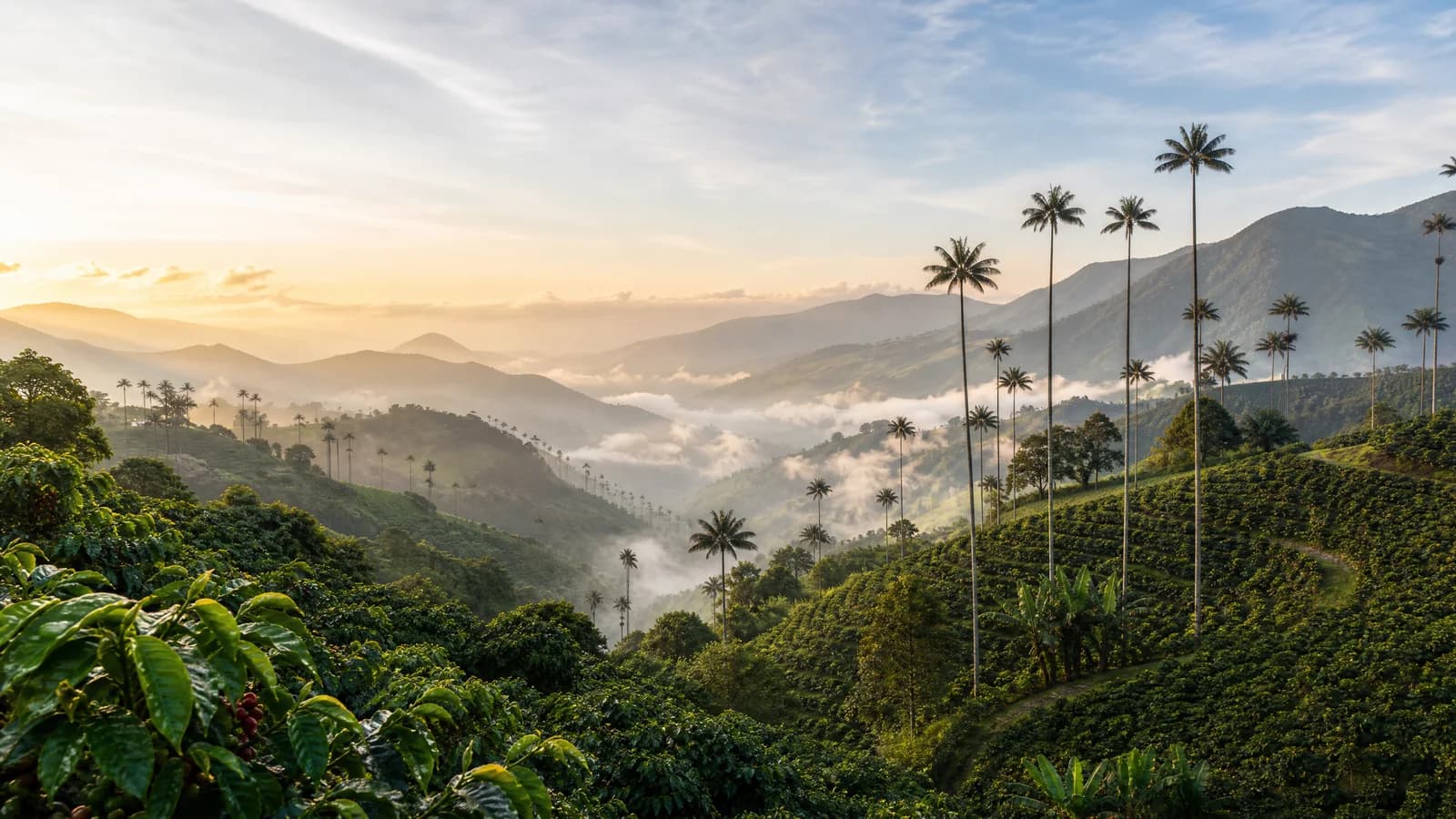

Colombia tempts people with a mild climate, low costs and the coffee region around Pereira. Why it is not a tax haven, and why it is still the right choice for many.
Hardly any country has changed its reputation as much over the past twenty years as Colombia. Where headlines once frightened people, a growing community of expats now moves here, drawn by something very down to earth: an excellent ratio of quality of life to cost. Spring-like weather all year, warm people, and in the coffee region around Pereira a landscape that takes your breath away. Today Colombia is one of the most exciting places on the continent to move to, and the real question is not whether it is beautiful, but who it actually pays off for.
Not a tax haven, and you need to know that
Let us say it clearly and early: Colombia is not a territorial tax country. It taxes its tax residents on their worldwide income, progressively, with a top rate of 39%, well above anything the territorial countries of the region charge. In principle you become tax resident after 183 days in the country within any 365-day period. On top of that there is a wealth tax on large fortunes, which only applies above a high threshold and rarely affects the ordinary person relocating, but it exists and has to stay on your radar. Whether a tax treaty protects the income you still have at home depends on where you come from:
In other words: if you move to Colombia and really live there, you bring worldwide taxation into your life. Like Brazil, Peru and Argentina, Colombia is a country to live in, not one for quietly saving tax. If you are looking for a zero-tax base, you are simply in the wrong place, which is why you should know the honest overview of the tax landscape before you go.
What Colombia stands for instead
If not tax, then what? The answer is a whole list of very tangible things. There are the low living costs, which let you enjoy a noticeably higher standard of living on a European or North American income. There is the mild climate of the highlands, which means eternal spring: Medellín carries the nickname "City of Eternal Spring" for good reason. There is the location, with short trips to North and Central America and to the Caribbean. And there is the coffee region, the Eje Cafetero around Pereira, Manizales and Armenia, with its green slopes, its calm and a way of life that enchants many people instantly. If you live on a pension or a foreign income, the same amount turns into a noticeably richer everyday life here. Then there is the human side, which many underestimate: Colombians are known as particularly warm and open, integration is easier than in some cooler parts of the world, and if you bring a little Spanish, you will be welcomed quickly. It is this mix of purchasing power, climate and warmth that turns visitors into people who stay.
The way in
In practice, the way in runs through the Colombian visa system with its migrant and resident categories, administered by the authority Migración Colombia. For people relocating, the most relevant are the retiree visa for people drawing a pension, the investor visa through a property or business investment, and the popular digital nomad visa with a low income threshold. After five years with migrant status (M visa), the route opens to permanent residence (R visa) and, five years after that, to naturalisation, about ten years in total, with a passport that travels solidly. A point for tax planners: the digital nomad visa does not by itself make you tax resident; that is decided purely by the 183-day rule.
Security: an honest assessment
The old reputation still clings to Colombia, but the reality is more nuanced. The popular expat cities, Medellín with its upmarket neighbourhoods El Poblado and Laureles, the quiet coffee region, the small colonial towns, are perfectly liveable if you choose wisely and bring big-city common sense. At the same time, Colombia remains a country with real security issues: there are neighbourhoods and regions you avoid, and widespread street crime and scams demand attention. The continent's rule of thumb applies: risk is concentrated, not everywhere. If you choose your neighbourhood deliberately and learn the local rules, you live considerably more safely than the headlines suggest.
The cost calculation, in concrete terms
Let us talk about the real trump card: costs. Colombia is one of the cheaper countries in the region, and on a solid pension or foreign income you live here at a level that would be out of reach in Western Europe or North America. Rent, domestic help, fresh food, restaurants and basic medical care are well below European levels. In the upmarket neighbourhoods of the big cities you can have Western comfort and still pay a fraction. That is why so many stay: it is not the tax that attracts them, but the purchasing power. If you barely get by on USD 2,500 to 3,000 a month at home, you lead a very comfortable life in Medellín or Pereira.
The cities at a glance
So where to go? Medellín is the magnet, with eternal spring, modern infrastructure and the popular neighbourhoods El Poblado and Laureles, the most international choice. The coffee region around Pereira, Manizales and Armenia offers the same mild mountain air in quieter, greener surroundings, ideal if you prefer nature to the metropolis. Bogotá, the capital, is cooler, higher and busier, with the widest choice but also the most hectic everyday life. And Cartagena on the Caribbean coast stands for colonial charm and warmth, but it is humid and more touristy. For most people relocating, the road leads to Medellín or the coffee region, both regions that combine climate, costs and way of life most happily.
Common mistakes I see
Two misconceptions come up again and again. First, seeing Colombia as a tax-saving model: because of worldwide taxation, that leads straight to disappointment. Second, overlooking the 183-day rule and becoming tax resident by accident: if you do not want that, you have to count your days in the country carefully, not estimate them. If you keep both in view from the start, you get Colombia's advantages, the purchasing power, the climate, the zest for life, without underestimating the tax downside.
Colombia compared with the region
Let us put Colombia in context. On tax, it sits with Brazil, Peru and Argentina in the group of worldwide-income countries, clearly behind territorial states such as Paraguay or Panama if saving tax is all that matters. The Colombian passport sits in the solid middle of the region, stronger than the Paraguayan one, weaker than the Chilean one with its ESTA access. Where Colombia is almost unrivalled, however, is the ratio of quality of life, climate and costs. No other country in the region combines eternal spring, warm people and low prices as convincingly as the Colombian highlands. Colombia does not win the tax table, but it often wins the heart, and for a great many people relocating, that is the currency that decides in the end.
The advantages at a glance
Colombia's strengths lie in everyday life, not in the tax table. First comes the climate: Medellín and the coffee region offer a mild, spring-like climate all year round at altitude, without air conditioning and without extremes. Then there are low living costs, which allow a good life for a fraction of Western European prices, and an accessible visa system: the digital nomad visa with a low income threshold, the retiree visa and the investor visa open the way in. Only the migrant visas such as retiree and investor lead to naturalisation: after five years to the resident visa and from there, after another five years, to the passport, about ten years in total; the digital nomad visa does not count towards it. The way of life is warm and open, and the cities are more modern and international than the old image suggests; many consider Medellín the most pleasant big city in the region. Good private clinics in the major cities, spectacular nature and a growing international community round off the picture. Where climate, costs and security combine best is covered in the Colombia safety check, and the country overview is on the Colombia country page.
The disadvantages, plainly stated
Two points have to be on the table. First: Colombia is not a tax haven. If you become tax resident under the 183-day rule, you pay tax on your worldwide income, at progressive rates reaching into the high range, and the digital nomad visa alone does not automatically protect you from that. If you are looking for tax exemption on foreign income, you are better off in a territorial country such as Paraguay or Panama. Second: security remains a real issue. In the middle-class neighbourhoods of Medellín, Bogotá and the coffee region you live peacefully with the usual precautions, but the situation varies greatly by region, and the principle no dar papaya (don't give anyone the opportunity) has to become second nature. Then there is the language barrier without Spanish, a bureaucracy that demands patience, the distance to Europe and the altitude of Bogotá, which not everyone gets used to. Moving to Colombia does not, on its own, end your tax residence at home, and what leaving costs you depends on the country you come from:
There are also smaller but real points of friction. The tax burden for residents, with an additional wealth tax and progressive rates, is not a side issue but calls for real planning before you pass the 183 days. Medical care is good in Medellín and Bogotá, but quickly thins out outside the big cities, so private cover is a must. The political direction has shifted recently, and reforms in tax and healthcare create uncertainty you should keep an eye on. And as tempting as the eternal spring air is, the tropical lowlands and the Caribbean coast are hot and humid, while the altitude of Bogotá affects some people's circulation and sleep. None of this rules Colombia out, but all of it should be part of a realistic calculation.
Who Colombia is made for
Colombia is the country for people who really want to live there, who put climate, costs and quality of life above their tax rate. For the retiree whose pension lets them live like royalty here. For the family or the free spirit looking for a warm, welcoming, affordable home who accepts worldwide taxation as part of the price. It does not suit the location-independent entrepreneur who mainly wants to cut taxes; they are better off in a territorial country such as Paraguay. But for anyone looking for a life and not just a structure, Colombia can be the most beautiful promise in the region.
This exact fit, quality of life against tax burden, is what I review with my clients before they decide. If Colombia is calling you, let us run the numbers properly. Book a conversation with me; the link is right below.
👉 Book a consultation with Harley
Carpe Diem. Life is short and fleeting. One shot. Make it count.