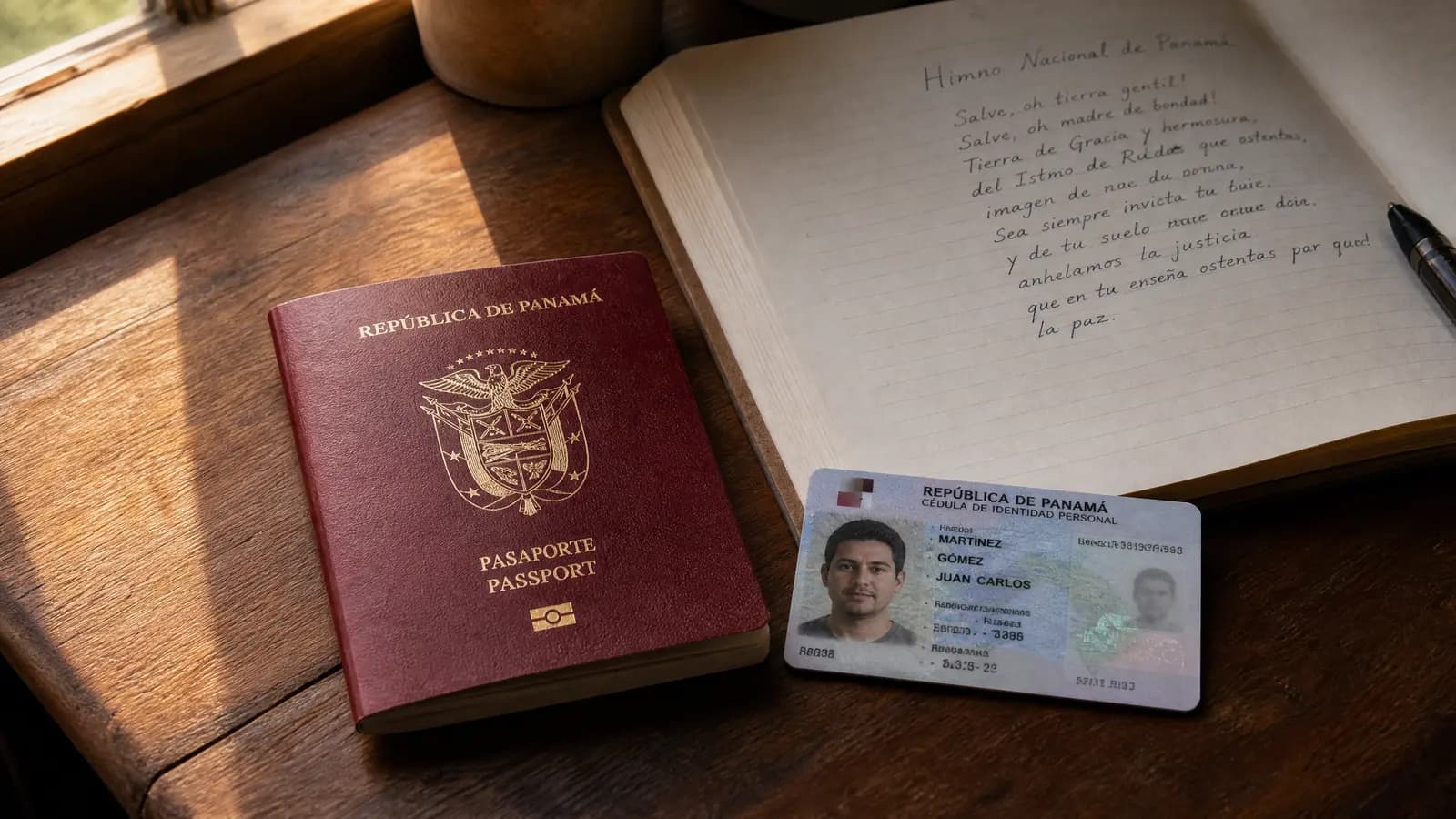

Panama requires everyone who naturalises to swear a solemn oath before the governor renouncing their previous citizenship. And yet thousands of naturalised dual nationals live in Panama, entirely legally from the point of view of their home countries. How those two facts fit together is the most important question of this article, and the answer decides whether the Panamanian passport is a gain or a risk for you. First, why the question is worth asking at all: in 2026 the Panamanian passport stands at 26th place on the Henley Passport Index, its best position in two decades, with visa-free or simplified access to around 148 destinations, including the entire Schengen Area, the United Kingdom, Japan and Brazil. I will take the procedure, the exam, the oath and the consequences for your home passport apart honestly, because more half-truths circulate online on this than on almost any other migration topic.
The requirements: five years, and a reciprocity shortcut
The standard route under Article 10 of the Constitution and Decree 3/2008: five years of uninterrupted permanent residence with the Cédula E, counted from the grant of permanent residencia, not from your first entry, a detail that lengthens the effective waiting time. For Spaniards and Latin Americans there is a reciprocity route, with the time limits their countries grant to Panamanians. In every case, the following also apply: proof of economic solvency, a clean criminal record, mandatory representation by a lawyer, and, something almost all Plan B thinkers underestimate: permanent residence on paper alone is not enough, you must show genuine ties and actual presence. Anyone who holds permanent residencia only as a dormant Plan B and flies in briefly every two years meets the rules of immigration law, but not the expectations of the naturalisation procedure; experienced law firms therefore advise substantial presence, property in the country, economic activity and a demonstrable local tax history.
The exam: anthem by heart, a hundred questions, a judge
Panama does not give its passport away; it tests for it seriously, unlike Paraguay, for example. After filing comes an interview in Spanish with the immigration authority, then the actual exam at the Tribunal Electoral: a written part with 100 multiple-choice questions on Panama's history, geography and state organisation, plus an oral exam before a judge who assesses Spanish and integration. And the trap of recent exam rounds, which a surprising number of candidates fall into: candidates had to recite the national anthem and the pledge to the flag by heart, and anyone who had not prepared for that failed, however well the written part went. Overall the level is manageable: if you have really lived in the country for five years, learned Spanish and prepared, you usually pass at the first attempt. But it is a real citizenship exam with a failure rate, not a form you fill in on the side.
The long march through the institutions
Now the part that sets Panama apart from its neighbours and the reason why I adjust my clients' expectations early and honestly. After the exam is passed, the file moves through several bodies, the immigration authority, the electoral tribunal and the governor's office, and at the end of the chain the President of the Republic decides personally by signing the Carta de Naturaleza. Each of these bodies can ask for more documents, delay or refuse, and there is no enforceable legal right to the presidential signature; it is a political act of discretion. Realistic timelines: 12 to 24 months in cases that go well, but law firms with long experience honestly speak of up to five years until the Carta is issued, depending on the political climate; under some governments the signatures piled up for years because no president wanted to make himself politically vulnerable over naturalisations. Total costs, depending on the law firm, are around USD 4,000 to USD 7,500. After the presidential signature come the swearing-in before the governor, entry in the civil register, the new Cédula N and finally the passport.
The oath, and what it really means for your old passport
Which brings us back to the opening question, the most misunderstood point of the whole topic, where I clear up a stubborn error. De jure, Panama requires naturalised citizens to renounce: you swear before the governor to give up your civil and political ties to your country of origin. De facto, however, the position is what experienced Panamanian law firms say quite openly: renouncing before a Panamanian authority does not mean that you actually lose your previous nationality, because whether a passport lapses is decided solely by the law of your home country, and that almost always requires its own formal procedure before its own authorities. Panama itself does not enforce the sworn renunciation and does not report it to your home country; Panamanians by birth may hold several passports without any problem anyway. In practice, that leaves three typical situations, depending on your home country:
Countries that allow multiple nationality and treat a renunciation as effective only if it is made formally before their own authorities: the oath sworn in Panama does not, by itself, trigger the loss. Your passport stays. Countries with no restriction on multiple nationality at all: your passport is unaffected. Countries where the voluntary acquisition of a foreign citizenship automatically leads to the loss of their own, regardless of what the Panamanian oath achieves in practice, unless you obtained a permit to keep it beforehand: if your country is one of these, settle this before you even file the application in Panama, otherwise you lose your passport without the Panamanian oath making any difference.
Two honest footnotes. First: the oath is a sworn declaration before an authority; how you personally deal with it is something to discuss beforehand with your lawyer in Panama and your adviser at home, not with a YouTube video. Second, the asymmetry of Article 13: as a naturalised Panamanian you can lose Panamanian citizenship again if you then take on a further foreign citizenship. Anyone building a whole passport portfolio therefore places Panama strategically at the end of the sequence, not in the middle.
Why five years in Panama take longer than elsewhere
A point I explain to my clients early, because it decides realistic planning: Panama's five-year period only starts with the granted permanent residencia, not with your first entry or the provisional permit. If you come through the Friendly Nations Visa, you first spend two years in provisional status before permanent residence is granted at all, and only from then does the naturalisation clock start ticking. In total, the nominal five years can thus become seven or more in reality before you are even allowed to apply, and the march through the institutions up to the presidential signature comes on top. That is not an argument against Panama, but it is the reason why I always plan backwards when the passport is the goal: if you want to naturalise in Panama at 60, you should not start residence at 58. This timeline, set out honestly, prevents the biggest disappointment this otherwise strong programme holds.
What the passport can do, and what it cannot
The reward for the long procedure is a genuinely world-class document: 26th place with around 148 destinations reachable visa-free or on arrival, including the whole Schengen Area, the United Kingdom (with an electronic ETA), Japan, Brazil and practically all of Latin America. The honest limits: for the US, Canada and China you still need a visa, and if US access is your main goal, Panama is not the way to solve it; other routes are. Then come full citizens' rights: voting, unrestricted land ownership even in the border zones closed to foreigners, access to the professions and offices barred to foreigners, and a home that can never again expel or extradite you.
The honest trade-off: a bonus, not a building block
Finally the assessment the passport seller will not give you, because it hurts his business. Panama's permanent residencia is so strong, so low-maintenance and so lasting that for most of my clients citizenship is the bonus on top, not the actual planning goal: it requires genuine presence and integration over years, it ultimately depends on a presidential signature without any legal entitlement, and it may take years longer than any brochure promises. If you primarily and predictably want a second passport, you get there faster and with less uncertainty with Argentina (two years on paper, although that rule is currently before the Supreme Court) or Paraguay (three years on permanent residence), as I show in the respective articles, among them the guide to Paraguayan citizenship. If, on the other hand, you live in Panama anyway, have your business or property there and really spend the five years in the country, the Carta de Naturaleza is the logical, valuable crowning step, with a passport that is at a two-decade high and opens the door to half of Europe and Asia.
This is exactly the trade-off, residencia versus naturalisation, Panama versus the faster neighbours, sworn oath versus the actual law of your home country, that I go through with my clients before the five-year clock even starts, because the right order in your passport portfolio can save years and decides which passports end up in your drawer.
How Panama's five years compare with the rest of the region is shown in Naturalisation in Latin America: 21 countries compared.
If the Panamanian passport could be part of your plan, let's think through the sequence, your presence and your home country's side carefully. You can book a conversation with me using the link below.
👉 Book a consultation with Harley
Carpe Diem. Life is short and fleeting. One shot. Make it count.