
Foreigners buy in Argentina almost exactly like locals, often in cash and in US dollars. Here is the straight step-by-step guide: the escribano, the CDI, the escritura, the closing costs and the traps when you buy land.
Buying property in Argentina is surprisingly easy for foreigners, and at the same time quite unlike what you may know from home. Different, because the market traditionally runs in cash and in US dollars, because the notary plays a far bigger role, and because rural land comes with its own rules. Easy, because Argentina gives foreigners almost the same rights as its own citizens. Whether you have your eye on a period apartment in Buenos Aires, a vineyard in Mendoza or a house in Patagonia, this guide walks you through the process candidly, with every step and every trap. One thing up front: this is practical knowledge, not legal advice on your individual case.
Can foreigners buy at all? Yes, almost without restriction
Let's start with the most important question. Foreigners can buy urban property in Argentina practically without restriction. Article 20 of the Constitution puts them largely on an equal footing with citizens, you need neither a residence permit nor citizenship, and there is no minimum purchase price, as the official government portal on tax identification numbers also confirms. Apartments, houses and commercial units in cities are open to you just as they are to an Argentine. That openness is remarkable, because many countries restrict foreign buyers to certain property types or zones. In Argentina you can live in the property, rent it out, sell it or mortgage it like a local, under the same civil and tax rules. The only real restriction in Argentina concerns rural land and border zones, more on that later. For the classic city apartment, though, the door is open.
The key player: the escribano
The most important person in the purchase is the escribano, the public notary, whose role is far bigger than that of a notary in many other countries. The escribano is a neutral guarantor of legality: he checks the title, looks for charges, mortgages and outstanding debts, draws up the deed of sale and registers the transfer of ownership at the land registry. Without an escritura pública before an escribano, no property purchase is legally valid. For a foreign buyer he is indispensable, and many of my clients also bring in an independent lawyer who represents only their interests, because the escribano is neutral, not your advocate. This double protection, escribano plus your own lawyer, is worth every cent when you buy abroad. The escribano guarantees the form, your lawyer protects your interests, and together they form a safety net no foreign buyer should do without.
Step by step: the process
The process follows a clear order. First, you agree a price with the seller and sign a reserva, a reservation with a small deposit. Second, you obtain your tax identification number, the CDI for non-residents or the CUIT, available from the tax authority. Third, the escribano carries out the due diligence and checks title and charges with the land registry, classically through what is known as the informe de dominio. Fourth, you sign the boleto de compraventa, a preliminary contract with a larger deposit. Fifth comes the escritura pública, the actual transfer of ownership before the escribano, when the balance is paid. Sixth, the deed is registered with the land registry, and only then is your ownership fully effective against third parties. For a simple city apartment the whole thing takes roughly 30 to 90 days. If you cannot travel in person, you can buy through a power of attorney: an authorised representative on the ground signs the escritura in your name, a route non-resident buyers use all the time.
The peculiarity: cash and US dollars
Now for the point that surprises foreign buyers most. For historical reasons, Argentina's property market runs mainly in US dollars: prices are quoted in dollars, and the classic way to pay is physical cash, handed over and counted in the escribano's office on the day of signing. Suitcases of hundred-dollar bills at the notary's table are nothing unusual. If you are used to digital banking at home, this feels strange at first, but on the Argentine market it is simply everyday life and a sign of deep distrust of the national currency. The notes must be flawless, because sellers and notaries routinely reject damaged, marked or very old bills and check every single one. That said, in 2025 and 2026 dollar transfers through Argentine foreign-currency accounts are gaining acceptance, especially for larger transactions, so the cash ritual is slowly changing. For a foreign buyer, the lesson is to sort out the payment logistics early and leave no gaps, because this is where the practical stumbling blocks lie, and an experienced adviser clears them out of the way beforehand.
The closing costs
Budget realistically for the closing costs, because they are not trivial. Overall you should allow roughly 10.5 to 11% of the purchase price for closing costs, as market overviews show. That covers the escribano's fee (roughly 1 to 1.5%), the registration fees, the agent's commission (usually 3 to 4% plus VAT), and various taxes and charges that vary by province, because each province and the City of Buenos Aires set their own rates. If you are working to a total budget, build in this roughly 10% from the start, so that no nasty surprise awaits you at the notary's table. A good adviser puts the full cost breakdown in front of you before the first step.
Where to buy? The regions at a glance
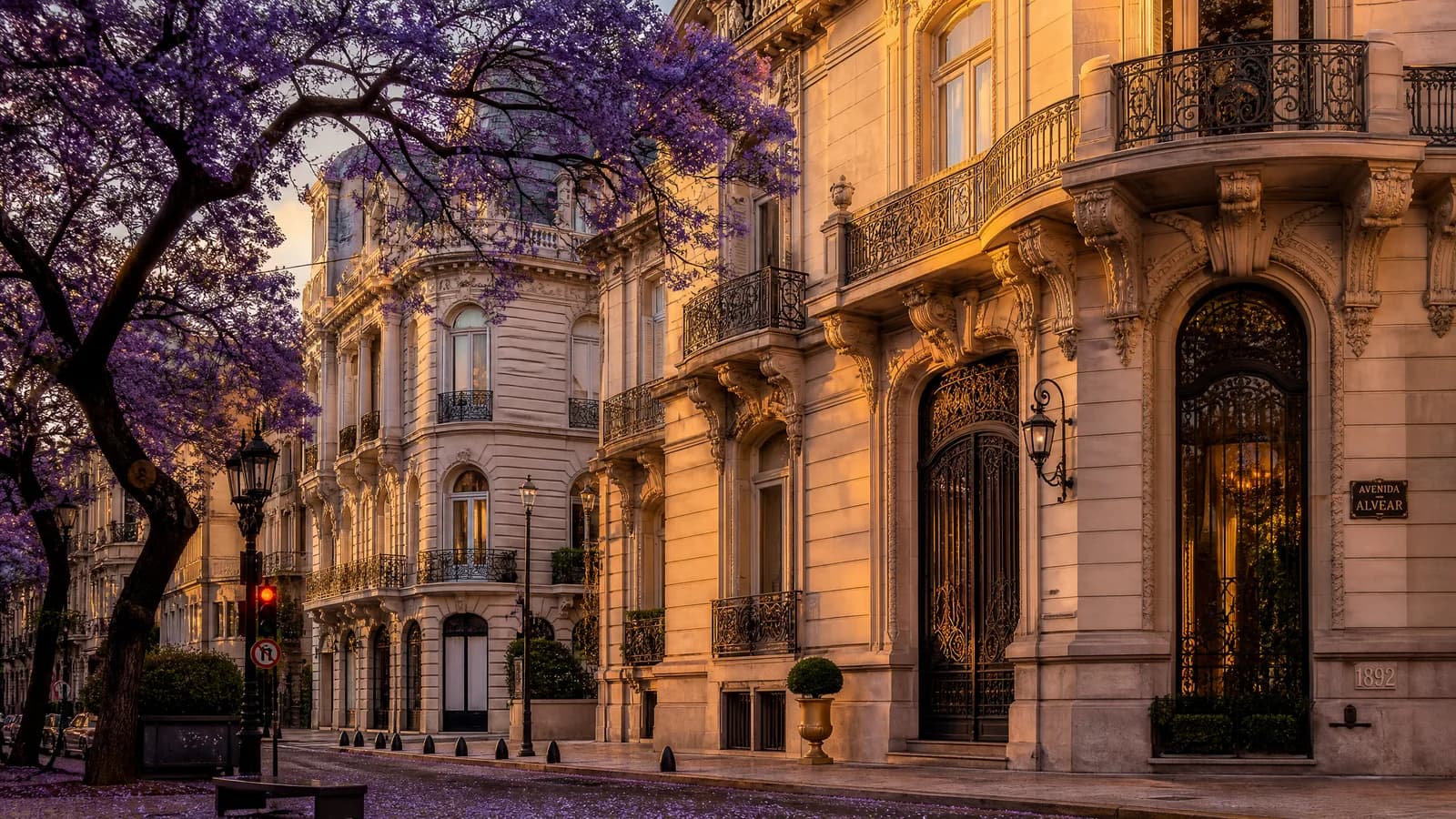
So where is best? Buenos Aires is the heart of the market: sought-after neighbourhoods such as Recoleta, Palermo and Belgrano offer elegant period buildings and modern apartments, and since rent control was abolished at the end of 2023 the rental market has picked up noticeably, with far more supply. Apartment prices in the capital are rising again in 2026. Mendoza, at the foot of the Andes, is the region for vineyards and country houses, ideal if you want to combine a real asset with a way of life, often with your own vines. For many, a vineyard is a dream come true and at the same time an asset that holds its value. Patagonia in the south, around Bariloche and the Lake District, draws nature lovers with spectacular scenery and retreat properties. And the vast Pampas are the realm of productive farmland. For a simple, legally secure city apartment, head for Buenos Aires; for an income-producing real asset, Mendoza or the Pampas; for a retreat, Patagonia. Each region has its own character, its own price dynamics and, for rural land, its own legal subtleties.
The catch: rural land and border zones
Now for the only real restriction, and in 2026 it is in flux. Rural land has traditionally been governed by the Ley de Tierras (Law 26.737), which limits foreign acquisition of agricultural land: at most 15% foreign ownership per province and nationwide, caps on large areas and restrictions on land at significant bodies of water. The Milei government repealed this law by decree at the end of 2023, but the repeal is being challenged in court and is not settled until the highest court rules, which is why the old limits are treated as still in force for now. In addition, border and security zones require prior government approval for a purchase by a foreigner. For city apartments and urban houses none of this matters, but for farmland, vineyards with large plots or property near the border it is crucial. So have the escribano clarify the zoning status right at the start, before any deposit changes hands.
The typical traps
I see three mistakes again and again when people buy property in Argentina. First, paying a large deposit on the boleto before title and freedom from charges have been properly checked, because only the registered escritura really transfers ownership. Second, underestimating the closing costs and the cash logistics and ending up short of time at the notary's table. Third, overlooking the zoning status of rural or border land and realising too late that an approval is missing. Avoid these three, have your own lawyer alongside the escribano and sort out the payment early, and you will buy in Argentina as safely as at home, often more simply.
In practice: structure and tax
The question of structure comes before everything else. An Argentine property can be a wonderful real asset and inflation hedge, but it has to fit your overall tax architecture. Clarify beforehand whether you buy privately or through a structure, which ongoing charges and which taxes apply when you sell later, and how the property fits your residence planning. Before you build up larger assets abroad, you also need to know what your home country does when you move or hold assets elsewhere:
The property is one part; fitting it properly into your tax position is the other. Structure matters as much as location.
Is buying in Argentina right for you?
Buying property in Argentina is very doable for foreigners if you know its quirks: the big role of the escribano, the cash and dollar culture, the realistic closing costs and the special rules for rural and border land. For the classic city apartment the door is open and the process clear, while farmland and vineyards need extra care. Get good guidance, have your own lawyer alongside the neutral notary and sort out the payment early, and you acquire a genuine real asset far from Europe's thicket of regulation. This is exactly the process, from choosing the property to fitting it into your tax position, that I go through step by step with my clients.
If you want to buy property in Argentina, whether a city apartment, a vineyard or a country house, let us set up the process, the structure and your home-country tax side properly together, so the dream does not turn into an expensive mistake. Book a call with me; the link is right below.
👉 Book a consultation with Harley
Carpe Diem. Life is short and fleeting. One shot. Make it count.