
How safe is Argentina really? A clear-eyed 2026 check: which neighbourhoods to avoid, where life is calm, the natural hazards, and why inflation is the underestimated danger.
Ask Argentines where their country is dangerous and you get a precise answer: not here, but there. And they are right. Argentina is, together with Chile and Uruguay, one of the three safest countries in South America; Patagonia is as quiet as a mountain village; and at the same time there is a city, Rosario, whose drug war makes headlines, and neighbourhoods in Buenos Aires that the police do not enter. If you are moving there, you need to know this map, not the national average. I will draw it for you, with the sources that matter.
The big picture first
Two truths side by side. First: foreign ministries take crime in Argentina seriously. The UK Foreign Office (FCDO), for example, warns that armed robberies are a risk, that express kidnappings occasionally happen, and that you should be particularly cautious in a long list of places in Buenos Aires, from Palermo and San Telmo to La Boca and the Retiro bus terminal; its travel advice is worth reading in full. Second: in the regional comparison, Argentina regularly ranks among South America's top performers in the Global Peace Index, and millions of foreign residents and tourists experience a country that feels more European than almost anywhere else on the continent. The contradiction disappears once you understand one thing: Argentina's crime is mostly property crime in the big cities, not widespread violence. The perception data from Numbeo show the same pattern: high concern about theft, much lower concern about violent crime. Your risk depends almost entirely on where you are and how you behave.
Buenos Aires: the neighbourhood map
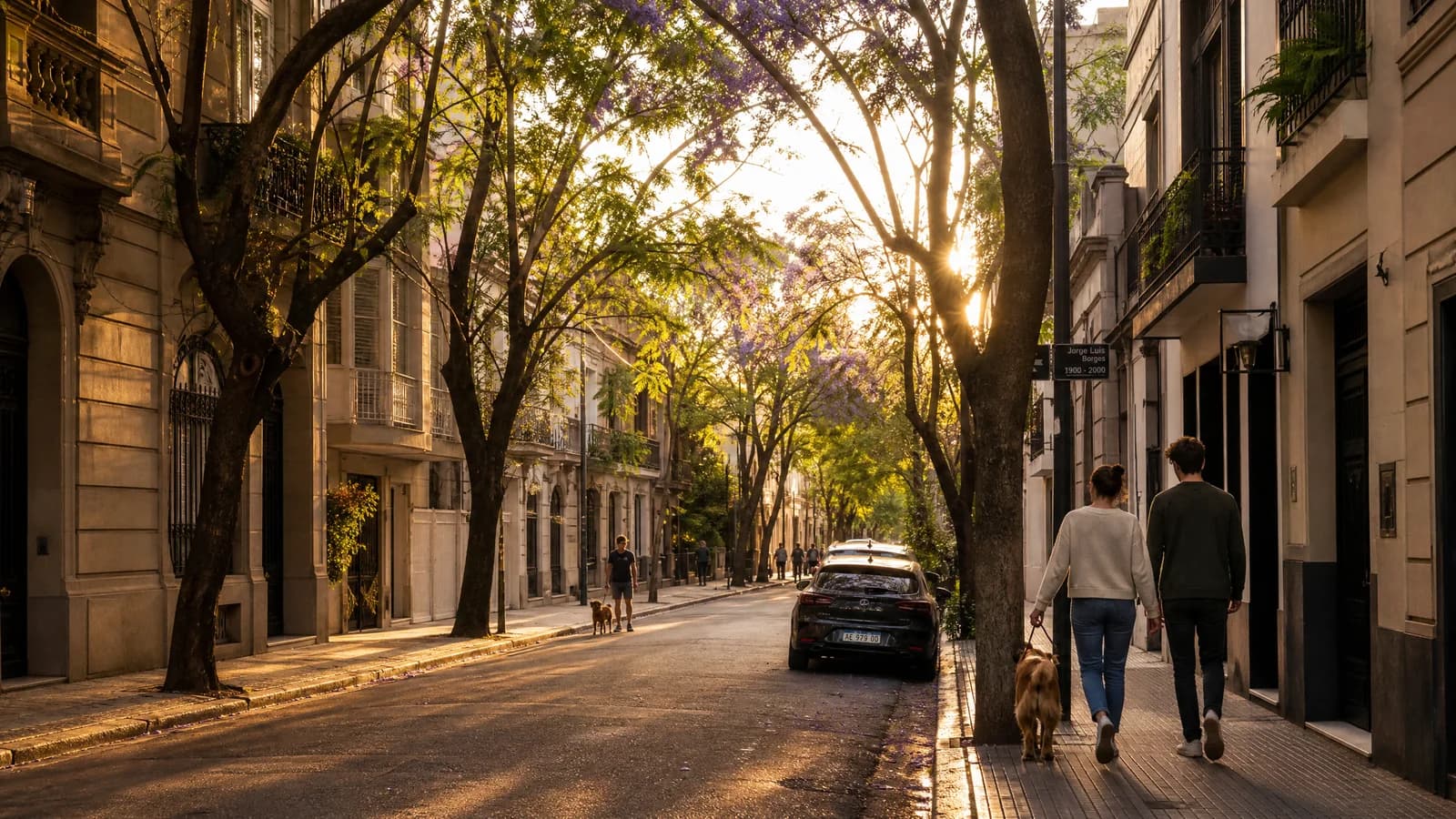
In the capital, the neighbourhood decides how life feels. In Palermo, Recoleta, Belgrano or Núñez you live in elegant, lively areas where people stroll in the evening and the restaurants are full; normal big-city caution applies there, not a state of siege. On the other side are the corners every local knows: La Boca away from the Caminito tourist strip, San Telmo after dark, the Microcentro after office hours and the Retiro station, right next to Villa 31, the city's largest informal settlement, which taxis will not drive into and the police do not enter. In the south of the city, Villa Lugano, Villa Riachuelo and Villa Soldati are areas newcomers avoid. Note the naming convention: in Buenos Aires, slums are called "Villa" plus a number, while Villa Crespo or Villa Urquiza are perfectly ordinary residential neighbourhoods.
The typical danger is not armed robbery but distraction theft and street theft: the mustard trick (someone "helps" you wipe a stain off your jacket while an accomplice empties your bag), the grab for your phone from a passing motorbike, and theft at the Retiro bus terminal and at the cruise and ferry terminals, where the boats to Uruguay leave; the FCDO names both among the places in Buenos Aires where you should be particularly cautious. Then there is a very Argentine problem: counterfeit money. Plenty of fake banknotes circulate, and the classic scam is "swapping" your genuine note for a fake one on the pretext of not having change, often in a taxi.
The special case of Rosario
One name has to appear in every serious safety article about Argentina: Rosario. The country's third-largest city is the centre of the Argentine drug trade, marked by gang crime and turf wars, with a murder rate several times the national average. The FCDO also urges particular caution there. For a newcomer, the conclusion is simple: Rosario is the wrong choice of home, just like Pedro Juan Caballero in Paraguay. The country is big enough.
Where it is genuinely calm
And now the other half of the map, the part the scaremongers leave out. Patagonia is one of the safest regions on the whole continent: in Bariloche, El Calafate and Ushuaia the biggest risk is the wind. Mendoza and Córdoba have normal big-city issues but a relaxed everyday life. And the smaller provincial towns and the countryside live with a calm that surprises many newcomers. The continent's basic rule applies here too: risk is concentrated in a few urban hotspots; everywhere else is everyday life.
Natural hazards, region by region
Unlike Paraguay or Uruguay, Argentina has real natural hazards, and they can be located precisely by region. The Andes are seismically active: earthquakes can occur in the provinces of San Juan and Mendoza, and several volcanoes on the border with Chile are active, among them Copahue. In the north, including Buenos Aires, heavy rain can cause flooding; in Patagonia there is an increased wildfire risk in the summer months; and in the subtropical north, down as far as Buenos Aires, dengue fever is a real issue, so insect repellent is as essential as your passport. None of this makes the country unliveable, but your choice of location should take it into account: if you build in the Mendoza wine country, you are building in an earthquake zone and should insure accordingly.
The underestimated danger: your money
And now the point hardly any safety article takes seriously, even though it hits most newcomers harder than any pickpocket: money. For decades Argentina was the land of galloping inflation. Under the Milei government it has fallen noticeably since 2024, but the lesson for newcomers remains: hold your wealth in pesos and you lose. Keep your reserves in hard currency, hold part of them in US dollars, and get to know the dual exchange rate system, the official rate and the market rate, which have traditionally drifted apart in Argentina. Never change money on the street, where counterfeit notes and scams lie in wait; use reputable channels. Real "safety" in Argentina is half a question of neighbourhood and half a question of how you hold your money. If you come from a stable hard-currency country, it is easy to underestimate this, because the mix of counterfeit money, exchange rate games and a volatile local currency is an everyday issue that touches you far more often than any villa miseria on the edge of town.
How it compares with the neighbours
To put the numbers in context, it helps to look across the border. In the regional safety comparison Argentina sits clearly ahead of Brazil and the Andean countries to the north, roughly level with Chile, while Uruguay usually comes out slightly calmer still. In other words: if safety concerns make you hesitate about Latin America, Argentina is one of the three countries most likely to put those concerns to rest. The perceived insecurity almost always comes from Buenos Aires headlines and the special case of Rosario, not from everyday life in Mendoza, Córdoba or the south. Know the map and you choose well and live calmly, from day one, not only after your first scare.
Safety in daily life: four rules
Now to the practical side. Choose your neighbourhood deliberately: the established residential areas of Buenos Aires or, straight away, the calm cities of the interior, and avoid the known hotspots, especially in the first months, while you still lack a feel for the city. Keep your valuables out of sight, use an inconspicuous everyday bag, and do not pull out your phone at every opportunity. Carry little cash and hold your wealth in hard currency. Insure against the real risks, illness and earthquakes in the west, not against headline panic. Follow these four rules and you will live as safely in Argentina as in most European cities, and far more beautifully than the headlines would have you believe. Safety here is not a matter of courage but of local knowledge, and that can be learned, ideally before you sign the lease.
This map, which neighbourhood, which city, which structure for your life and your money, is exactly what I build with my clients before they pack their bags. If Argentina is on your list, let's go through it with a clear head. Book a call with me; the link is right below.
👉 Book a consultation with Harley
Carpe Diem. Life is short and fleeting. One shot. Make it count.