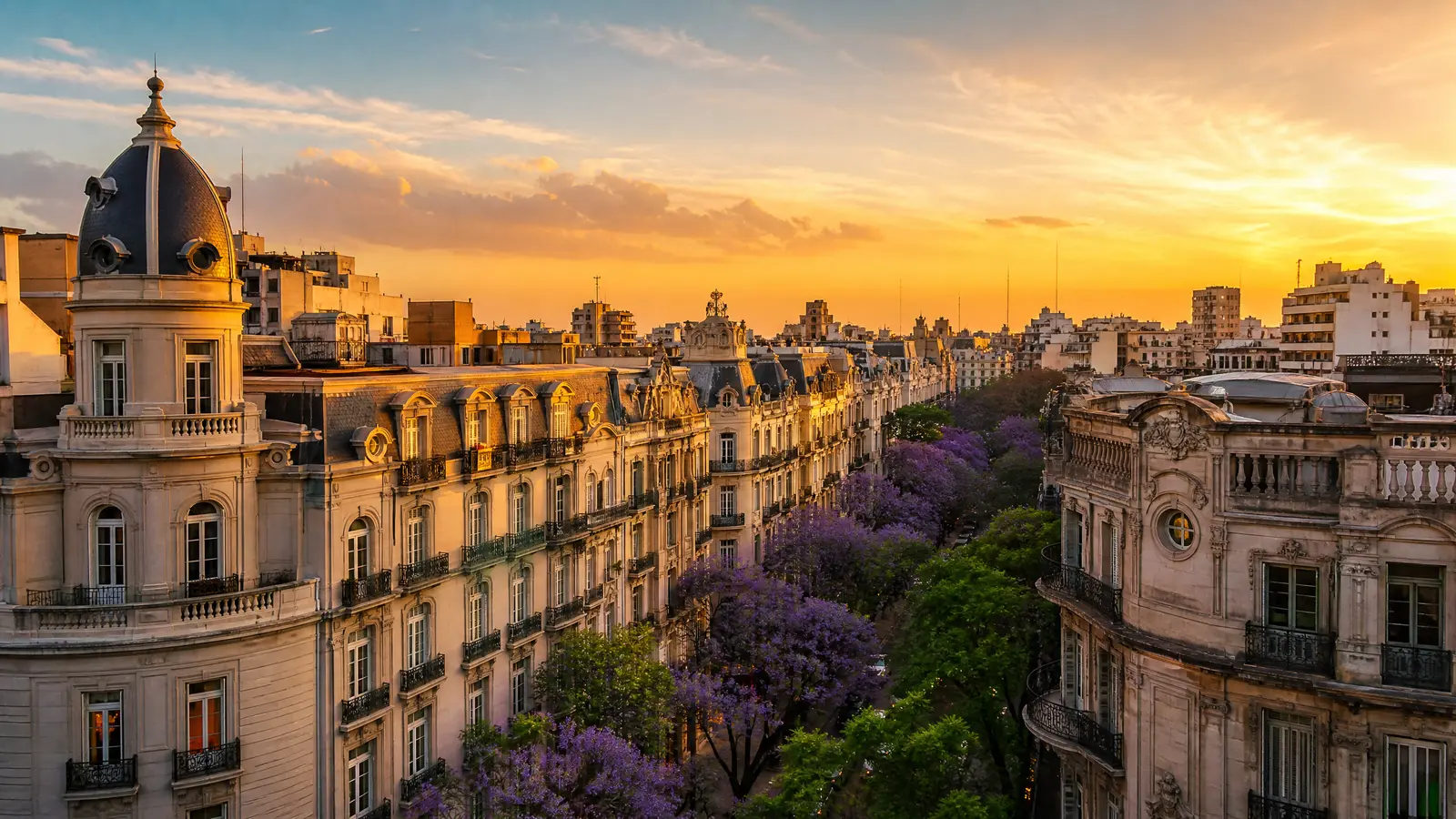

If your picture of Argentina comes from videos made in 2023, you are planning for a country that no longer exists. Back then: inflation peaking at 289%, currency controls, a country in free fall where anyone holding euros or dollars lived like a king. Today: inflation has fallen to around a tenth of its peak, the currency controls are history, the peso is strong, and that is precisely what makes the country more expensive for people earning in euros or dollars. At the same time, the Milei government has tightened the immigration rules. Argentina in 2026 is a different game, with different rules and different winners. I am there regularly, and I will tell you what it really looks like.
The new Argentina under Milei: a clear-eyed look
Facts first, verdict second. Inflation, which peaked at 289% in April 2024, was around 31% in 2025, the lowest level in about eight years, even though it has recently ticked up again and the 10% target for 2026 is looking shaky. The notorious currency controls, the cepo, have essentially been abolished since April 2025: as a resident you can hold dollar accounts, pay in dollars and transfer money internationally without the old rigmarole of permissions. The state budget has been consolidated, and exports grew by more than 21% in early 2026, driven by a record harvest and the oil and gas boom in the Vaca Muerta shale formation.
And the flip side, which I am not going to skip: industry, construction and retail are in recession, almost 27,000 companies have disappeared since Milei took office, and the strong peso makes the country noticeably more expensive in dollar and euro terms. The era when Buenos Aires was dirt cheap for people earning in hard currency is over. The country has become more stable, but it is no longer a giveaway.
What life really costs in 2026
Now the numbers. In spring 2026 the market rate was around 1,870 to 1,900 pesos to the euro. Living costs vary hugely: in Palermo or Recoleta, rents have now reached European levels, while a one-bedroom flat in the centre of Córdoba, Rosario or Mendoza costs around USD 200 to 400. A digital nomad can realistically budget around EUR 1,400 to 1,500 a month across the country, more in Buenos Aires. Food: local products are cheap, imports and technology expensive, and cars cost considerably more than in Europe. The rental law reform at the end of 2023 liberalised the market: contracts are freely negotiable, usually for two years with quarterly inflation adjustments.
The one sentence that sums it all up: with a euro or dollar income you still live comfortably in Argentina, but you are no longer a king, you are upper middle class.
The new rules: entry, insurance, visas
Now the part that has changed the most. Entry remains easy: 90 days visa-free for most Western passport holders, extendable once. But since 2025 health insurance has been mandatory for foreigners, and with Decree 366/2025 the government fundamentally tightened the migration rules: temporary residents no longer have free access to public hospitals and universities, and private cover is a requirement, not an option. If you want to stay, you go through the classic routes, above all the rentista visa for passive income from abroad (currently five minimum wages, roughly USD 1,500 to 2,000 a month) and the pensionado visa for retirees. I go through the details, deadlines and pitfalls in my article on Argentina residency.
And the most important news for passport hunters: the famous Argentine passport after two years still exists. Decree 366/2025 had tightened the two years into presence without a single trip abroad, but the national electoral appeals court declared that no-exit rule void in June 2026, jurisdiction over naturalisation is back with the federal judges, and the case now sits with the Supreme Court. Where things stand now, and what that means in practice, is covered in my article on the fastest route to a second passport.
Where to live
Argentina is huge, and where you settle decides your budget and how life feels. Buenos Aires is Europe in South America: culture, food, the best infrastructure, and the highest prices. Córdoba is the young university city with a tech scene, Mendoza the sunny wine country at the foot of the Andes, Bariloche the Alpine corner of Patagonia with mountains and lakes. Communities with European roots and a long history exist in several regions, from the villages of Entre Ríos to the old immigrant neighbourhoods of Buenos Aires. For hard-currency earners the rule is simple: the further from the capital, the further your money goes.
Work and the economy, honestly
Argentina has the best English skills in Latin America and a strong IT and services sector; services account for well over half of economic output. Foreign qualifications, European ones in particular, have an excellent reputation. But wages are far below Western European or North American levels, and the local economy is in upheaval. The formula is the same as everywhere else in the region: Argentina pays off if you bring your income with you, as a remote worker, as a retiree with a foreign pension, or as an entrepreneur with an eye on agriculture, energy and raw materials. The new investment incentive regime RIGI courts large investors with tax advantages, and the trade agreement with the United States signed in February 2026 opens further doors.
The tax question in brief
Argentina taxes residents on their worldwide income, and there is a wealth tax. That sets it fundamentally apart from Paraguay or Panama. The good news: tax residence usually only kicks in after twelve months of continuous presence, and with careful planning you can structure the transition. But if you live in Argentina permanently, you pay tax there on your worldwide income. Argentina is a quality-of-life destination, not a tax-saving one, and anyone who tells you otherwise is selling you the Argentina of the day before yesterday. Before the Argentine chapter begins, you need to wrap up your affairs at home properly. Moving to Argentina does not, on its own, end your tax residence at home, and whether an exit tax applies depends on where you come from:
The advantages at a glance
Argentina holds a hand that no neighbour can match. The biggest is the fast route to a passport: naturalisation is possible after just two years of regular residence, one of the fastest routes in the region, although the rule is contested in court: the no-exit version of the decree was annulled on 30 June 2026 and the case is now before the Supreme Court. Then there is the European way of life, especially in Buenos Aires, with world-class culture, food and wine regions that feel to many like home, only with better weather. Costs are low in hard currency: if you think in euros, francs or dollars, your money still stretches a long way after the devaluations of recent years and can still find well-priced property in prime locations. And the Milei reforms have changed the direction: inflation falling, the economy opened up, currency restrictions eased, a new investment regime for big capital. If you believe in the turnaround, you are getting in at historically low prices. The fast passport is covered in detail in Argentina's fastest route to a passport, the political situation in Argentina under Milei, and the country overview on the Argentina country page.
The disadvantages, honestly
The other side is just as clear. Argentina is the country of cycles: boom and crisis have alternated for decades, and nobody can guarantee that the current stabilisation will hold. If you move here, you are to some extent betting on a reform that may succeed, but might not. On tax, the most important point is uncomfortable: as a resident, Argentina taxes your worldwide income and also levies a wealth tax (Bienes Personales) that can cover assets worldwide. That is the opposite of a territorial model and needs careful planning. Banking has historically been difficult, with shifting restrictions, exchange-rate chaos and capital controls whose easing remains reversible. Add bureaucracy, occasional import restrictions and political volatility that can quickly turn a cheap environment back into an expensive one. The distance to Europe is considerable, and in parts of Buenos Aires everyday crime is an issue, put into perspective in the Argentina safety reality check. And whatever your home country, plan your exit from it in advance, so that the opportunity does not turn into a tax trap.
Day to day, there is more to weigh. For years the foreign exchange market was shaped by capital controls (the notorious cepo) and several exchange rates side by side, and even though Milei is easing things, caution is warranted, because in Argentina such rules have historically come back quickly. Saving in pesos is not an option: if you build wealth, you think in dollars and ideally keep it outside the local banking system. The economy is in upheaval, with real social hardship from the reforms, and nobody can credibly promise how the experiment will end. In short: Argentina is a country for people who see the opportunity and can stomach the risk, not for those looking for calm and predictability.
Who Argentina really suits in 2026
To put it more sharply: Argentina is made for people who want to combine European quality of life with South American space and who bring their income in hard currency: the remote worker who loves culture and cafés, the retiree looking for wine and a mild climate, the family that wants the best education levels in the region, the investor betting on energy and agriculture, and the patient type who is prepared to genuinely live in the country for two years (a rule now before the Supreme Court) for one of the best passports in Latin America. If you are after maximum tax savings, on the other hand, you are better off in Paraguay, and if economic predictability matters above all, in Uruguay. Argentina remains a country in upheaval, with all the opportunities and all the residual risk that comes with it.
Argentina against its neighbours, your budget against the new price reality, your time horizon against the new presence rules: that is exactly the weighing up I go through with my clients before they pack.
If Argentina could be your destination, let's take a realistic look at whether it still fits your plan in 2026. Book a call with me, the link is right below.
👉 Book a consultation with Harley
Carpe Diem. Life is short and fleeting. One shot. Make it count.