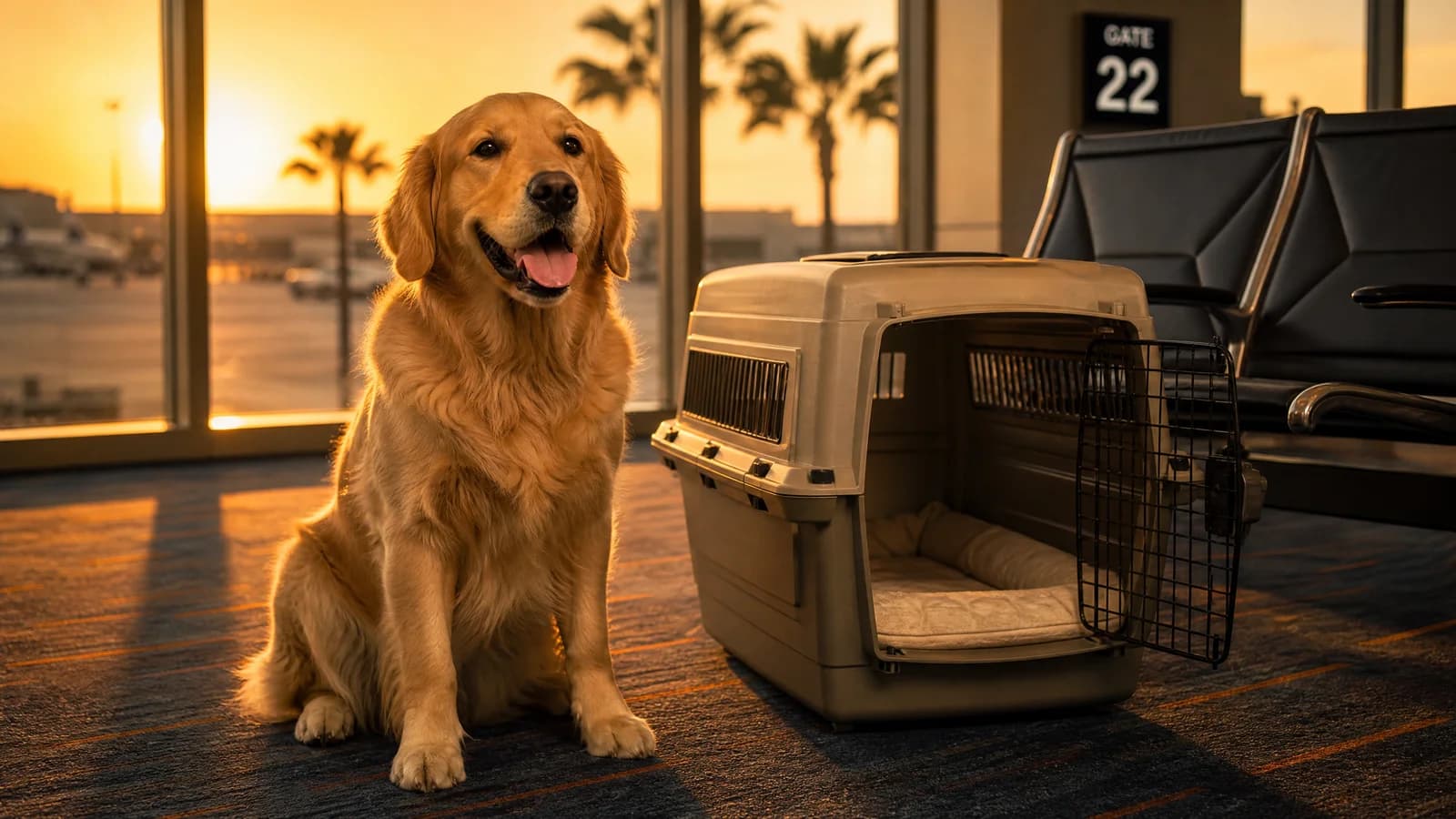

With almost every family I help move to Latin America, a question comes up at some point that matters more than any tax table: is the dog coming? Is the cat coming? My answer is almost always yes. Dogs and cats travel to Panama, Uruguay or Mexico every day, and the vast majority arrive without drama. What goes wrong almost never goes wrong at the destination. It goes wrong with the timing. So what you get here is not a catalogue of paperwork but what I do with my clients: a timeline, counted backwards from the flight date.
The first misconception: the EU pet passport
Let's clear up the biggest misunderstanding straight away. If you are coming from Europe, the blue EU pet passport you use to travel with your dog or cat through Spain or Italy is not an entry document in Latin America. It applies to travel within the EU; the border authorities over there have no interest in it. No country in Latin America lets your animal in because an EU document exists. Every country demands its own chain: chip, proof of vaccination, an official health certificate to its own specifications, sometimes with an apostille, sometimes with advance registration.
Even so, do not throw the passport away under any circumstances. It remains your best proof of vaccination and chip, which the official veterinarian relies on when issuing the export certificate. And for a later return to the EU it even becomes the most important document of all; more on that shortly.
The four building blocks that apply almost everywhere
The details differ from country to country, but the basic framework is remarkably similar across Latin America.
First, the microchip. An ISO-compliant 15-digit transponder to standard 11784/11785. The point that most often goes wrong: the chip must be implanted, or at least documented, BEFORE the rabies vaccination. Only the chip ties the vaccination clearly to your animal. Reverse the order and the vaccination formally does not count, and the clock starts again.
Second, the rabies vaccination. It is the heart of every entry. It can be given from twelve weeks of age at the earliest, after the chip, and after the first vaccination there is a 21-day waiting period before it is recognised as valid. Many destination countries also require the vaccination to have been given at least 30 days before entry, Uruguay for example. And it must be valid on the day of travel, not only on the day the certificate is issued. That is a classic reason animals are turned away.
Third, the official health certificate. This is where it differs from a holiday: your own vet's paperwork is not enough. What is required is a certificate endorsed by the state veterinary authority. In the US the USDA does this; in EU countries the counterpart is the official veterinarian of the state veterinary service. Some destination countries also want this certificate with an apostille or legalisation; Panama, for example, explicitly requires it. So find out not only WHAT your destination wants, but also which level of authentication.
Fourth, the IATA crate. Larger animals fly in the climate-controlled hold, in a crate built to the IATA requirements: sturdy, leak-proof, ventilated, and big enough for your animal to stand upright, turn around and lie down. Buy the crate weeks in advance and let your animal sleep and eat in it. A crate your animal first steps into on departure day means stress for everyone involved, and a wrongly sized crate is a reason for the check-in desk to refuse transport.
The tight window where trips fall apart
Building block number three has a catch, and it is the real final boss: the official health certificate is only valid for a short time. A window of ten days before departure is the usual order of magnitude; Paraguay works with ten days, Mexico accepts certificates up to 15 days after issue. In those few days you have to fit in the appointment with your own vet, the appointment with the official veterinarian, any translation and apostille, and the flight itself. Official veterinarians do not always give appointments at short notice, and the apostille also needs lead time depending on where you live. Get the certificate too early and you arrive with expired papers. Leave it too late and there is no appointment left. This window is why you plan the whole process backwards from the flight date and not forwards from today.
Four countries as a sample
To make it concrete, four destinations I work with all the time. I checked the state of play in August 2026, but these rules change, so always check your case directly with the destination country's authority before you fly.
Panama is the country with the famous home quarantine. The responsible body is the Ministry of Health, MINSA, with its zoonosis department; alongside it the agriculture authority MIDA checks the papers at the airport. You need an official export health certificate with a valid rabies vaccination, apostilled in the country of origin. You register the arrival at least three working days in advance using a form, at Tocumen airport you pay 130 balboas per animal in cash, and then you take your animal home. The quarantine takes place at your home, not in a kennel. In practice: show the papers, pay, take the animal with you.
Uruguay is pleasantly clear. The responsible body is the Ministry of Agriculture, MGAP. Rabies vaccination for animals over three months, at least 30 days before entry and valid on the day of entry, plus the official health certificate. A rabies titre test is not required for entry. Dogs have one special rule: a treatment against the tapeworm Echinococcus with the active ingredient praziquantel, no earlier than 30 days and no later than 72 hours before arrival, certified by a vet. That is a tight window within the tight window, so plan the vet appointment accordingly.
Paraguay handles pets through the veterinary authority SENACSA. Up to five dogs or cats count as pets; from the sixth animal you are treated as a commercial import. The basis is the Mercosur-harmonised requirements, in a new version since 2024: international veterinary certificate, chip, valid rabies vaccination, the certificate issued no more than ten days before departure, and an inspection by the SENACSA inspector on arrival in Asunción. With complete papers there is no routine quarantine. If Paraguay is your destination anyway, you will find the immigration side in our Paraguay guide.
Mexico is now the simplest case of the four, since the authority SENASICA streamlined the procedure. You do not need prior approval. Coming from Europe, you need a health certificate from an official or accredited vet, no older than 15 days, proof of a valid rabies vaccination and a parasite treatment within the last six months. At the airport you go to the agricultural inspection point OISA: fill in the form, the animal is looked at, the crate is disinfected, done. Animals with fresh wounds or parasite infestation are turned away, and missing treatments must be made up locally at your own expense. The Mexican embassy in Vienna has summarised the details in a current information sheet.
The return trap almost nobody has on their list
This is the point where I regularly see surprised faces in consultations. Entering Latin America is usually manageable. The tough part is getting back into the EU, and you have to think about it BEFORE you leave.
The EU keeps a list of third countries whose rabies situation it recognises as equivalent. From Latin America, essentially Argentina, Chile and Mexico are on it. Coming back from these countries, the chip and a valid vaccination are enough. But if you come from Paraguay, Uruguay, Brazil, Colombia, Costa Rica or Panama, the EU requires a rabies antibody test: blood drawn no earlier than 30 days after vaccination, analysed in an EU-approved laboratory, at least 0.5 international units per millilitre, followed by a waiting period of three months from the blood draw before the animal may enter the EU again.
And now the trick that is worth its weight in gold: if you have the titre test done in the EU before you leave, and your vet enters the result in the EU pet passport, the three-month waiting period on return disappears completely. The test remains valid as long as the rabies vaccination is boosted without a gap. That is exactly why I tell every client whose home is in the EU: do the titre test in the EU as a precaution, even if the destination does not require it, even if no return is planned. Plans change: deaths, inheritances, homesickness. With the entry in the passport, you simply fly back. Without it, you wait abroad with your animal for three months.
If home is outside the EU, the same logic applies with different rules: your home country has its own requirements for pets arriving from Latin America, some of them considerably stricter, so check them before you leave, not when you want to go back.
Airline practice: cabin, hold and the summer
On paper the flight is the easiest part. In practice it decides your travel date.
Most airlines only allow animals up to around eight kilograms including the bag in the cabin; Lufthansa, for example, draws the line exactly there. Anything heavier travels as so-called excess baggage in the climate-controlled hold of the same aircraft you are sitting in, registered at least 72 hours in advance. Very large animals or certain routes now only go as cargo with a forwarder. As for costs, the cabin is usually between EUR 50 and 100 per leg, and the hold as excess baggage on long haul roughly between EUR 120 and 300 depending on crate size and airline. If it goes through a pet transport forwarder with its own cargo booking, then going by the accounts I know from my practice and from expat forums, you are quickly well into four figures. Do the maths early, not in the last week.
And then there is summer. This comes from practice, not from any law: many airlines impose heat embargoes and do not accept animals in the hold when ground temperatures exceed around 29 degrees Celsius at the departure, transfer or destination airport, and the decision is sometimes only made on the day of departure, based on the weather. Short-nosed breeds such as French bulldogs, pugs or Persian cats are hit harder: stricter limits, often a complete refusal for the hold in summer, and with some airlines all year round. If you want to fly from Europe via Miami in July, doing so with a dog in the hold is a gamble. Early-morning flights, direct connections and the cooler season are the simplest insurance.
The truth about quarantine
The fear of your animal spending weeks behind the bars of a state facility is the most common reason people keep putting the subject off. For Latin America it is almost always unfounded. With complete, correct papers there is no institutional quarantine in the usual destination countries: not in Uruguay, not in Paraguay, not in Mexico, not in Chile or Brazil. Panama's quarantine takes place at your home. In Latin America quarantine is not the rule but the penalty for missing papers. If your animal is turned away, in the worst case it flies back with the same airline. That is exactly why being pedantic about the documents pays off.
Your timeline, counted back from the flight date
This is how I set it up with clients, counted from departure day D.
D minus 6 months: check the destination's rules with its authority, clarify breed restrictions, settle airline options and season. Check the chip or have one implanted, then boost the rabies vaccination. Have a frank talk with your vet about whether your animal can cope with the journey: age, heart, airways.
D minus 4 to 5 months: if home is in the EU, have the titre test done there and the result entered in the pet passport. Buy the IATA crate and make it part of the furniture. Book the flight, register the animal with the airline, keep the written confirmation.
D minus 4 to 6 weeks: do a final cross-check of all destination requirements, complete advance registrations, and for Panama prepare the quarantine form. Reserve the appointment with the official veterinarian for the certificate window, clarify the apostille route.
D minus 10 days to D: vet check, for Uruguay the praziquantel treatment in the 72-hour window, have the official health certificate issued and authenticated, put together a folder of copies, one set of papers in your hand luggage and one taped to the crate.
Keep to this chain and the airport becomes an uneventful formality. Reverse it and you lose weeks or the flight. And because the animal rarely moves alone: how to time the move with the whole family is in my article on moving to Latin America with kids, and protecting the people should be part of the same plan, with the right health insurance.
In the end, importing a pet is not a legal problem but a project management problem with four moving parts: the chain of authorities in your home country, the destination's rules, the airline and the calendar. Each part on its own is simple. Things fail where they fall out of sync. This synchronisation, from the titre test to the official vet appointment in the ten-day window, is exactly what I plan with my clients when we set up residence and the move, so that your most loyal companion does not end up as an open item on the list.
If you want to move to Latin America with your dog or cat, let's set up the timeline for your animal and your destination together, in good time and in the right order. Book a call with me; the link is right below.
👉 Book a consultation with Harley
Carpe Diem. Life is short and fleeting. One shot. Make it count.