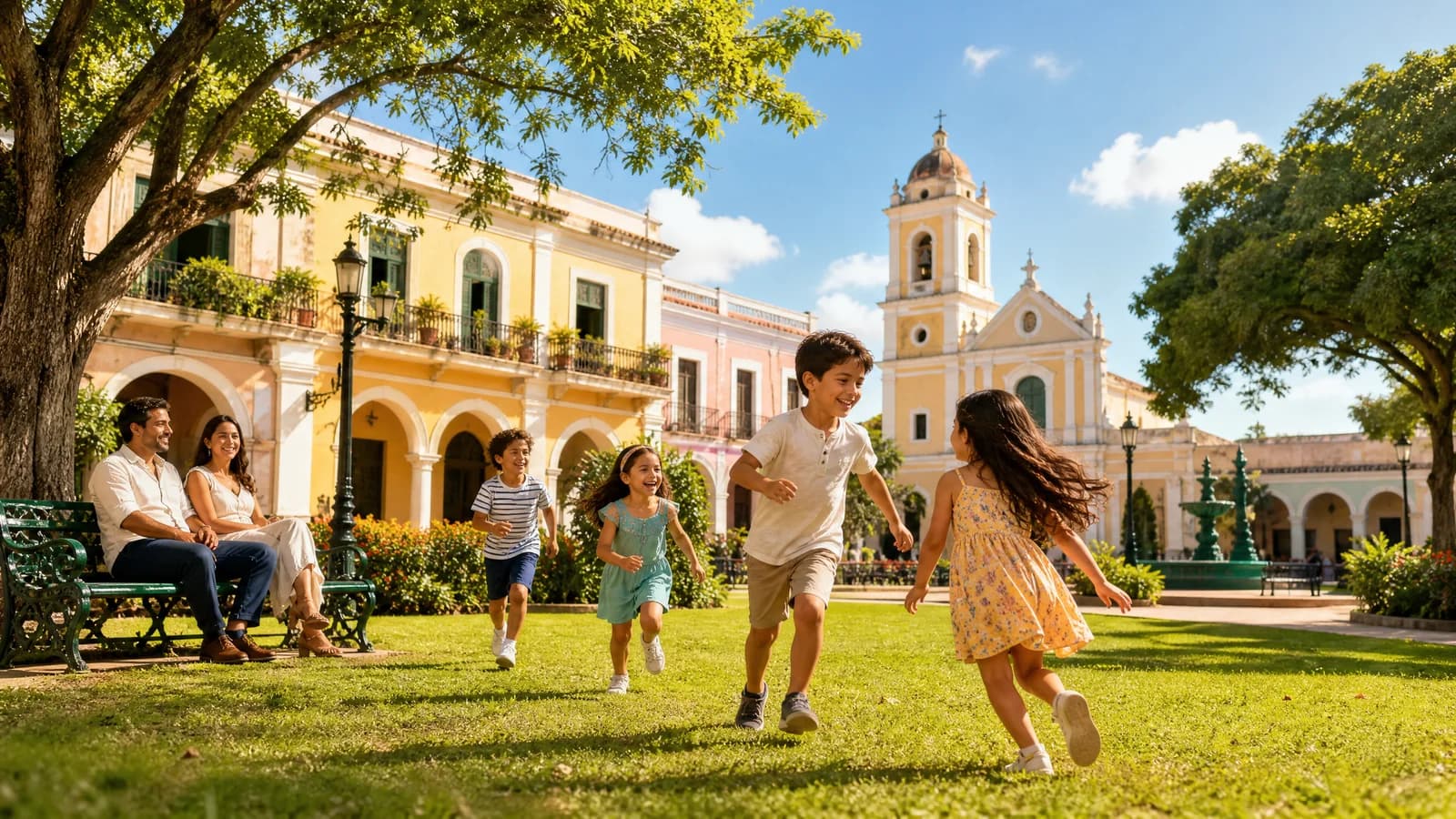

Moving to Latin America with children: schools, healthcare, safety and family life, plus the honest truth that the children's situation is no tax trick for the parents. The 2026 guide.
Moving abroad with children is something completely different from packing a suitcase on your own. Suddenly schools, doctors, safety and whether the children feel at home matter more than the last percentage point of tax. What is a side issue for a single entrepreneur becomes the main question with children. The good news: Latin America can be a real win for families, with close family life, a good climate and a slower pace. The catch: a family move works only when the parents' own residence and tax position are set up properly, and nothing about the children changes that. This guide shows you the practical side of a family move and the one truth many people do not want to hear. One note up front: for families, quality of life decides, not the tax table.
Residence for the whole family
Let's start with the legal side, because it is simpler than many expect. On the investment and retiree routes we cover on this site, children usually come along as dependents on the parent's application, so the family receives its residence permits together. That makes the choice of route a family decision: the main applicant's route sets the timeline, the costs and the presence rules for everyone. If you plan with children, check early which documents each country wants for dependents, such as birth certificates, which usually need an apostille and a translation, and how school-age children are registered once you arrive.
Schools: international, bilingual, local
The first practical question for every family is schools. The good news: every larger city in the region has international and bilingual schools, often with a German, American, British or IB curriculum. In Mexico City, Panama City, Montevideo, Medellín, Santiago and even Asunción, families find schools where the transition works for the children and the path to university abroad later stays open. An IB diploma, for example, is recognised by universities worldwide and keeps every door open for the children. Fees are well below those of comparable private schools in Europe or the US. A good international school that costs a fortune in the north is affordable here for many families. One caveat: quality varies, the best schools are concentrated in the big cities, and if you live in the countryside you have less choice. So when choosing a school, look closely at the specific city, not just the country. Visiting the school before the move, talking to other expat families and reading the curriculum will save you a lot of trouble later.
Healthcare: private and affordable
The second family question is health. In the region's cities, private medical care is good to very good and affordable compared with Europe and North America, with modern clinics, well-trained doctors and short waiting times. For families with children, private health insurance is usually the right route, often at a fraction of what families pay at home. Many families find that good private cover costs them less than they were used to paying in co-payments alone. The World Health Organization documents the region's health systems at the WHO. Here too: quality is concentrated in the cities, the public system is often weaker, and care is thinner in rural areas. If you are planning with children, choose where you live partly by its proximity to good clinics, a criterion people without children rarely think about. A good children's hospital within reach is worth more with small children than the most beautiful sea view in isolation.
Safety: the decisive family criterion
For families, safety is often the most important criterion of all, and the differences are large. Uruguay, Chile and Costa Rica are among the safest countries in the region and particularly suited to families. But even in countries with a mixed reputation there are very safe regions and neighbourhoods: Panama, for example, is notably calm in places such as Boquete, Coronado or the good neighbourhoods of the capital. Conversely, even countries that are safe overall have individual areas you should avoid with children. You will find the World Bank's development data for the region at the World Bank. The rule of thumb is this: the country alone does not decide safety; the specific city and the specific neighbourhood do. That rule applies to safety just as much as to schools and clinics. Families should therefore choose where they live with care and, if in doubt, live there on a trial basis for a few weeks before they commit. A trial stay often reveals more about how a place works day to day than any statistic.
The lifestyle case for families
Beyond the hard criteria there is a soft but weighty reason to move to Latin America with children: family life itself. The culture of the region is strongly family-oriented, children are welcome everywhere, the climate allows a life outdoors, and the pace is calmer than in the north. Many families report that they spend more time together here, that the children grow up outdoors and that everyday life is more relaxed. Less pressure from appointments, more sun and a warmer way of dealing with each other noticeably change family life. On top of that, the children grow up bilingual, a gift for life. Spanish as a second mother tongue opens doors for them all over the world later on. This quality of life cannot be measured in a tax table, but for many families it is the real gain of the move. This is often exactly the difference between a move you regret and one you would never want to undo. Families who come for the right reasons stay; those who came only for the tax often go back.
The hard truth: children are not a tax trick
And now the point many people would rather not hear. Moving with children, schooling them abroad or settling them happily in a new country changes nothing about the parents' tax residence. Where the parents are taxed depends solely on their own residence, as the tax summaries for each country show, and nothing about the children replaces a proper exit from the parents' home tax system. Anyone who hopes the family's new life abroad settles the tax question on its own confuses two completely different things: where the family lives day to day and where the parents are tax resident. Drawing that distinction clearly avoids expensive misunderstandings. I often see families arrive with the wrong expectations and feel relieved once we separate the two levels clearly.
First, set the parents up properly
Now to you. A move with children works for tax purposes only if the parents get their affairs in order. That means properly ending tax residence at home, genuinely moving your centre of life and, if company shares are involved, checking whether an exit tax applies. These steps come before the move, not after it. Only once the parents are properly set up does the full benefit of the new life take effect, for the children and for the family finances alike. A half-hearted deregistration while your centre of life effectively stays at home puts the whole plan at risk. What exactly your home country requires when a family leaves depends on where you come from:
The order is the same as always: first a sound structure for the parents, then the good life with the children. Structure decides, not the destination.
Where this leaves you
Moving to Latin America with children can be a great gain, but for the right reasons. In practice, schools, healthcare and above all safety decide, and all three are concentrated in the big cities, which is why choosing the specific city matters more than choosing the country. The family-oriented way of life is the real gain for many. But one fact remains: the children's new life is a gift for the children, not a tax trick for the parents, and the move works only once the parents have properly left their home tax system. That combination of family happiness and sound structure is exactly what I build with my clients. After all, a move with children should improve your life, not burden it with avoidable tax mistakes.
If you want to move to Latin America with your family and set it up right from the start, let's plan it together. Book a call with me; the link is right below.
👉 Book a consultation with Harley
Carpe Diem. Life is short and fleeting. One shot. Make it count.