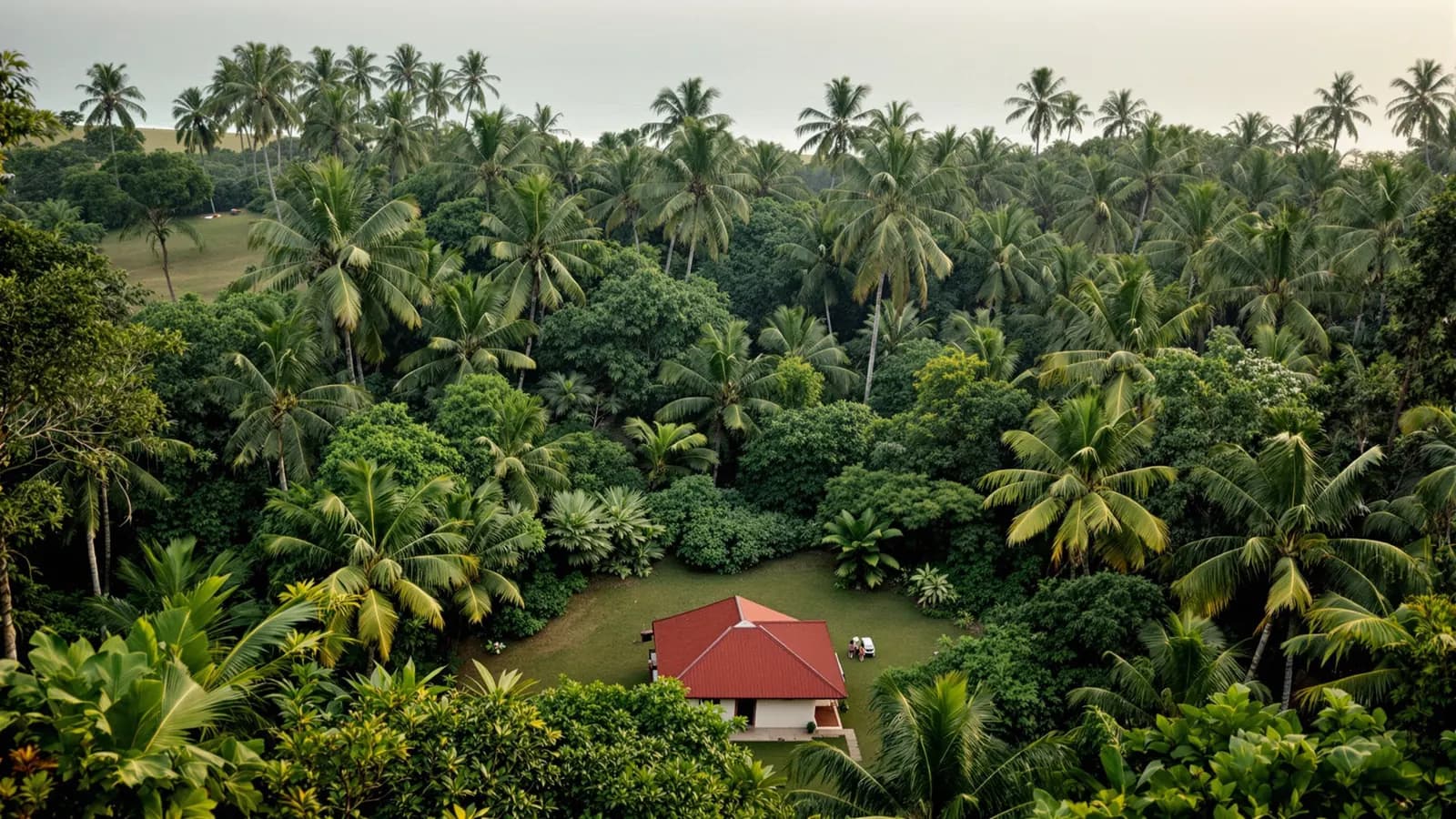

Buying property in Costa Rica is surprisingly accessible for foreign buyers, but it has one trap that has already cost many people who moved there dearly. I would rather be straight with you than sell you anything, so here is the most important point first: as a foreigner buying property in Costa Rica, you have essentially the same rights as a local. You need no special permit and no local partner, and you can own land, houses and condominiums outright. The big exception concerns beach plots in the so-called maritime zone; more on that in a moment. Costa Rica also has a central, well-organised land registry at the national register, which makes the country attractive to investors and people relocating. Unlike in some neighbouring countries, you need neither a local nominee nor a complicated company structure to acquire ordinary ownership that enjoys the same protection as a Costa Rican's.
Full ownership rights, but beware the maritime zone
The good news first: outside the coastal strips, you buy ordinary full ownership in Costa Rica (fee simple, titled property), registered in the Registro Nacional, the central land registry. Foreigners and locals have equal legal standing. You can hold the property in your own name or in the name of a company, and you are free to buy, sell and bequeath it. This legal certainty is one of the reasons Costa Rica is so popular with international buyers despite higher prices, because the registry is central, searchable online and reliable by regional standards.
Now for the trap, and it is a serious one. The Zona Marítimo Terrestre (ZMT), governed by Law 6043 of 1977, covers the first 200 metres of coastline, measured inland from the high-tide line. These 200 metres are split into two zones: the first 50 metres are the Zona Pública, public land that nobody can own and that may not be built on. The following 150 metres are the Zona Restringida, where you cannot acquire full ownership, only a time-limited concession (a leasehold right) with terms of usually 5 to 20 years. Foreigners face an additional hurdle: anyone who has not lived in Costa Rica for at least five years may not hold a majority stake in such a concession and has to fall back on structures through a Costa Rican company with a local majority. Only around 5% of beach plots carry full title at all. My clear advice, shared by reputable local advisers: foreigners should, as a rule, not buy in the maritime zone. If you really want to be close to the sea, buy fully titled land just outside the ZMT boundary. One sobering figure shows why the ZMT is so dangerous: in sought-after coastal areas such as Tamarindo, Jacó, Manuel Antonio, Santa Teresa, Nosara or Playas del Coco, most properties offered as "beachfront" are in fact concession land, not full ownership. Anyone unaware of the distinction may, in the worst case, buy a time-limited right of use believing they are acquiring real ownership. Concessions are also administered by the municipalities, which vary in how strict and how well organised they are, adding further uncertainty. Concession rights are recorded as such in the Registro Nacional and give you use of the land, not ownership of it.
The real catch with a concession shows up later. It expires and has to be renewed, and renewal is not automatic: it lies at the discretion of the municipality, which can change the terms or impose conditions. A concession can also, as a rule, not be mortgaged like full ownership. Conventional banks rarely lend against it, which shrinks the pool of buyers on resale and depresses the value. If you want to tie up your capital near the sea, run the numbers with a clear head: a fully titled plot in the hills with a sea view is almost always a smarter investment than a shiny "beachfront" concession whose future depends on a municipal decision. Close to the sea, yes, but with real title.
The buying process step by step
Outside the maritime zone, the process is clearly structured. After choosing a property and agreeing terms comes the crucial phase, the due diligence by an independent lawyer. This involves checking the title record in the Registro Nacional to make sure valid ownership rights exist and that the property is free of mortgages, debts, liens and other encumbrances. The cadastral plan (plano catastrado) is compared with the actual boundaries, and for building land you obtain from the municipality the Certificado de Uso de Suelo, which confirms what may be built. Only once all this checks out is the transfer of ownership executed as an Escritura Pública before a notary, who verifies the identity of the parties and then registers the transaction in the Registro Nacional. One additional check experienced buyers never skip: making sure there are no unpaid utility bills, municipal charges or tax debts on the property, because these can pass to the new owner. The match between the cadastral plan and the actual size of the plot also matters, because diverging or overlapping boundaries are not unusual in Costa Rica and can later lead to expensive disputes with neighbours. As a foreigner and future owner, you need a Costa Rican tax and identification number (DIMEX) to pay the taxes that arise. It is also common for buyer and seller to handle the deposit through an escrow agent, which secures the payment, especially when you transfer money from abroad. For a straightforward cash purchase with flawless title, the whole process from agreement to registration usually takes a few weeks. Unlike in Chile or much of continental Europe, the notary in Costa Rica is also a lawyer (notario), which blurs the roles. That is why you should always bring in your own lawyer who represents only your interests, rather than relying solely on the notary the seller provides.
Protecting yourself against title fraud
One point I stress firmly, because the risk is real: Costa Rica has organised land fraud, and reports even link notaries to fraudulent networks, above all in the high-end coastal segment in Guanacaste and Puntarenas. Protect yourself by never buying without independent legal advice that represents only your interests, by verifying the title in the Registro Nacional yourself, and by walking away immediately at any inconsistency or missing document. You can find a lawyer through the bar association (Colegio de Abogados), the embassies or a reputable estate agent. Bear in mind that Costa Rica has no binding caps on legal fees, so agree the costs in advance. A typical fraud pattern you should know: forged titles or titles sold several times, non-existent owners, or sellers who are not actually entitled to sell. That is exactly why an independent check of the title in the Registro Nacional matters so much: only an unbroken chain of ownership gives you security. Never let anyone pressure you into a signature or a deposit; reputable sellers and agents give you the time for a thorough review.
Purchase costs and taxes
Purchase costs are manageable. The transfer tax is 1.5% of the property's value, and total purchase costs from transfer tax, notary, registration and legal fees typically come to around 4 to 5.5% of the purchase price. Buyers and sellers commonly split certain of these costs, but that is negotiable and should be set out clearly in the purchase contract. As an owner you pay an annual property tax of only 0.25% of the registered value, one of the lowest anywhere. High-value properties may also attract a luxury property tax. When you sell later on, the capital gain has been subject since 2019, as a rule, to a capital gains tax of around 15%, though there is an exemption for an owner-occupied main home. These local taxes do not change the basic principle that your foreign income remains tax-free in Costa Rica. A practical note on the declared price: some sellers suggest putting a lower purchase price in the deed to save transfer tax. Do not do it. Such under-declaration is not only risky, it comes back to bite you when you sell, if not sooner, because your capital gain is then mathematically higher and today's tax saving becomes tomorrow's tax bill. Declare the actual purchase price properly; the low property tax of 0.25% makes the supposed advantage small anyway.
Financing and the company option
Financing through Costa Rican banks is harder and more expensive for foreigners than at home: credit options are limited and interest rates high. In practice, most foreign buyers therefore buy as cash buyers, from their own capital or with financing raised in their home country. Many people who move there also hold their property through a Costa Rican company (Sociedad Anónima or SRL), which can bring advantages for succession planning and administration but needs to be set up properly from a tax and legal point of view. Whether a company makes sense for you needs to be assessed case by case. Note that Costa Rican companies come with an annual corporate tax and ongoing obligations, which is why the structure does not pay off for everyone. If you are buying a single home for your own use, buying directly in your own name is often simpler and cheaper, while a company is better suited to several properties, rentals or complex succession planning.
The market and the popular regions
Property prices in Costa Rica are on the high side for the region, driven by strong international interest and good infrastructure. The range runs from inexpensive plots in the interior to exclusive villas. The market has tightened noticeably in recent years with the growing number of people relocating and remote workers, which has pushed prices up considerably in popular areas. For foreign buyers, the main areas of interest are the Central Valley around Escazú, Santa Ana, Atenas and Grecia, with its mild highland climate, and selected well-developed coastal regions. On the coast, though, you have to keep the ZMT in mind, which is why many buyers opt for fully titled properties in the hills with a sea view rather than directly on the beach. Condominiums are a popular and often simpler option, because you acquire your unit plus a share of the common property, and the complex is usually better managed and secured. A tip for anyone looking: view a property at different times of day and of year if you can, because a plot that looks ideal in the dry season can look very different in the rainy season, whether through flooding, landslide risk on a slope or poor access on unpaved roads. In rural areas you should also check water and electricity supply and internet connection specifically before buying, because what sounds like a given in a listing is not always so on the ground.
Property prices in 2026 by region
Costa Rica is not one uniform market; prices depend heavily on location. The following table gives rough 2026 guide values in US dollars, the currency of the property market. They are ranges, not guarantees, and within each region sea views, infrastructure and condition can multiply prices.
| Region | House / villa (purchase) | Condominium | Building land (per m²) |
|---|---|---|---|
| Central Valley (Escazú, Santa Ana, Atenas) | USD 250,000–800,000+ | USD 150,000–450,000 | USD 80–250 |
| Guanacaste (Tamarindo, Nosara) | USD 350,000–2 million+ | USD 200,000–600,000 | USD 100–400 |
| South Pacific (Uvita, Dominical) | USD 300,000–1.5 million | USD 180,000–500,000 | USD 60–250 |
| Caribbean coast (Puerto Viejo) | USD 150,000–500,000 | USD 120,000–350,000 | USD 40–150 |
The Central Valley is the choice of most people who live here year-round: mild highland climate, the highest density of doctors and expats, short distances, but little sea. Guanacaste in the dry north-west is the most expensive coastal region, driven by US buyers and the international airport at Liberia, with peak prices in Tamarindo and Nosara. The South Pacific around Uvita and Dominical combines rainforest and beach; it is greener, wilder and somewhat cheaper, but rainier and less developed. The Caribbean coast around Puerto Viejo is the most affordable, Afro-Caribbean in character and relaxed, but furthest from upmarket infrastructure. Important: prices in the popular expat zones have risen sharply in recent years, and the bargains of old are history in many places.
Apartment, condo or house
For newcomers, an apartment in a condominium is often the most straightforward route. You acquire your unit plus a share of the common property; the complex is usually guarded, managed and equipped with a pool and maintenance, in return for a monthly condo fee. That reduces the effort, especially for anyone not on site all year. A detached house offers more privacy and land, but requires you to take responsibility for maintenance, garden, water and security yourself. In both cases foreigners have full ownership rights, as long as the property is not in the maritime zone. If you want a sea view without falling into the ZMT trap, go for fully titled properties in the hills above the coast rather than directly on the beach. Another advantage of the condominium: the community takes care of security and maintenance, which makes particular sense for owners who spend part of the year abroad and do not want to leave their property unattended.
Buying land and building yourself
Building your own home is common in Costa Rica and can pay off, but it takes planning. For building land, foreigners have the same rights as locals (outside the maritime zone), but the hard questions are about infrastructure: is there legal access that is passable all year? Is there water from the public utility AyA or a legal well concession? Is electricity available at the plot? A cheap plot without services quickly becomes expensive once you retrofit them. For construction costs in 2026, budget roughly USD 1,000 to 1,500 per square metre for solid mid-range quality; high-end construction with an architect and premium materials is more like USD 1,800 to 2,500 and up. On top come permits through the APC system and site supervision by a registered architect or engineer, which is mandatory in Costa Rica. Also build in generous time buffers, because construction projects in the tropics tend to take longer than planned, and the rainy season slows progress. If you build, never pay the full sum up front; pay in clearly defined instalments as construction progresses.
Financing: it is a cash market
The most important point on financing: Costa Rica is essentially a cash market. Conventional mortgages for foreigners are hard to get from local banks and often come with high interest rates, short terms and considerable effort. Most people who move there therefore buy with their own capital, often from the sale of a property back home. Where private seller financing is offered, it deserves particularly careful scrutiny. The purchase runs through a lawyer and a notary (in Costa Rica usually the same person, the notario), and the money is best handled through an escrow account that is only released once ownership has been properly transferred. Planning your financing realistically, rather than hoping for a cheap local loan, spares you the most common disappointment.
Running costs and taxes in detail
The ongoing burden in Costa Rica is pleasantly low, but not zero. Property tax is around 0.25% of the registered value a year, a fraction of what owners pay in many countries. More expensive properties above a statutory threshold are also subject to the Impuesto Solidario, a luxury property tax with a graduated rate that many buyers overlook. On the purchase itself, transfer tax and registration fees together come to roughly 3.5 to 4% of the purchase price, plus legal and notary fees. If you buy in a condominium, you pay monthly condo fees for maintenance, security and common facilities; these vary widely and should be asked about specifically before you buy. For rented properties, local income tax and VAT come on top.
Common mistakes when buying property
I see the same expensive mistakes again and again. First, stumbling into the maritime zone: anyone who thinks they can buy a beach plot right on the water as they might elsewhere is confusing a revocable concession with real ownership; the first 200 metres from the high-tide line can almost never be fully titled. Second, skimping on due diligence: without a current registry extract, a registered survey plan (plano catastrado) and a check for encumbrances, rights of way and water rights, you are buying blind. Third, letting the seller share their own lawyer with you: buyer and seller need separate, independent legal representation; anything else is a conflict of interest. Fourth, moving cash or deposits without escrow: the money should sit in an escrow account that is only released once the transfer is complete. And fifth, underestimating squatters (precaristas): an unguarded, unused plot can become legally tricky in Costa Rica if someone settles on it. Avoid these five, and you buy in Costa Rica as safely as almost anywhere in the region.
Costa Rica compared: expensive, but solid
To put the facts in context: Costa Rica is not the cheapest property destination in Latin America; in Paraguay you get considerably more space for your money. What Costa Rica stands for is the combination of full ownership rights for foreigners, a central, reliable land registry and political stability, which gives the purchase a legal certainty that is not a given in the region. For many, that justifies the premium. If you combine the purchase with a move, never look at it in isolation, but together with your visa, tax and life planning. The overall picture is in the guide to moving to Costa Rica, the safety reality check puts the security situation in context, and you will find the country data on the Costa Rica country page. In short: Costa Rica rewards those who know the traps, check thoroughly and knowingly pay the premium for security rather than hunting for a bargain.
Property and residence
An important point for investors: buying property can serve as the basis for the Inversionista visa and so open a route to residence. The threshold of USD 150,000 applied under Law 9996 only until its window ended on 14 July 2026; for new applications it is currently not clearly regulated, which is why we clarify it before the purchase. Conversely, owning property alone does not give you a residence permit; you have to file the corresponding visa application. More on that in the Costa Rica residency guide. This combination of a property purchase and an investor visa appeals to many people relocating, because it joins the dream of a home in the tropics with a solid residence status. If you buy a property mainly as an investment and do not live in Costa Rica permanently yourself, plan for the tax treatment of rental income too, because it is Costa Rican-source income and therefore taxable locally. For the popular case of holiday letting through platforms, that means the income is subject to local income tax and VAT, and you need proper tax registration for it. Ignore this point and you risk back-tax claims. For an owner-occupied retirement home, by contrast, things are simple: apart from the low property tax, there are no recurring charges.
If you have a specific property in Costa Rica in mind and want to know how to avoid the maritime zone, set up due diligence properly and protect yourself against fraud, get it reviewed before you pay any deposit.
👉 Book a consultation with Harley
Carpe Diem. Life is short and fleeting. One shot. Make it count.