
Latin America has become the stage on which the world's two biggest powers test their strength. On one side China, which for years pushed into the region with loans, ports and infrastructure. On the other the United States, which with its visibly revived doctrine is reasserting its claim to the Western Hemisphere. For anyone relocating, this is not distant politics, but a factor that touches currency, banking and the choice of country. So in this article you get both: the verifiable facts on the two spheres of influence, and what they mean in practice, depending on whether you are planning as a retiree, an entrepreneur or an investor.
The two spheres of influence
China's way was the way of money. Through the Belt and Road Initiative, Chinese capital flowed into raw materials, renewable energy and major projects, targeted at countries with resources, large markets and important corridors. Not marching in, but investing. The figures behind it: Panama joined the initiative in 2017 as the first country in Latin America, and more than twenty states in the region followed, among them Argentina, Chile, Peru, Ecuador, Bolivia, Uruguay and Venezuela. Colombia joined in May 2025, as the 141st country worldwide. The absentees are revealing: the region's two largest economies, Brazil and Mexico, never joined. Brazil explicitly declined in November 2024 and prefers to work with Beijing project by project, without formal membership. And Argentina, which signed in 2022, has swung clearly towards Washington under Milei, without ever formally withdrawing. So the initiative is not a monolithic bloc, but a web of declarations of intent that each country interprets in its own way.
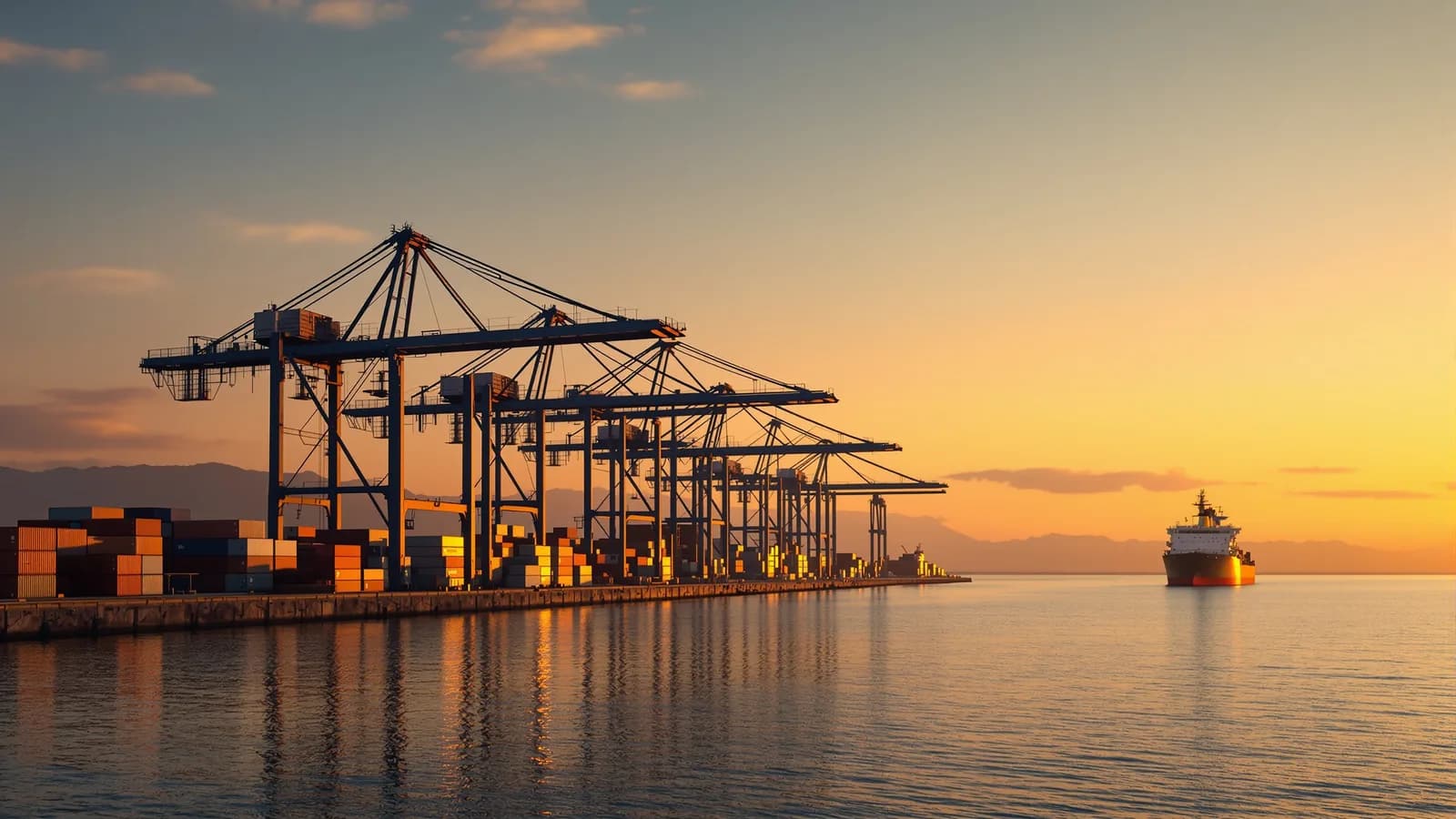
The showcase of China's strategy has stood on Peru's Pacific coast since the end of 2024. The deep-water port of Chancay, around 80 kilometres north of Lima, opened on 14 November 2024, around the APEC summit in Lima and with Xi Jinping taking part. It is operated by a joint venture in which the Chinese state group Cosco Shipping holds 60% and the Peruvian mining company Volcan 40%. Around USD 1.3 billion went into the first phase, with about USD 3.5 billion planned in total, financed partly through a syndicated loan from Chinese banks led by the Bank of China. The first phase handles around one million standard containers a year, plus six million tonnes of bulk cargo and 160,000 vehicles, and the port can take ships carrying up to 24,000 containers, the largest class currently sailing. The decisive point, though, is the route: Chancay connects South America's Pacific coast directly with Shanghai for the first time, in around 23 days instead of about 35 with transhipment along the way. Peru became a logistics hub between South America and Asia overnight.
The US, for its part, is asserting its claim to leadership in the hemisphere with the revived Monroe Doctrine, now written into the 2025 National Security Strategy, visible too in the controversial Venezuela operation at the start of 2026, in which US forces detained President Maduro. How this return of the doctrine fits into history is covered in our article on 250 years of the US and Latin America. Economically, the American response has so far been thinner than the Chinese one: the Americas Act, a bipartisan bill from March 2024 meant to create trade benefits and nearshoring incentives for the region, was never passed. Washington works less with capital than with pressure. And it works: in February 2025 Panama became the first country in Latin America to leave the Belt and Road Initiative again, a few days after a visit by the US Secretary of State.
The fight over the ports on the Panama Canal shows how hard the rivalry has become. The Hong Kong group CK Hutchison had operated the Balboa and Cristóbal terminals at the two ends of the canal since 1997. In March 2025 it announced it would sell these ports, as part of a USD 22.8 billion package, to a consortium led by the US asset manager BlackRock and the shipping line MSC. Beijing objected, the reviews dragged on, and in February 2026 Panama's Supreme Court declared the Hutchison concession unconstitutional. The state took over the terminals and awarded interim contracts to APM Terminals and the MSC subsidiary TiL. The lesson is worth remembering: when two great powers wrestle over infrastructure, in the end neither Beijing nor Washington decides, but the constitutional court of a country with just over four million people. That is Latin America, too.
Two spheres of influence, then, and a continent in between. And both sides have their allies and their points of conflict in the region.
Why this matters for your Plan B
Now the practical part, because this is where geopolitics turns into a question of location. The new rivalry influences which direction individual countries move in, and that has consequences for you.
It touches currency stability. Three countries in the region have handed their monetary policy entirely to the US: Panama has used the US dollar since 1904, practically since independence, and has never built a central bank that could print its own paper money. Ecuador dollarised in 2000 after the collapse of the sucre, and El Salvador followed by law in 2001. El Salvador's Bitcoin experiment did not change that: in early 2025, as part of an agreement with the International Monetary Fund, Bitcoin lost its status as legal tender, and the dollar stayed. Dollarised countries can neither devalue their currency nor debase it with the printing press, and they are monetarily tied to the US, whatever their governments are saying politically at the time. Countries that swing between the blocs and have to defend their own currencies, by contrast, carry a risk you know from Argentina. The full map is in our article on the dollarised countries of Latin America.
It touches banking. International dollar payments run through correspondent banks in the US and over SWIFT. Countries with a stable US link keep this access, and their banks process your transfer from Europe or North America without drama. China's alternative system CIPS is growing, but is still a fraction of that. If you are a Western expat, your pension, your portfolio and your company revenue flow through the Western system, and you want to be in a country whose banks are firmly connected to it. What that looks like in practice is in our article on USD banking in Latin America.
It touches your choice of country. If you plan long term, you also think about the geopolitical currents a country sits in. One important point: a Belt and Road signature alone is no warning sign. Chile, Peru and Uruguay are members and at the same time stable, Western-style states under the rule of law, whose largest trading partner has long been China, without their institutions becoming any more Chinese. What matters is not the declaration of intent, but whether a country's courts, central bank and administration are independent enough not to become a pawn. Peru takes Chinese port capital and is still a country that levies its taxes on the Western model, as you can read in PwC's summary for Peru.
What this means for retirees, entrepreneurs and investors
For retirees, the payment chain is what counts. Your pension is paid in euros, pounds or another home currency and has to arrive reliably in an account at a bank that is connected to the Western system. A dollarised country removes the risk of a local currency entirely, leaving only the exchange rate between your pension currency and the dollar. That is exactly why Panama, with its Pensionado programme, has topped the lists for decades; the details are in the Pensionado guide. The great power rivalry changes little in this calculation, as long as you choose a country that is anchored in the dollar area monetarily. Whether your pension stays taxable at home once you move is a separate question, and it depends on your country:
For entrepreneurs, it gets more interesting. Chancay noticeably lowers logistics costs towards Asia, which matters for anyone moving physical goods between continents. At the same time, anyone working with a US LLC plus residence in Latin America depends on the American system twice over: for payment processing and for contract law. The consequence is not an either-or decision, but a question of location: a country of residence with territorial taxation and reliable dollar access, such as Panama or Paraguay, and clients wherever they are. That way you benefit from trade with both blocs without handing yourself legally to either.
For investors: where infrastructure corridors appear, land prices move, and the area around Chancay was no different. But that is a bet on development, not a promise, and it belongs at the edge of a portfolio, not at its centre. More important is the structural lesson of the great power rivalry: concentration is the risk, diversification the answer. If you spread residence, accounts and assets across two or three jurisdictions, as described in the two-or-three-bases strategy, your existence is not at stake when a single country switches sides or a court overturns a concession. The Hutchison case on the Panama Canal is the textbook example of the year.
The calm middle
And here is the good news for anyone relocating: most countries in Latin America that are candidates for a Plan B sit in the calm middle. Panama, Paraguay, Costa Rica, Uruguay, Chile. They are neither front-line states of the great power struggle nor pawns of the blocs. They are pragmatic, trade with everyone and let no one take them over. This middle ground is the safest place to be.
Look at how different this middle looks. Panama has left the Belt and Road Initiative, keeps the dollar and the treaty-guaranteed neutrality of the canal, and remains the region's banking centre. Paraguay has gone its own way for decades: it is the only country in South America that maintains diplomatic relations with Taiwan instead of Beijing, which puts it outside China's sphere of influence, while being too small and too low-key to attract Washington's interest. Uruguay and Chile have signed the Belt and Road declaration and sell a substantial share of their exports to China, without touching their Western legal order. Costa Rica does not even have an army. That is not weakness, it is the old strategy of small countries: trade with everyone, submit to no one. Why the region as a whole works as a geopolitical refuge is explored in our article on Latin America as a safe haven.
Putting it in perspective
The great power rivalry between China and the US is real, and Latin America is its stage. But for the smart expat, that is no cause for worry, but a frame of reference. The map this article has drawn is simple in the end: avoid the front-line states, check the institutions rather than the headlines, and take dollarisation for what it is, built-in insurance against geopolitical turbulence. If you choose the right countries, the pragmatic, dollarised, Western-oriented ones, you sit in the calm middle of a storm that hits others. Geopolitics does not make Plan B harder, it makes the choice of country more important.
If you want to know what your own Plan B looks like in this environment, which country, which residence, which account structure, talk to us. We have been building setups like these for clients for years, with a clear head and without doomsday rhetoric, and you will find what we offer under our services.
Carpe Diem. Life is short and fleeting. One shot. Make it count.