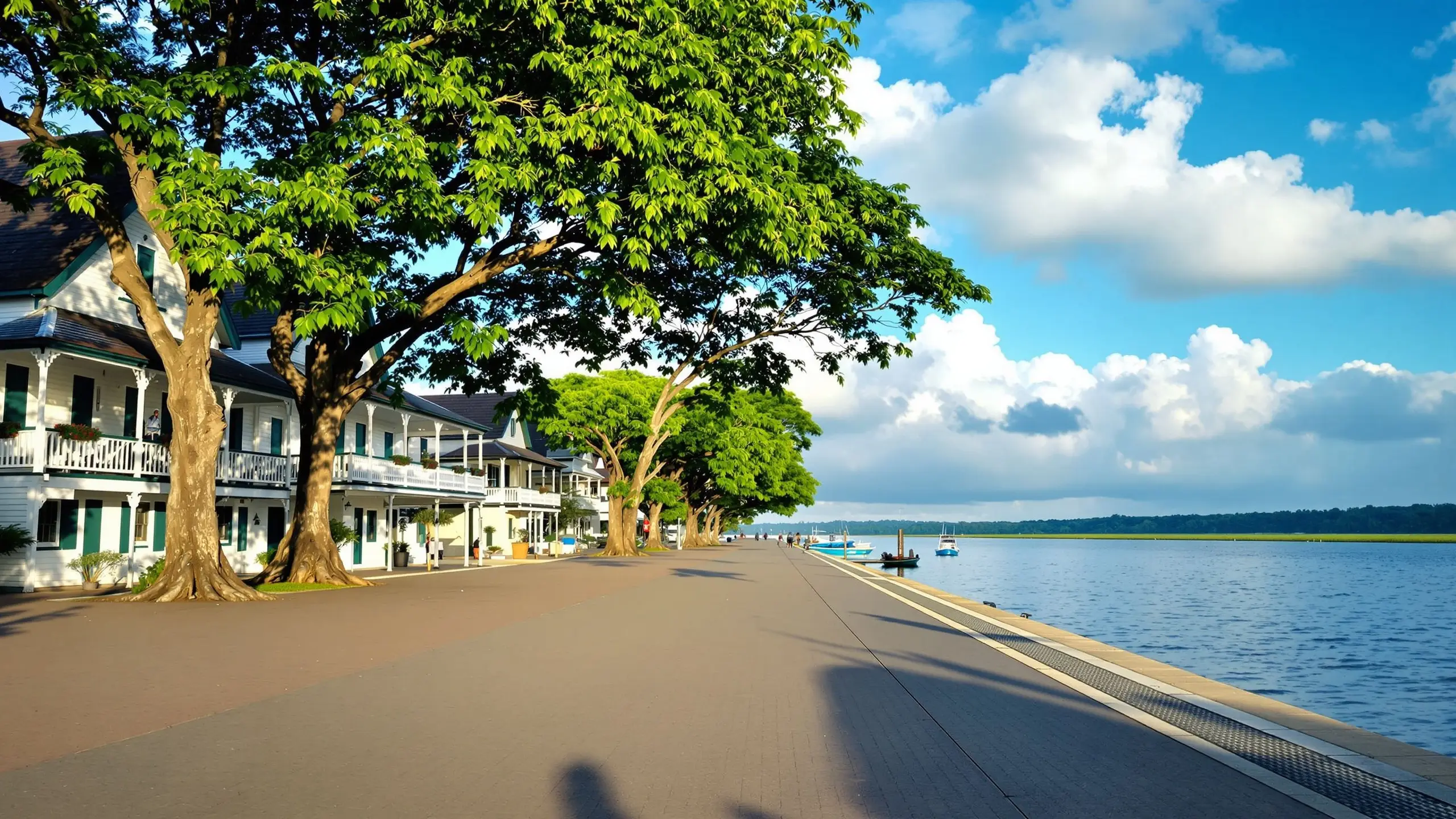
Suriname
Dutch-speaking, non-CRS and very affordable. And a tax law from 1922 that takes 38% of your worldwide income from a very low threshold.
Why Suriname?
Dutch-speaking, non-CRS, very cheap and almost unknown outside the Netherlands. And a tax law from 1922 that reaches your worldwide income as a resident, at 38% from a threshold you will hardly stay below.
Suriname is often traded as a South American insider tip, and it belongs to South America only geographically. The official language is Dutch, the law is Dutch-style civil law, and the categories are called verblijfsvergunning, vestigingsvergunning and hoofdverblijf. If you think of Suriname in terms of the rentista and pensionado categories of its Spanish-speaking neighbours, you miss the country; there are no such programmes here. What is true: Suriname has never committed to automatic information exchange, the cost of living is very low, and the UK Foreign Office (FCDO) does not advise against travel to any part of the country. What is also true, and tips the calculation: if you live in Suriname, you are a binnenlandse belastingplichtige and are taxed on your entire income, at a top rate of 38% that starts at an amount that is very low for readers like you. Permanent settlement takes five years of actual main residence, and naturalisation is not an administrative act but an Act that Parliament passes in batches.
- ✓Non-CRS: Suriname has never committed to automatic information exchange and has set no date
- ✓Very low cost of living in the local segments of the economy
- ✓No advice against travel: the FCDO does not advise against travel to any part of Suriname
- ✓Dutch legal system with a clear line between unlimited and limited tax liability
- ✓The catch: residents pay tax on their worldwide income, at 38% from a very low band threshold
Residence permits and residency options
The residence permit for a fixed period, two years at most, renewable. Renewal must be applied for no later than three months before expiry, otherwise the chain of legal residence breaks and the clock for everything that follows starts again. Fee USD 150.
If you are neither of Surinamese origin nor a national of a CARICOM country, you need an MKV in advance. That covers every applicant from North America, the UK and the EU without exception. Without it, the procedure does not start.
Permanent settlement. The condition is that you have had your legal hoofdverblijf in Suriname for five years, meaning the actual centre of your life and not just a registered address. Add complete proof of legal residence over the full five years and registration in the population register. Fee USD 200. Dependants of a holder qualify for joint settlement after just one year.
If you want to work, you also need a werkvergunning. Only persons of Surinamese origin and CARICOM skilled nationals are exempt. How many days of absence a verblijfsvergunning tolerates before the hoofdverblijf counts as given up is not quantified anywhere, so we give no figure.
Tax in Suriname
The basic rule is in the income tax law of 1922, which is still in force and was last amended in 2024. It is the classic Dutch construction: if you live in Suriname, you are a binnenlandse belastingplichtige and are taxed on your zuiver inkomen, with no limitation to Surinamese sources. Non-residents, by contrast, are caught only with their domestic income. The Belastingdienst puts it exactly the same way on its own website. For residents, Suriname is therefore a worldwide income country, no ifs and buts.
The scale for individuals: the first SRD 108,000 are tax-free, then 8% up to 150,000, 18% up to 192,000, 28% up to 234,000 and 38% on everything above. The much-quoted solidariteitsheffing at 38% and 48% was expressly temporary and ended on 1 January 2022; anyone still listing it is working from an old version.
What matters is not the top rate but where it starts. The band thresholds are in Surinamese dollars and very low by international comparison. For practically every newcomer that means 38% on worldwide income, from the first year of residence. We deliberately give no conversion into US dollars or euros, because we did not take an official reference rate as evidence on the review date.
Two more things we do not claim: whether Suriname has a double tax treaty with your home country we have not checked, so we say neither yes nor no. And what your home country wants from you when you leave is not Suriname's decision anyway.
Citizenship: the route to a second passport
The requirement is simple; the procedure is not. The competent foreigners' authority requires for naturalisation valid residence permits for the last five years or a vestigingsvergunning. The legal basis is the Nationality and Residence Act of 1975 as amended in 2014.
But then: after the police report, the authority combines a bill covering at least fifty names, which goes through the legislative department and the Council of State to the National Assembly, is debated and passed there in a public session, promulgated by the President and published in the Staatsblad. In Suriname, naturalisation is a legislative act in a batch procedure, not an administrative decision. The authority does not say how long that takes, so we give no duration.
Whether Suriname requires renunciation of your previous nationality on naturalisation could not be established from either the statute or the description of the procedure. We claim nothing about it.
Our Suriname insider tip: Paramaribo
Paramaribo is the only address in the country with the infrastructure a newcomer needs. The inner city from the Dutch colonial period, with its white wooden houses, is a UNESCO World Heritage Site, the climate is tropical, the city lies on the Suriname River, and for Dutch speakers the official language is home ground.
On the situation: the FCDO does not advise against travel to any part of Suriname. It reports burglary, armed robbery and violent crime in Paramaribo and the surrounding area, and pickpocketing and robbery that are increasingly common in the main business and shopping areas. One concrete point: criminals could target you in quiet or secluded areas, including the Palm Garden (Palmentuin).
Two points that appear in no glossy brochure. First, air travel: according to the same advice, all known airlines in Suriname are on the UK Air Safety List of carriers that do not meet international safety standards. Second, health: medical facilities are severely limited, and not all of them accept payment from insurers, so you may have to pay in advance; plan elective treatment outside the country. In the rainy season from May to August the north and centre of the country are prone to flooding.
The card says Low. In the local segments of the economy Suriname is very cheap; imported goods are not. That is a comparative assessment by our editors against the twelve, not a measured figure.
Banking outside Suriname
Banking and your operating company belong outside Suriname, and here the reason differs from the territorial countries in this overview. Suriname taxes you as a resident on everything anyway, so a clean separation of sources does not save you from the tax rate. What it saves is your ability to act: payments, access to foreign currency and the banking infrastructure of a small country with a volatile currency history do not belong at the centre of an international structure.
Non-CRS status only means that Surinamese banks do not report account data automatically to your home country. It does not replace a return there, and it is no counterweight to 38% on worldwide income. Holding those two sentences together is our core business.
Flag theory: why bank outside the country?
Because the country is a CRS participant and you do not want to create local economic substance or a permanent establishment, banking and your operating company belong outside Latin America. We structure this for you. More about our services →
Who is Suriname right for, and who not?
✓ A good fit for
- ✓Anyone with family or work ties to Suriname who wants the legal position set out correctly
- ✓Anyone who actually moves there, wants to live very cheaply and knowingly accepts worldwide taxation
- ✓Anyone looking for the Dutch-speaking world who plans for the five years until vestiging
✗ Less suited to
- ✗Anyone who wants to optimise tax (residents pay on their worldwide income, top rate 38%)
- ✗Anyone looking for a low-presence second residence (vestiging requires five years of actual main residence)
- ✗Anyone who wants a plannable second passport (naturalisation passes through Parliament as a batch Act)
Frequently asked questions about Suriname
Does Suriname tax my foreign income?
Yes. If you live in Suriname, you are a binnenlandse belastingplichtige and are taxed under the income tax law of 1922 on your entire income, with no limitation to Surinamese sources. Only non-residents are caught on domestic income alone.
How high is the tax rate really?
The first SRD 108,000 are tax-free, then 8%, 18% and 28% in bands, and from SRD 234,000 it is 38%. That threshold is so low that it practically always applies to newcomers. The temporary solidariteitsheffing at 38% and 48% ended on 1 January 2022.
How long does it take to get permanent settlement?
Five years of legal hoofdverblijf, meaning the actual centre of your life in Suriname, proven without gaps. The residence permit before that is valid for two years at most and must be renewed no later than three months before expiry.
How does naturalisation work?
Through an Act of Parliament. After five years of valid residence permits, or with a vestigingsvergunning, you apply; the authority then combines a bill covering at least fifty names, which goes through the Council of State to the National Assembly and is passed there in a public session. We give no duration, because none is stated anywhere.
Does Suriname report my accounts to my home country?
No. On the OECD list Suriname is in the group of developing countries that were not asked to commit and have set no date for a first exchange. Your reporting obligations at home are unchanged.
Next steps
VidaLibrePlan advises on twelve countries in Latin America. Suriname is not one of them.
Non-CRS, very cheap and discreet in South America: that is what makes Suriname interesting, and it is exactly what Paraguay gives you without the price. Suriname taxes residents on their worldwide income at a top rate of 38%, starting at an amount that is very low for readers like you, and requires five years of actual main residence before permanent settlement (vestiging). Paraguay exempts foreign income and keeps your residence alive with one day a year. On information exchange, though, Paraguay is the exception only for now: it does not exchange account data automatically today, but has committed to the OECD to a first exchange by 2028.
Explore Paraguay →Is Suriname right for you?
Start with a free assessment: we look at your situation and tell you honestly whether this country fits you.
Explore the countries we advise on
Productive farmland and vineyards in your own name, a real-asset hedge far from the world's trouble spots.
✓ Farmland + real assets + optional 2-year passport
A strong Global South passport, reached in around six years on the standard route.
✓ Strong Global South passport
Latin America's economic anchor, with the highest legal certainty in the region.
✓ Strongest passport (US ESTA) + foreign income tax-free for up to 6 years